Commentary: Will stadium networks ever catch up with demand?

Dallas fan in mobile action at AT&T Stadium. Photo: Phil Harvey, MSR

Dallas fan in mobile action at AT&T Stadium. Photo: Phil Harvey, MSR

If there’s one thing the stadium-networking industry learned — or should have learned — from the stunning stats from Super Bowl 50, it’s that nobody really knows where or when the demand for in-venue bandwidth will stop growing.

Thanks to the smart folks who built the Levi’s Stadium Wi-Fi network — and the smart deployers and carrier partners who doubled down on the DAS this summer — the venue was able to handle an incredible 26 terabytes of wireless data on Super Sunday, with 15.9 TB amongst the four major cellular carriers on the DAS, and 10.1 TB on the stadium’s Wi-Fi network. Both were easily new records for single-day events, far eclipsing the totals seen at Super Bowl XLIX the year before.

The question, of course, for everyone else is: What comes next? And what does that mean for networks built in the past few years?

Keep building for growth

Editor’s note: This column is an excerpt from our latest STADIUM TECHNOLOGY REPORT, which is available for FREE DOWNLOAD from our site. In addition to this analysis and stadium tech deployment profiles we also take an in-depth look at the new trend of deploying Wi-Fi and DAS antennas under seats, and provide a wireless recap from Super Bowl 50. GET YOUR COPY today!

Texas A&M student recording the halftime show. Photo: Paul Kapustka, MSR

Texas A&M student recording the halftime show. Photo: Paul Kapustka, MSR

In some follow-up discussions with folks from Aruba, the Levi’s Stadium networking team, Verizon Wireless and others in the industry, I wondered out loud if what we are seeing is just yearly growth in demand, or whether expanded networks are merely satisfying pent-up demand that was always there.

To be sure, the “big” events like the Super Bowl, the World Series and the Final Four are always going to generate outsize traffic numbers, especially as more and more fans join the selfie craze and post photos and videos from the stadium, showing the rest of the world how great their life is. According to Verizon, the amount of traffic uploaded on their DAS network at Super Bowl 50 was double the upload traffic the carrier saw at Super Bowl XLIX, validating Verizon’s belief that traffic was going to grow significantly.

For mobile traffic in general, and for in-stadium wireless activity specifically, the continued growth over the past few years can likely be traced to a number of factors, including the ever-increasing power of mobile devices; the new number of bandwidth-hungry apps that incorporate images and video; and a steady increase in familiarity with devices and apps, as older folks — those more likely to purchase event tickets — catch up to their kids in wanting to use, and being able to use, the content-sharing features of social media and other communication apps. And, simply, more people trying and successfully connecting to in-stadium networks, reversing historical thinking that told them from experience in past years that connecting at a stadium was futile. In almost all venues these days, no longer is that the case.

So with no end yet in sight to the general doubling of traffic on a year to year basis, the big question out there for stadium technology teams has to be — is what we have now enough to handle growing needs, and if not, what are we going to do about it? The fact that cellular carriers (correctly) assumed they needed to add capacity to the Levi’s Stadium DAS a year after it was deployed should give pause to anyone building a network right now; though your venue may not be hosting the Super Bowl anytime soon, it might not hurt to re-think the traffic projections that have been made and step them up a bit, just in case.

These signs are up all over AT&T Park. Photo: Paul Kapustka, MSR

These signs are up all over AT&T Park. Photo: Paul Kapustka, MSR

On both the Wi-Fi side and the DAS side, we may also be looking soon at a need for new kinds of technology to help build the networks of the near future. In this issue we take an in-depth look at the trend toward putting antennas for both Wi-Fi and DAS under seats, mainly to build networks that are more dense and can handle more traffic.

Verizon, which pioneered DAS under-seat antennas at Levi’s Stadium this year, said it is already seeing stadiums where just adding another sector of traditional DAS produces diminishing returns; if traffic on both types of networks keeps growing at the current rate, when will existing designs become obsolete? And what will replace them?

Stadium network owners shouldn’t ignore policy

As stadium-networking types ponder the future, it would serve the industry well to start thinking together as well, especially in the areas of telecom policy and standards-setting. As the builders of telecom networks worldwide ponder the future of 5G technologies there are some discussions where stadium networking representatives are nowhere to be found, especially in the potentially troubling direction of LTE-U, the idea of carriers using unlicensed bands for LTE traffic.

It’s still early days in the LTE-U discussions, but a recent decision by the FCC to allow carriers to conduct tests of the technology should be a call to action for the stadium networking industry. While nobody knows quite for sure yet what will happen to an in-venue Wi-Fi network if and when LTE-U traffic appears, it seems to make sense for the industry to get together and at least present some kind of unified voice before decisions get made.

At the recent Silicon Flatirons telecom policy conference in Boulder, Colo., there were exactly zero representatives from the venue Wi-Fi ecosystem present, including no visible representation from the Wi-Fi and DAS gear manufacturers who sell into the stadium networking space. With telecom providers hungry for spectrum of any kind, it’s a fool’s bet to assume that the unlicensed bands used in stadiums worldwide today will remain as free and available as they are now. It’s just another factor that’s needed to be considered, as venue tech professionals plan for a future of ever-increasing needs.

VenueNext app already paying off for Orlando Magic

Screenshot of new Orlando Magic stadium app built by VenueNext

Screenshot of new Orlando Magic stadium app built by VenueNext

The NBA’s Orlando Magic, the first customer for VenueNext outside of Levi’s Stadium, is already seeing a revenue-generating return on its choice, according to figures released by the team and VenueNext.

New this year for fans at the Magic’s stadium, the 20,000-seat, Wi-Fi equipped Amway Center, the VenueNext-designed app is already generating new direct revenue of $500,000 through in-app advertisement sales, while also being used by fans to order food and drinks that can either be picked up at an express window, or for certain sections of the stadium, delivered to the seat.

With the NBA season just past the halfway point, VenueNext and the Magic said that the number of fans attending games in Orlando using the app on a monthly average is showing an almost 96 percent increase from last year and the team’s previous app. So far this year 30 percent of attendees have used the app, a figure at the high end of team-app usage.

Perhaps most interesting from a marketing standpoint is the stat claiming that 80 percent of season-ticket holders have used the app to gain entry to the arena and to manage their tickets, activity that can be mined by the team for marketing info. According to the team and VenueNext, mobile entry to the stadium has reached 26 percent of all fans, an increase of 200 percent over figures from last season.

Fast deliveries, increased ticket sales

Though neither the team nor VenueNext would provide any stats for average food orders placed per game or how many have been placed so far this year, they did say that deliveries — available to just a part of the stadium right now — are taking an average of 5 minutes and 26 seconds to complete. The ability to use the app to order in-seat delivery of food, drink and merchandise is one of the hallmarks of the VenueNext app used at Levi’s Stadium for San Francisco 49ers home games. At the recent Super Bowl 50 at Levi’s Stadium, the app allowed fans to order only drinks for delivery and food for express pickup; fans at the Super Bowl placed 3,284 food and beverage orders through the app, a stadium record.

Another screen view of the new Orlando Magic stadium app

Another screen view of the new Orlando Magic stadium app

The team also said that fans have been using the app to purchase more of the “Fast Break Pass” products that provide discounts for multiple-game purchases that aren’t full season tickets. According to a blog post by Orlando Magic CEO on the VenueNext website, the app has allowed the team to greatly expand its flexible-pass offerings:

Fast Break Pass sales are up 233% from last season, in part, because the app has given the Magic the ability to expand to six different Fast Break Pass products that span the entire course of a season, providing a unique product for an untapped market. The app also includes added location identifiers so Fast Break Pass holders can receive their seat assignments now once they are within a mile of the arena (previously it wasn’t assigned until they entered the building).

On the sponsorship side, the Magic said it sold the approximately $500,000 of in-app advertising to fantasy gambling outlet FanDuel and to Sun Pass, which we think is a Florida electronic tollroad payment operation. At Levi’s Stadium, the 49ers sold a similar in-app advertising package to eSurance for the 2014 season, producing $750,000 in revenue. The Magic app has a direct link to a FanDuel game.

The Orlando figures are a good selling point for VenueNext, which is still somewhat of a newcomer in the team and stadium app business, trailing leaders like YinzCam, which recently struck a deal to re-do 22 of the NBA team apps. While its performance at Levi’s Stadium and now at Orlando are significant, VenueNext recently fell short of its own publicly announced goal to sign up 30 new customers before the end of 2015, something the company announced when it revealed its $9 million funding round last year.

While some of those new clients may be signed but not yet ready to announce, VenueNext has only announced two other new clients besides Orlando, the New York Yankees and the Dallas Cowboys. Given that one of the investors in VenueNext was concert promoter Live Nation, it’s a good bet that some of the new clients may be concert arenas, and not just more sports stadiums.

March Madness viewing: More digital options, plus some virtual reality

MML_iPhone_01-WatchRemember when college basketball tournament season only had a small slice of games available online? Or when you had to pay extra to watch online? It wasn’t that long ago. Thankfully though the future is here now and for 2016 the college hoops postseason has even more ways to watch games mobile or online, including one option to watch games via virtual reality programming.

Like last year, if you have a qualifying cable contract, you are basically covered and should be able to watch all the NCAA Men’s Basketball Tournament games live, on whichever platform you want. The best way to start is to head to the NCAA’s March Madness home page, where you should be able to find any and all information on devices, apps and other avenues to streaming coverage. According to Turner Sports, the NCAA and CBS Sports the games will be available live on 12 different platforms, including Amazon Fire TV, Apple TV, Roku players and Roku TV models. The new March Madness Live app isn’t avalable until Thursday, so check back soon for the go-to app for everything March Madness.

Also like last year, you should be able to watch a few minutes of the first game you see without having to log in — great if you are just trying to catch a buzzer beater. The games of course will be available on regular TV, and the March Madness home page has what may be a great time saver, a widget that helps you find those obscure cable channels other than CBS or TNT where the games might be on. Since we’ve just moved, MSR’s NCAA viewing team might make good use of the Zip Code-powered channel finder.

Screen Shot 2016-03-08 at 12.14.34 PMEven if you don’t have a cable contract you can still watch a lot of games that are streamed online; games broadcast on CBS will be available for no charge on desktop, mobile and tablet platforms, while games broadcast on the other channels (TNT, TBS, truTV and local channels) should be available on those providers’ websites. Again, if you get stuck or lost just defaulting back to the March Madness home page should give you a path to whatever game it is you’re looking for.

Big East tourney available in VR

If you have a NextVR platform you will be able to watch the 2016 Big East tournament (it starts Thursday, March 10) thanks to a partnership between FOX Sports and NextVR. We’re not VR-savvy here at MSR headquarters yet but with seven games and 15 hours of programming scheduled this might be a cool treat for VR fans. NextVR has an instruction page on how to watch the games in VR; if anyone tries this out, send us an email with a report on how it worked (or didn’t) and we’ll let everyone else know.

Also, don’t forget — this year for the first time the NCAA Men’s Championship game, scheduled for Monday, April 4, will be on TBS, NOT on CBS, the first time the champs game has been only on cable. And, there will be streaming options as well during Final Four weekend, according to the official announcement:

For the NCAA Final Four National Semifinals on Saturday, April 2, from Houston, NCAA March Madness Live will provide three distinct live video streams of both games to provide unprecedented viewing options for fans – live streaming of the traditional game coverage provided on TBS, along with “Team Stream by Bleacher Report” coverage or team-specific presentations offered via TNT and truTV. This year’s NCAA Tournament will include the National Championship airing on TBS, the first time the championship has ever been televised on cable television.

Fan experience soars with arrival of Wi-Fi at Montreal Canadiens’ Bell Centre

Fans outside the Bell Centre. All photos: Montreal Canadiens

Fans outside the Bell Centre. All photos: Montreal Canadiens

Fans of the National Hockey League’s Montreal Canadiens finally have a technological stadium experience that matches the team’s successful on-ice legacy, with the debut this season of a fan-facing Wi-Fi network that empowers a wide range of services meant to make the game-day experience second to none.

As part of an announced $100 million refurbishing of the 20-year-old Bell Centre, the new Wi-Fi network is already letting the Canadiens support services like in-seat food and beverage delivery ordered via a mobile-device app, as well as mobile ticketing and fan-loyalty programs. According to Pierre-Eric Belzile, vice president of information and communication technology for the Canadiens, the new network has been in development for several years, when the team determined that its fans needed better connectivity inside the 21,288-seat arena.

“Since we have Bell [Canada] as a partner, we have a completely new DAS inside the arena,” Belzile said. But a few years ago, he said the team was looking at making video available to the public, and to support “all the new devices” coming online, the idea of providing Wi-Fi to fans started taking shape.

Sticking with what works

Editor’s note: This profile is an excerpt from our latest STADIUM TECHNOLOGY REPORT, which is available for FREE DOWNLOAD from our site. In addition to this and other in-depth profiles we also take an in-depth look at the new trend of deploying Wi-Fi and DAS antennas under seats, and provide a wireless recap from Super Bowl 50. GET YOUR COPY today!

The arena, Belzile said, already had a Wi-Fi network for internal operations, including point-of-sale systems for concessions and ticketing, that was installed in 2006. Belzile, who has been at the stadium for the past 15 years, said he liked that system’s infrastructure, which was provided then by Nortel. The familiarity with the technology led Belzile and his team to look first to the current Nortel technology owner, Avaya, for a buildout to a fan-facing system.

Avaya Wi-Fi AP on an overhead mount

Avaya Wi-Fi AP on an overhead mount

“I had such a good experience with the [Nortel] switches, how flexible they are, it was a normal decision to look at Avaya,” Belzile said. That look turned into a deal, and for this season Avaya gear is at the base of the 500-AP strong network that brings free Wi-Fi to every seat in the house.

For an Oct. 15 game, Belzile said the network was already working well, with approximately 4,000 unique users and a peak of 3,200 concurrent connections, even with little to no promotion of the Wi-Fi by the team. That night the Canadiens saw 320 gigabytes of data carried on the Wi-Fi network, a nightly number that has no doubt grown as the season progressed.

With an upper bowl that circles the entire stadium, Belzile said “it was an easy call” to mount all antennas overhead, and not trying to go the more costly route of installing them under seats. Cement columns in the backs of rows also made for convenient AP mounting spots, Belzile said. For the hard-to-reach rows down near the ice, Belzile said that Bell has made extra efforts to improve the DAS coverage there, ensuring that the closest seats also have good connectivity.

Bringing food to the fan

The new network also allows the Canadiens to provide in-seat food and beverage delivery to fans who order from the app, a service available to all seats except the “Club Dejardins” level, where the team said food is included with the ticket. Though no food-delivery stats have yet been provided by the team, the team said its goal is to deliver all orders within five minutes of them being placed.

Wi-Fi mounts on concrete post

Wi-Fi mounts on concrete post

The concession-delivery service is just part of an aggressive mobile-device strategy, one that includes a social media promotion headlined by the “Club 1909” (for the year the team was founded) program, which offers benefits like free tickets for loyalty points accrued.

Belzile said fans at the stadium can use the team’s mobile app to view instant replays, as well as participate in online quiz contests. On the concourses, the team added HD displays that show live game action, so that fans out of their seats don’t have to miss what’s happening on the ice. The multicast video system, Belzile said, is supported by the stadium’s Avaya-based network, and is easy to update dynamically, instead of the old static ads that used to be displayed.

“Sponsors have been very pleased with the results” from the new displays, Belzile said.

Though a bit of a newcomer to the stadium-network space, Avaya already has some big-name deployments under its belt, including its namesake Avaya Stadium in San Jose, Calif., home of pro soccer’s San Jose Earthquakes, as well as a yet-unannounced deployment already working at the Pepsi Center in Denver, home of the NBA’s Nuggets and the NHL’s Avalanche.

Belzile, who said he took a trip to San Jose recently to see the huge outdoor bar that is one of the signatures of Avaya Stadium, said he’s extremely pleased with the new Bell Centre network and what it supports: Solid connectivity for fans.

“We wanted to let people do whatever they wanted to do with their devices, anywhere in the building, even when they are at the game,” Belzile said. “The [new] network really helps improve the experience for the fans.”

Boston Bruins  v Montreal Canadiens - Game Three

Sporting Innovations’ lawsuit against former co-CEO is dismissed

Asim Pasha

Asim Pasha

The somewhat bizarre lawsuit brought last year by Kansas City-based Sporting Innovations against its former co-CEO Asim Pasha for allegedly conspiring to set up a competing firm using Sporting Innovations assets and intellectual property has been dismissed, with a stipulation that the firm cannot re-file similar charges at a later date.

According to a document dated Feb. 29 provided to us by Pasha’s lawyers from Lathrop & Gage LLP, Kansas City, Sporting Innovations’ claims against Asim and his son Zain Pasha (who also worked for Sporting Innovations) were dismissed with prejudice, meaning they cannot be filed again in the future. As part of the negotiation, Pasha also agreed to dismiss his counterclaims against Sporting Innovations, basically meaning that the legal entanglement between the two parties is over.

Robb Heineman

Robb Heineman

Neither Pasha nor Sporting Innovations (now called FanThreeSixty) or FanThreeSixty CEO Robb Heineman would comment on the lawsuit dismissal, but with this result you have to wonder why exactly the case was brought in its initial fashion with its initial claims, including Sporting Innovations’ claim of $75,000 in damages. Though Pasha seems to have perhaps lost any claim to his 20 percent ownership stake in the company — according to Pasha’s lawyers he no longer owns any part of Sporting Innovations — Pasha also announced that he is taking over as the chief technology officer for the new stadium being designed for the AS Roma club, the Stadio Della Roma, which is scheduled to open in 2017 or 2018. We are trying to schedule some time to speak with Pasha about the new stadium, which seems like a very interesting, advanced project, so stay tuned.

On the Sporting Innovations/FanThreeSixty side, the firm is still apparently continuing with part of its original lawsuit, against other defendants. According to the legal document:

The Stipulation of Dismissal, with prejudice, does not affect Plaintiff Sporting Innovations KC LLC’s claims against Vernalis Group, Inc., Nader Hanafy, Inventory Intel, LLC, and Ubi Technologies, LLC, which parties remain as Defendants.

We have emails in to FanThreeSixty for comment, and we also asked Heineman to comment on the case in an “ask me anything” session he recently held on Twitter, but have not gotten a reply to either query. As we noted previously, Sporting Innovations/FanThreeSixty hasn’t announced any new clients recently for their stadium app program, and several high-profile customers, including the Pac-12 and the Tampa Bay Lightning, are no longer using Sporting Innovations software.

New Report: Super Bowl 50’s super wireless, under-seat Wi-Fi feature and more!

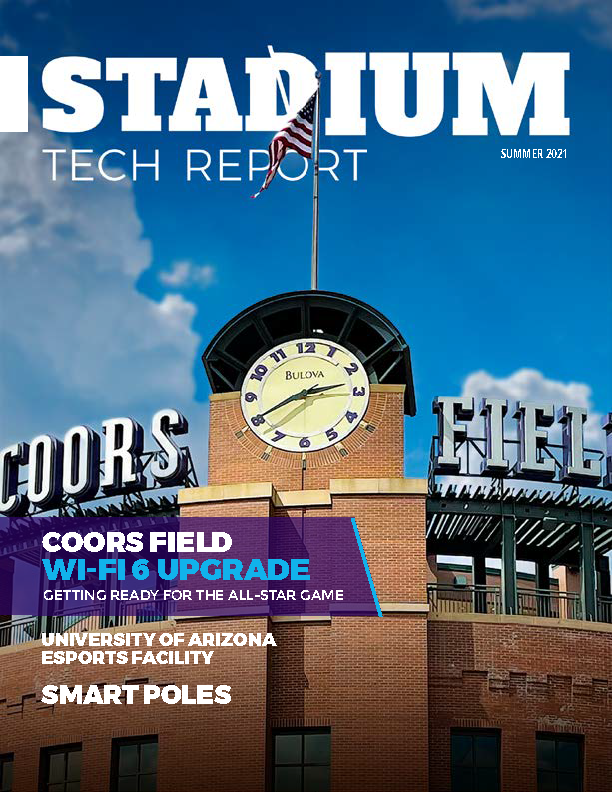
STR Q1 THUMBThe record-setting wireless network consumption at Super Bowl 50 is one of the lead topics in our latest STADIUM TECH REPORT, our long-form publication that takes an in-depth look at the most important news of the stadium technology world, alongside some great in-depth profiles of successful stadium technology deployments. Download your free copy today!

With fans consuming 26 terabytes of wireless data — 15.9 TB on the stadium’s distributed antenna system (DAS) and another 10.1 on the Wi-Fi network — the Super Bowl provided the ultimate test for the Levi’s Stadium wireless infrastructure, one that the venue passed with flying colors. One unique factor of the stadium’s wireless deployment, under-seat antennas for both the DAS and the Wi-Fi networks, is covered in-depth in our most recent issue, with a feature story about how under-seat deployments got started, and why they may become the default antenna placement for large public venues going forward.

Also in the issue: A profile of Wi-Fi and associated mobile device strategies at the University of Wisconsin, including geo-fencing for fan marketing at away games; a close-up look at the wireless infrastructure at the Denver Broncos’ Sports Authority Field at Mile High; a profile of the new Wi-Fi network at the Montreal Canadiens’ Bell Centre; and a look at some new social-media strategies deployed by the Miami Dolphins. All this information is available now for FREE DOWNLOAD so get your copy today!

We’d like to thank our Stadium Tech Report sponsors, who make this great content free for readers thanks to their support. For our Q1 issue our sponsors include Mobilitie, Crown Castle, CommScope, Samsung, Corning, JMA Wireless, Aruba, SOLiD, Xirrus and 5 Bars.