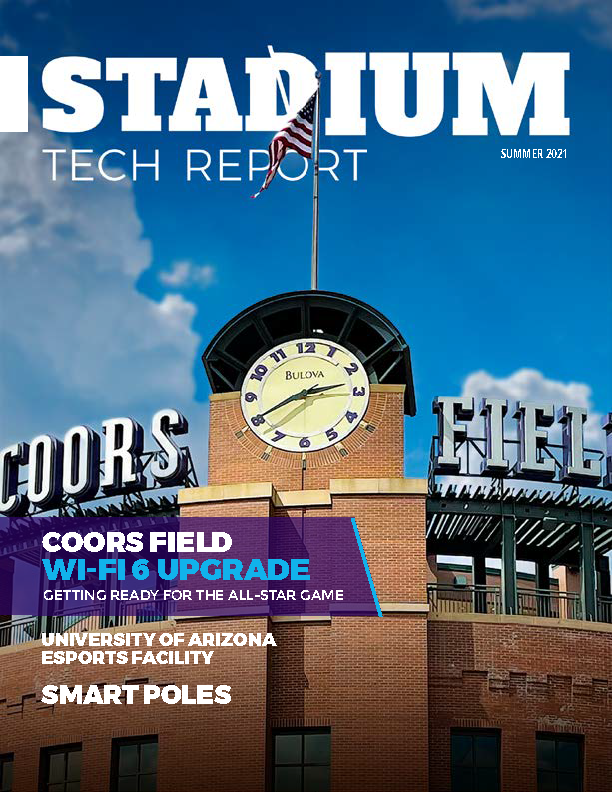
Stadium Tech Report: Read why we think MLB is the sports digital experience leader

STRQ@_thumbIs there any doubt that when it comes to the digital fan experience, Major League Baseball is in first place? That’s the way we see things, and research we did for our second quarterly long-form STADIUM TECH REPORT issue bears that opinion out. Thanks to a far-sighted strategy that kept league control over all Internet content, and some innovative, forward-thinking technology leaders at several MLB teams, baseball is ahead of all other U.S. sports when it comes to delivering a consistent, enriched fan experience through technology. But will the lead last?

You can find some of the answers to that question in the second issue in our STADIUM TECH REPORT series which you can download for free right here. If you’ve already registered with us, all you need is a username and password; if you’re new to MSR, we just need an email address and title and you’re on your way to the best long-form compilation of research and analysis, as well as in-depth interviews with industry experts in the stadium technology marketplace. We’d also like to thank our Stadium Tech Report sponsors, which for this issue inlcude Crown Castle, SOLiD, Corning, ExteNet Systems and TE Connectivity — without their support, we couldn’t make all this excellent content free for readers.

AT&T senior executive vice president John Donovan

AT&T senior executive vice president John Donovan

MLB tech profiles, interview with AT&T’s John Donovan

What’s in our issue #2 of STR? Glad you asked! Inside the report our editorial coverage includes:

— MLB stadium tech research: This editorial research provides a technology update on stadiums used by all 30 MLB teams, gauging the level of deployment of Wi-Fi, DAS and beaconing technologies.

— MLB tech deployment profiles: These mini-case studies will take an in-depth look at technology deployments at MLB facilities including AT&T Park in San Francisco, Target Field in Minneapolis, and Miami’s Marlins Park. This issue also includes an in-depth interview with AT&T senior executive vice president John Donovan, the man behind AT&T’s successful DAS deployment strategy.

— MSR exclusive stadium tech analysis: The report also includes MLB stadium tech analysis from MSR editor in chief Paul Kapustka, as well as a bonus mini-case study of DAS deployment at historic Churchill Downs, home of the Kentucky Derby.

White box at bottom is one of the under-the-seat Wi-Fi access points at AT&T Park.

White box at bottom is one of the under-the-seat Wi-Fi access points at AT&T Park.

MLB stadiums: Wi-Fi and DAS deployment is strong

Since last year, 8 more MLB teams have added fan-facing Wi-Fi to their ballparks, bringing the league total to a respectable 67 percent, with 20 out of 30 stadiums with Wi-Fi. On the distributed antenna system (DAS) front things are even better, with 25 out of 30 parks having enhanced cellular connectivity thanks to a DAS (our report currently erroneously shows that the Washington Nationals don’t have a DAS — we learned late this weekend that they do, so DAS is doing even better than we thought). Though the adoption rate is lower than that found in the NBA (where 26 of 29 stadiums have fan-facing Wi-Fi), baseball as a league does a much better visible job of promoting the service, which is more impressive when you consider that deploying Wi-Fi in an open-air arena is a considerably tougher task than in a building with a ceiling, like an NBA stadium.

Perhaps it’s no surprise that the National League West Division leads the pack in MLB connectivity, with all 5 teams having both Wi-Fi and DAS deployments in their park. The adoption rate in that division may have something to do with other teams following what is perhaps the overall connected-stadium leader in any sport, AT&T Park in San Francisco. The first with Wi-Fi (since 2004), AT&T Park continues to lead in innovation and experimentation, as witnessed by their embrace of new tricks like under-the-seat Wi-Fi APs and the new iBeacon technology, which is being tested in 20 MLB parks this season.

All of this is explained in greater detail in our STADIUM TECH REPORT for Q2 2014 — so download your free copy today!

AT&T: Hoops fans use more data than hockey fans

In a somewhat-not-surprising statistical revelation, AT&T said that basketball fans used more wireless data on its network than hockey fans at the respective arenas during both leagues’ recent championship series.

Using measurements of only AT&T customer traffic from the AT&T digital antenna system (DAS) deployments in arenas in Miami, San Antonio, Los Angeles and New York, AT&T said that hoops fans at the NBA Finals had both higher average data consumption rates and peak data rates than their NHL-watching counterparts. And when it came to home-fan data use, Miami’s American Airlines Arena hit the highest mark, with an average of 177 gigabytes of data used at the two games played in South Beach.

Though the San Antonio Spurs won the NBA title, fans at AT&T Center in Texas used an average of 138 GB of data. Miami’s arena also generated the highest peak data total of 223 GB of data. Of course maybe most of that was Miami fans using OpenTable to make early dinner reservations as the Spurs started blowing the Heat off the court.

On the frozen side of things, Los Angeles won both the real title and the data title, with fans in the Staples Center using an average of 98 GB of data during the three games there during the Stanley Cup Final. The average data usage in New York at Madison Square Garden was 83 GB of data on the AT&T network.

In defense of hockey fans, it’s really no surprise that they used less data since hockey games, especially playoff games, are mostly action and excitement, and not a million time outs. Plus, we all know that had the Chicago Blackhawks been rightfully in the Final to defend their title from last year, Da Hawks fans would have pushed everyone to shame with video renditions of the Chelsea Dagger. Next year.

Stadium Tech Report: Miami Marlins rely on ExteNet DAS to keep wireless traffic flowing

Marlins Park. Credit all photos: Miami Marlins.

Marlins Park. Credit all photos: Miami Marlins.

If you know anything about Marlins Park, maybe it’s the stadium’s unique retractable roof or the spectacular art that catches your eye. But there’s also something you can’t see that is equally exciting, at least when it comes to the in-stadium connectivity experience: A neutral-host distributed antenna system (DAS) that has more than kept pace with the rapid, continual increase in fan cellular activity.

“When it came to DAS, we were ahead of the game,” said David Enriquez, senior director of information technology for the Miami Marlins, in a recent phone interview. Well before the 37,000-seat stadium opened in 2012, Enriquez said the Marlins’ IT team was researching and planning for enhanced cellular connectivity – even before “DAS” became a hot industry acronym.

“We planned for a DAS even before they were in vogue,” said Enriquez. “We saw it as a necessary evil.”

With the iPhone and all its cataclysmic changes already in motion, Enriquez said the Marlins wanted to avoid what had happened recently at another arena that opened in the Sunshine state without good connectivity.

“What we didn’t want to see was something like what happened in Orlando, when they opened the arena [in 2010], it had bad coverage, and they were crucified in the press for bad [cellular] service,” Enriquez said. “We said, what we’d love to have is the complete opposite of that.”

David Enriquez

David Enriquez

At the opening of Marlins Park, the connectivity inside the walls was better than most, with a full-park Wi-Fi network using gear from Meru Networks and a neutral-host DAS deployed by integrator ExteNet Systems. And though Wi-Fi often gets the headlines when there is talk about stadium networks, in many facilities like Marlins Park, the DAS is an equal workhorse, since many fans still either don’t know how or don’t take the time to switch their devices over to Wi-Fi.

DAS is the workhorse

According to Enriquez, on an average night at the ballpark the Wi-Fi network will handle 40 percent of the wireless traffic, with the DAS taking care of the other 60 percent. That may be because of lack of knowledge, or perhaps satisfaction with the signal the DAS is giving them, Enriquez said.

“Early on, most people, honestly, did not know how to change [their phone] to Wi-Fi,” Enriquez said. Most fans, he added, weren’t typically streaming lots of video — they may, he said, have used the MLB At Bat app to look at a replay or two, but that could all be handled by DAS. “That trend is changing though and we are seeing much more video traffic, especially with the younger generation of guests,” Enriquez said.

Marlins Park outside

Marlins Park outside

“The truth is, many users may not take the time to switch [to Wi-Fi],” Enriquez said. “If they’re getting 4 to 5 bars on their cellular signal, they’re happy.”

Though the Marlins and ExteNet now have five major carriers on their DAS – AT&T, Verizon Wireless, Sprint, T-Mobile and MetroPCS (now part of T-Mobile), Enriquez said there was a bit of the chicken and egg problem at the start.

“Early on, nobody wanted to be the first on (the neutral DAS),” Enriquez said. “ We [the stadium] were just another node. Now, 3 years later, we are a central node in the Miami area and all the carriers are here. We’re a very central location.”

Staying in neutral

Enriquez, who has considerable experience in the large-venue IT world, said that having a neutral host for the DAS eliminates any potential concerns about favoritism between service providers. Even though costs to the team or stadium may be lower if they allow a carrier to take over DAS deployment, Enriquez said that for the Marlins a neutral host was worth the extra price.

“We didn’t want an advantage to be held by one carrier,” Enriquez said. Even if a carrier says it will act as a neutral host, when one carrier owns the deployment, others can “find it hard to believe there will be an equal time slice” when it comes to antenna access.

“We just wanted to avoid that, and make it irrelevant [as a concern],” Enriquez said.

The choice of bringing in an integrator like ExteNet, he said, provides an additional streamlining of operations, as there is now a single point for vendors to interact with to work out technology and deployment issues.

“We wanted to deal with one vendor – I didn’t want to be the middleman between the carriers and the Marlins,” Enriquez said. In that regard, he said, ExteNet has been “wonderful” as a neutral host. “They deal with all the carrier issues that I have no desire to deal with,” Enriquez said.

Less space needed for DAS upgrades

And even as fan cellular bandwidth use continues to grow – requiring carriers to constantly upgrade their systems – Enriquez said that DAS infrastructure is benefiting from improved technology to the point where even as carriers upgrade, their head end footprint is shrinking.

AT&T, for instance, has upgraded its DAS presence in Marlins Park four times over the past 2 years, Enriquez said, to the point where the carrier now has coverage for all four frequency bands. “They [AT&T] have done quite a bit to expand their coverage,” Enriquez said.

Still, the Marlins Park DAS head end hasn’t had to find new space beyond its original 1,500-square foot enclosure.

“Every time someone comes in to replace gear, we have a smaller [DAS] footprint,” Enriquez said. “It’s not going to eat you out of house and home anymore.”

Like other stadium IT directors, Enriquez is still surprised by the amount of wireless traffic generated by the fans who come to the games. “It’s incredible to see the need [for bandwidth” grow,” he said. “But people continue to give our network a thumbs up, we see that in our guest comments all the time. I just don’t know what we would do without the DAS.”

Stadium Tech Report: Atlanta Hawks’ Philips Arena signs Boingo for DAS, Wi-Fi

Philips Arena. Credit: Atlanta Hawks.

Philips Arena. Credit: Atlanta Hawks.

As the central event stadium of its kind in the region, Atlanta’s Philips Arena is well known for the entertainment options it offers, from professional sports to concerts, ice-show extravaganzas and even the circus. What it didn’t want to continue to be known for was its inability to provide service when fans at the stadium tried to connect to the Internet.

“We wanted to avoid the spinning [timeout] wheel of death,” said Andrew Steinberg, senior vice president and chief revenue officer for the Atlanta Hawks and for Philips Arena, in a recent phone interview. Home to the NBA’s Hawks, Philips stood out as one of just six NBA arenas without fan-facing Wi-Fi services, and with no cellular DAS.

That will change soon, thanks to a deal Philips signed with Boingo Wireless to provide free fan Wi-Fi and a neutral host DAS for the facility by the start of the next NBA season.

Andrew Steinberg

Andrew Steinberg

According to Steinberg, the area’s well-connected citizens, who probably trail only California’s Silicon Valley in devices per person, weren’t happy when they tried to access their social networks at Philips.

“We know people are coming to arena have been very challenged, just to tweet or post a picture to Instagram,” Steinberg said. “We needed to correct that.”

The process to do so actually started a couple years ago, when the Philips IT team put out a request for proposals that was very detailed in nature. “We wanted a robust backbone and infrastructure, and we were very thorough,” said Steinberg about the review process. “We wanted to find the best solution. And Boingo [Wireless] had the best fit for our plans.”

Neutral DAS a necessity

Philips Arena

Philips Arena

One of the requirements for Philips was that its DAS host needed to be a neutral third party, and not a single carrier. “I much prefer a neutral host DAS,” said Steinberg. “I’ve seen it done different ways. What I prefer is a best in class solution from a partner who can further engage the carriers.”

Boingo, Steinberg said, “delivered on that promise” and will have all the major carriers online when the DAS deployment is ready to go for the next NBA season.

Doug Lodder, vice president of business development at Boingo Wireless, said Steinberg and the Hawks were “very thorough” with their request for technology. “They took the time and did due diligence – they were way out in front of most venues [in their proposals],” Lodder said.

According to Steinberg, the infrastructure at Philips – which opened in 1999 – presented no special challenges to deployment. There was even plenty of space on site for the DAS head end, which is sometimes a challenge for stadium retrofits.

If there is a challenge, it could come from Boingo’s crews having to work around the extensive activity schedule at Philips, which includes concerts, games, and even the occasional “mudder” race with mud pits and obstacles. According to Steinberg, the arena averages about 130 events a year. But Lodder said Boingo is used to such deployment scheduling. “We can do three shifts in a row if needs be,” Lodder said.

Build it, then you can use it

Even though Philips hasn’t had high-end connectivity, that doesn’t mean Steinberg and his team haven’t been looking at what a good network will allow them to do.

“One of the foremost challenges is to increase revenue while improving the fan experience,” said Steinberg, “while also keeping the fans engaged with the game or event.”

From activities like seat upgrades to future apps, Steinberg said the Philips team knew they needed a good network, as soon as possible.

“The fan engagement potential and opportunities are large, but they require the necessity of connectivity,” said Steinberg. “We have a robust tech roadmap, and having connectivity like this was something we felt was paramount.”

Especially so in an area like Atlanta, which has more than its share of people whose lives already revolve around connectivity. Steinberg said that expectation shouldn’t end just because those people wanted to attend an event at Philips.

“We want people to experience a seamless transition from their office to our venue, and not have a disconnect,” Steinberg said.

AT&T scores Wi-Fi and IPTV deal at Wisconsin, DAS deal for Arkansas hoops

Camp Randall Stadium, University of Wisconsin. Credit: David Stluka/UW

Camp Randall Stadium, University of Wisconsin. Credit: David Stluka/UW

AT&T’s march into the college stadium marketplace continues apace, with announcements today of a Wi-Fi and IPTV deal for the University of Wisconsin’s Camp Randall Stadium, and a DAS deployment at the University of Arkansas’s hoops home, the Bud Walton Arena.

While AT&T has been extremely active pushing primarily DAS deployments into college and pro stadiums, the IPTV deal for the 80,321-seat Camp Randall Stadium is an interesting twist (and one we’ll try to find out more about in an interview later on). For right now all we have to work with is this press release, which says AT&T will deploy an in-stadium video solution that brings “innovative video and digital content distribution solution on nearly 700 high definition screens.” To us this sounds like it might be a Cisco SportsVision deployment, but we’ll double-check since it’s the first time we’ve heard of a video deployment with an AT&T branding behind it.

On the Wi-Fi side, it seems AT&T is doing its usual job of high quality engineering, with 750 access points planned, according to the press release.

At Arkansas, where AT&T had previously deployed DAS in the football arena, it will now also do so in the 19,200-seat Bud Walton Arena. No word yet if this is a neutral host deployment that AT&T will allow other carriers onto, or if it is an AT&T-only deal.

More photos below!

Head end gear at the Bud Walton Arena. Credit: AT&T.

Head end gear at the Bud Walton Arena. Credit: AT&T.

Bud Walton Arena, University of Arkansas. Credit: University of Arkansas website.

Bud Walton Arena, University of Arkansas. Credit: University of Arkansas website.

Stadium Tech Report: Niners President Marathe confident that Levi’s Stadium network, apps will deliver as promised

Niners president Paraag Marathe (center) at Intersport Activation Summit panel.

Niners president Paraag Marathe (center) at Intersport Activation Summit panel.

So, Paraag Marathe — will the network at Levi’s Stadium live up to its considerable pre-launch billing and be ready to go when the stadium opens later this year?

“It better work, since we’ve been talking about it,” said Marathe Friday, during a panel discussion at the Intersport Activation Summit presented by SportsBusiness Journal/Daily in San Francisco. “We better be right.”

Even though the short history of in-stadium networks suggests that any new endeavor be launched with words of caution, Marathe and the San Francisco 49ers are instead confident — very confident — that their new stadium will launch with a network second to none, and have game-changing services like food and beverage delivery to seats and on-demand instant replay that will redefine the game-day experience.

Paraag Marathe, president, San Francisco 49ers

Paraag Marathe, president, San Francisco 49ers

In both his panel discussion at the Ritz-Carlton hotel and in an additional interview afterward, Marathe provided some additional details about plans the Niners have talked about previously for the technology features at the new stadium, which is located in Santa Clara, Calif., smack dab in the middle of Silicon Valley. Though Marathe said the stadium’s location — quite literally next door to several high-tech company campuses — made technology “part of the DNA,” he stressed Friday that the Niners are seeking to use technology to improve the fan experience, and not just to have cool stuff.

“It’s not technology for technology’s sake,” Marathe said. “It’s to enhance being at the game.”

But he did add that the stadium’s Wi-Fi network will be the base for much of the innovation.

Wi-Fi is ‘the master key’

An under-the-seat access point. Credit: Aruba Networks

An under-the-seat access point. Credit: Aruba Networks

The Wi-Fi network, which Marathe said “will absolutely be working” when the park opens, is “the master key that unlocks everything,” he said. Currently being built with Wi-Fi access point gear from Aruba Networks and back-end network equipment from Brocade Networks, the Levi’s Stadium Wi-Fi network will also have twin 10-Gigabit broadband pipes provided by Comcast to provide what Marathe said will be throughput “30 times more than any other stadium.”

Marathe said the Wi-Fi network is being built with what he calls a “spider web” of access points, though neither the Niners nor Aruba have yet said just how many access points will be used to create the network. There will also be a neutral-host cellular DAS at the stadium, built by DAS Group Professionals (DGP). Already, DGP has signed up the “big four” carriers of AT&T, Verizon Wireless, Sprint and T-Mobile, to use the DAS at the stadium.

What will the networks be used for? Marathe outlined four main points of technology innovation during his talk, including high-definition, on-demand replays via the new Niners stadium app; in-seat delivery of food and beverages to every seat; way-finding features to perform tasks like locating friends, finding parking spots, and to tell which bathroom lines are shortest; and paperless tickets, based on RFID and near-field communication to fans’ devices. Of the four, the replay idea and the food-delivery service stand out as massive technical and industrial challenges.

Promised: Better replays than those on TV

If there is one promise that has many in the stadium technology industry shaking their heads, it’s Marathe’s pledge of Levi’s being able to deliver “better replays than what the coaches are seeing,” since team coaches only get to see replays provided by the network broadcasts. The Niners, Marathe said, will have “a massive [internal] production crew” working on the replay feature, since replays not only need to be picked out of the video stream, they also need to be coded to work over the Internet and to be delivered to handsets. Though Marathe admitted that the video quality may dip a bit below true HD if a lot of fans try to watch replays at once, he told the conference crowd that the Niners’ stadium app is going to deliver “HD, slo-mo [replays] within seconds after a big play.”

While other stadiums, like Barclays Center in the NBA, use technologies like Cisco’s StadiumVision Mobile to deliver separate “channels” of live video and replays, Marathe said the Niners’ app will allow fans to choose their own replays and when they want to watch them. “If you have a [replay] channel, you’re subject to whatever is on that channel,” Marathe said.

The food-delivery feature, Marathe said, is more than putting a menu in an app — “it’s an immense industrial engineering exercise,” he said, to figure out things like how many runners are needed and when and how food needs to be prepared. In addition to food delivery — an option he said will be available to every seat in the 68,500-seat stadium — the Niners will also have “express pickup” lanes for digitally placed orders at concession stands, an idea that Marathe said helps eliminate or significantly reduce two of the three things that make concession interactions a time-consuming act.

“There’s decision time, transaction time, and preparation time,” Marathe said. “If you can eliminate two of three variables, that’s a few more minutes fans have to watch the game.” Waiting until fans show up at a stand to prepare the food will help keep the order fresh, he added.

Wayfinding, paperless tickets and the 9-Nerds

If there’s one idea that’s already gotten a lot of press, it’s the plan to have wayfinding technology assist features like the one that will let fans know how long the bathroom lines are. Marathe said the idea was to make it simple — “red light, yellow light, green light” — to let fans know that if they have to go, it might be faster to try the bathroom one section over.

“We’re really just trying to be smart,” said Marathe. Other wayfinding apps might include a parking-spot locator, or a friend-finder feature.

The fourth area where Marathe wants Levi’s to innovate in is paperless ticketing, which he said wouldn’t be 100 percent this year but it will eventually get there. A future scenario described by Marathe might use RFID or near-field communications to let fans simply walk through a gate without having to show a ticket or even a bar code to be scanned. Some ski areas, like Aspen and Vail in Colorado, already use such technology to let skiers get on lifts without having to show anyone their RFID-equipped lift tickets.

“The idea is to have greeters who can actually greet you” when you walk in, and perhaps extend a personal offer for discount goods purchases or seat upgrades, Marathe said. “It’s a more human interaction,” fueled by technology.

Wi-Fi coach in the stands at Gillette Stadium. Credit: Extreme Networks

Wi-Fi coach in the stands at Gillette Stadium. Credit: Extreme Networks

Finally, to help fans figure out how to use the new network and apps, Marathe confirmed plans previously reported by Mobile Sports Report to hire a crew of “network coaches” to roam the stands. According to Marathe the coaches will be called “9 Nerds” (say it quickly) and will likely be college students, dressed in what Marathe called “Poindexter outfits.” The Niners are looking to hire 150 such network helpers, which would be the largest such crew we’ve heard of in the stadium networking marketplace.

“They’ll stand out,” Marathe promised.

Lots of network use — and a team ready for its launch

With all the hype about the network, Marathe expects that Levi’s Stadium wireless usage will far eclipse that at other stadiums, where often far fewer than half of the fans in attendance actually ever use things like Wi-Fi or stadium apps.

“Forget 10 percent [fan network use], we’re going to see something higher,” Marathe said. Even people who don’t have digital devices, he said, will probably borrow one “just to bring it to Levi’s to test it out.”

When asked why his team was so confident — in an industry where under-promising seems to be a sensible way to go — Marathe said that both the Silicon Valley heritage and the greenfield nature of the building gives the Niners and Levi’s a technological edge.

“Five years ago, we put together a kind of think tank with VCs and design people, and thought about what would be useful [at a new stadium], well before we ever put a shovel in the ground,” Marathe said. And even though the Niners’ CTO left the team earlier this year, Marathe is confident that his crew of 25 engineers (which he said also still gets some consulting help from the departed CTO, Kunal Malik) will deliver the network and apps as promised.

Having advanced technology in the new stadium, Marathe said, “was our mandate — the DNA of the building is all these tech companies that are around us. It’s who we are.”