Extreme Networks, NFL announce deal for Wi-Fi analytics

Extreme Networks and the NFL today announced a deal that makes Extreme the league’s official provider of Wi-Fi analytics, a non-binding agreement that simply makes Extreme’s diagnostics technology available to teams with Wi-Fi networks in their stadiums.

Extreme will also be the official provider of Wi-Fi analytics for the upcoming Super Bowl at MetLife Stadium in New Jersey, one of four NFL facilities currently using Extreme’s analytics technology. Two of those stadiums, the New England Patriots’ Gillette Stadium in Foxborough, Mass., and the Philadelphia Eagles’ Lincoln Financial Field in Philadelphia, use Extreme equipment for their entire Wi-Fi installation.

While the deal does not mean that the NFL will be paying for any team to install full Wi-Fi networks using Extreme technology and equipment, it does give Extreme a bit of a leg up and some league-approved exposure as teams continue to look for suppliers to help them build out their internal wireless infrastructures. Wi-Fi analytics technology, typically housed in back-end networking gear, helps provide real-time looks into network performance, along with detailed statistics about how customers are using the networks, from what types of content they are uploading or downloading, to how long they are staying engaged. Operators can use such performance statistics to fine-tune networks as well as to figure out strategies for providing compelling, engaging content and a better overall fan experience with wireless.

“Enhancing the fan experience is one the NFL’s top priorities and the decision to team up with Extreme for Wi-Fi analytics is a great step forward in achieving our goals,” said NFL CIO Michelle McKenna-Doyle, in a prepared statement. “We were impressed with Extreme’s implementations with the Patriots and the Eagles and we believe this agreement will help our clubs deliver on the high standards we have put in place to give our fans the type of experience they deserve.”

In addition to its own deployments for the Eagles and Patriots, Extreme is also providing Wi-Fi analytics at MetLife Stadium and at Ford Field in Detroit, even though the overall Wi-Fi infrastructure at those fields uses equipment from different providers. John Brams, director of sports and entertainment at Extreme, said analytics provide a key component of stadium networks, giving operators valuable insight into performance metrics and into how and what users are using the network do to.

“When you ask questions like how do you measure the return on investment for the network, to answer those questions you need the stats,” Brams said in a phone interview. “One of the biggest things teams can leverage is visibility into their environment.”
Fox Sports Go will live-stream Seahawks-Saints and Niners-Panthers this weekend; CBS will live-stream Patriots-Colts, Broncos-Chargers

Screen shot 2014-01-11 at 9.52.57 AMIf you’re a customer of a participating provider for Fox Sports Go, you can watch this weekend’s NFC playoff games either on the Web or on an Apple iPad using the Fox Sports Go website or mobile app. Here at Mobile Sports Report we love this kind of flexibility, since it lets us watch games on the big desktop PC screen if and when other family members want to use the main TV to watch Harry Potter movies. The Fox Sports Go website address is foxsportsgo.com, and the list of participating providers includes AT&T U-Verse, Comcast Xfinity, Suddenlink, Optimum, Midcontinent Communications, and Wow!.

CBS will also live-stream its coverage of the AFC divisional games this weekend, starting with the Colts-Patriots game at 8:15 p.m. ET on Saturday followed by the Broncos-Chargers game Sunday at about 4:40 p.m. Sunday. The games can be watched online at CBSSports.com’s NFL page, or via the CBSSports app, which I believe gets around the Verizon phone-ban by just showing the games via a web page. I did see a little disclaimer that says live streaming is only available via iOS devices. Someone out there give it a shot (I have an Android phone) and let us know if it works on an iPhone. You do not need to subscribe to any TV service to see the CBS live streams.

For Fox, Saturday’s Seattle Seahawks vs. New Orleans Saints game (4:30 p.m. ET start) and Sunday’s San Francisco 49ers vs. Carolina Panthers tilt (1 p.m. ET start) will both be live streamed, according to a Fox news release. To see the stream you need to validate your pay-TV subscription, and once that’s done you can watch all the other Fox games. The Super Bowl, which Fox is broadcasting this year, will not require a cable subscription.

Though the Fox Sports Go app is available for both the iPad and the iPhone, the Fox news release very specifically notes that the game is available only for the tablet version of the app. We are guessing here but we suspect that Verizon’s deal with the league for its NFL Mobile app — the only app for smartphone live NFL action — precludes Fox’s ability to offer live streaming to a phone-type device. All playoff games this weekend, including the AFC games on CBS (according to my phone), will also be available to NFL Mobile subscribers. NFL Mobile requires a Verizon 4G LTE phone and a $5 per month NFL Mobile subscription.

Someday, the league will get all these rights simplified. But not this weekend.

Stadium Tech Report: DAS, Wi-Fi puts end to no-signal problem at Denver’s Sports Authority Field

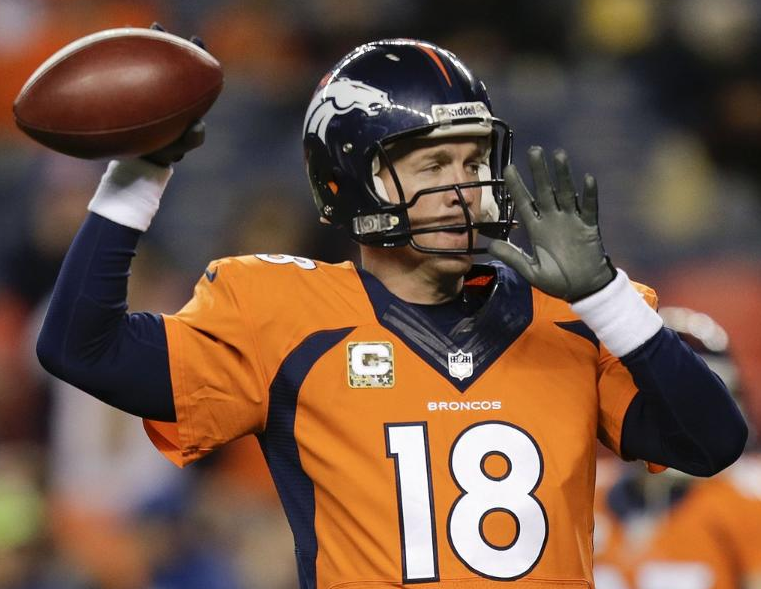
PeytonThese days, Denver’s Sports Authority Field at Mile High is the new home of the NFL’s most prolific signal-caller. With a record season for passing yards and passing touchdowns, Broncos quarterback Peyton Manning is recognizable for his animated pointing, shouting and line-of-scrimmage audibles, the ultimate practicioner of last-second communication.

Not too long ago, the fans at Mile High might have had to resort to the same tactics to communicate, using hand waving or shouting, since getting a cell signal was next to impossible. “Forget making a phone call, you couldn’t even send a text,” said Rick Seifert, communications manager for the Broncos’ stadium management company. “And it wasn’t just the fans. We [the staff] couldn’t make calls in the stadium to do our jobs.”

But in 2012, the Broncos changed all that with the installation of a full-featured distributed antenna system (DAS) deployed by TE Connectivity, and a fan-facing Wi-Fi network installed by Verizon Wireless.

Russ Trainor

Russ Trainor

The Broncos also put in a huge new digital scoreboard and robust back-end connectivity provided by Comcast as part of their blitz of networking improvements, and this past fall, AT&T joined in by upgrading its connection to the stadium’s DAS. By next year the Broncos hope to add AT&T and Sprint to its roster of Wi-Fi service providers, reflecting what vice president of information technology Russ Trainor sees as a “never ending growth” of wireless in-stadium consumption.

All carriers on board, slowly

One of the biggest problems with DAS deployments in stadiums is convincing major cellular carriers to work together. Since each carrier wants to deploy systems to do the best job for its customers, there is often a difference in opinion on strategy and operations, which is often followed by similar snags in contract negotiations. Trainor said that the stadium, built in 2001, presented unique RF challenges to wireless with its primarily exposed-steel construction. Verizon and Sprint were the first carriers to sign up for the neutral DAS, followed by AT&T this fall.

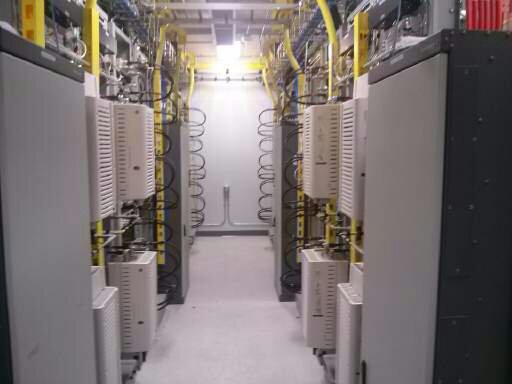
DAS equipment at Sports Authority Field. Credit: Denver Broncos

DAS equipment at Sports Authority Field. Credit: Denver Broncos

“It was tough to get them [all the major carriers] to agree on DAS, but we have good engineers on the back end and we came up with a nice solution for everybody,” said Trainor. While the antennas and stadium network are neutral, each carrier provides its own back-end gear, much of which at Mile High had to be placed in a building built outside the facility specifically to house telecom gear. In many stadium DAS deployments, the telecom gear can take up thousands of square feet, which can be challenging to find in facilities built before such needs were known.

“There’s no room inside for all the space they [the carriers] wanted,” Seifert said.

The Wi-Fi network, deployed by Verizon, uses Cisco equipment and is also a neutral host infrastructure, meaning that other carriers could use it to provide Wi-Fi connectivity to their clients if they so choose. According to Seifert, AT&T and Sprint will offer Wi-Fi services to customers next season, in part to answer the consistently growing demand. Like in other stadiums, fans at Sports Authority Field know what to do when they finally find bandwidth: Use more.

Steady growth in wireless use

When Sports Authority Field is at its listed capacity of 76,125 on game days, it becomes the 14th-largest city in Colorado, Trainor said. The team has already seen 525,000 downloads of its mobile application, which provides such in-stadium features as four different video replay angles, a connection to the NFL Network’s RedZone channel, and a direct link to the radio feed from hometown sports station KOA. The application is geo-fenced to ensure that the video rights are only used inside the stadium, and to give fans there a unique game-day experience.

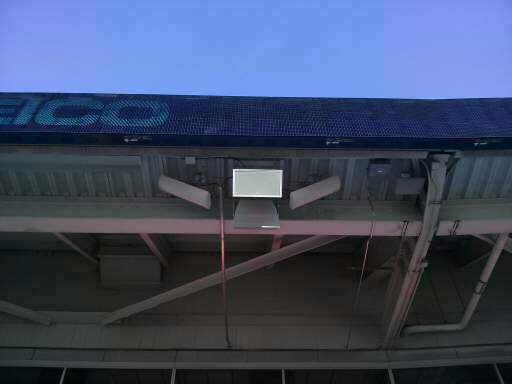
Wi-Fi antennas on stadium overhang. Credit: Denver Broncos

Wi-Fi antennas on stadium overhang. Credit: Denver Broncos

According to Trainor, the team usually sees an average of 4,000 simultaneous connections on the Verizon Wi-Fi network on game days, though on colder days when fans need to wear gloves that number can drop in half. Trainor said the Cisco infrastructure is designed to accomodate 25,000 concurrent connections, a number the team hasn’t yet reached. However, the team did have to double the back-end capacity already for the Wi-Fi network, which is being used more as more fans find it.

“Word of mouth really gets [usage] going,” said Trainor, who noted that at a Kenny Chesney concert last year, the stadium crew saw data uploads outpace data downloads for the first time — a sure sign that fans in attendance were using the network to do things like share pictures and videos with their social-network connections.

“We haven’t seen any true bottlenecks yet, but usage is consistently rising, game after game, for concerts, soccer and football,” Trainor said.

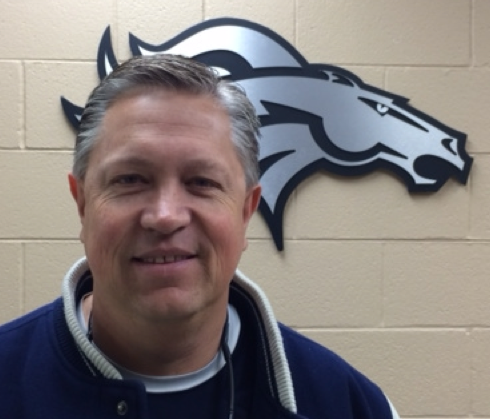
Rick Seifert

Rick Seifert

A good sign from the Wi-Fi networking statistics is a shift in usage from the often crowded 2.4 GHz bands to the 5 GHz bands, which Trainor said is likely due to fans using the latest 5 series iPhones, which support the 5 GHz Wi-Fi frequency. And no matter what happens to the Broncos in the playoffs, Trainor and Seifert know what they will be doing this summer: Upgrading the network components, in the never-ending battle to provide bandwidth.

“Verizon and Sprint have already made significant upgrades to their DAS deployments because of demand and changes in technology, like LTE,” said Seifert. “And next year we’ll probably see AT&T circle back again. It’s very dynamic.”

“As smart phones get smarter it’s a never-ending challenge” to provide connectivity, Trainor said. “It’s a job that’s never finished.”

‘Big Four’ wireless carriers sign on to use DAS at Niners’ Levi’s Stadium

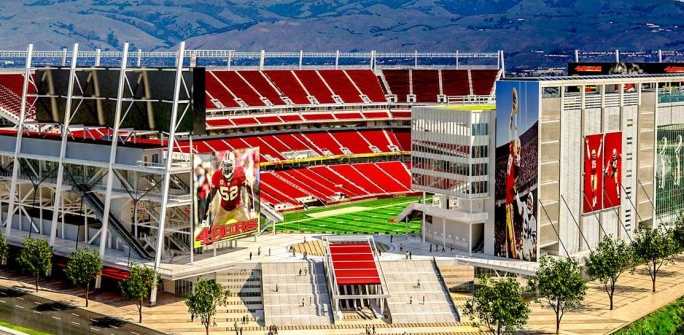
Levi's StadiumWhenever you are putting a neutral DAS in a stadium, one of the biggest challenges is convincing the major cellular carriers to participate in your deployment. Even before their new arena has opened, the San Francisco 49ers have scored a victory of sorts with the news that the four biggest U.S. cellular carriers — AT&T, Verizon, Sprint and T-Mobile — have all agreed to use the neutral-hosted DAS at Levi’s Stadium.

According to DAS Group Professionals, who are behind the DAS deployment at Levi’s, the system of small cellular antennas will also be synchronized with the stadium’s Wi-Fi coverage to produce “seamless” coverage for fans. Though we are historically wary of promises made before networks go live, the fact that the big players in U.S. cellular all agreed to use the neutral DAS shows at least in some way that the folks putting together the technology at Levi’s have a convincing story.

We’ll have more from DGP and the Levi’s DAS deployment at some point in the future, so stay tuned for the stadium launch that has everyone in the stadium tech marketplace watching and waiting.

ESPN the BCS winner with Megacast broadcast experiment

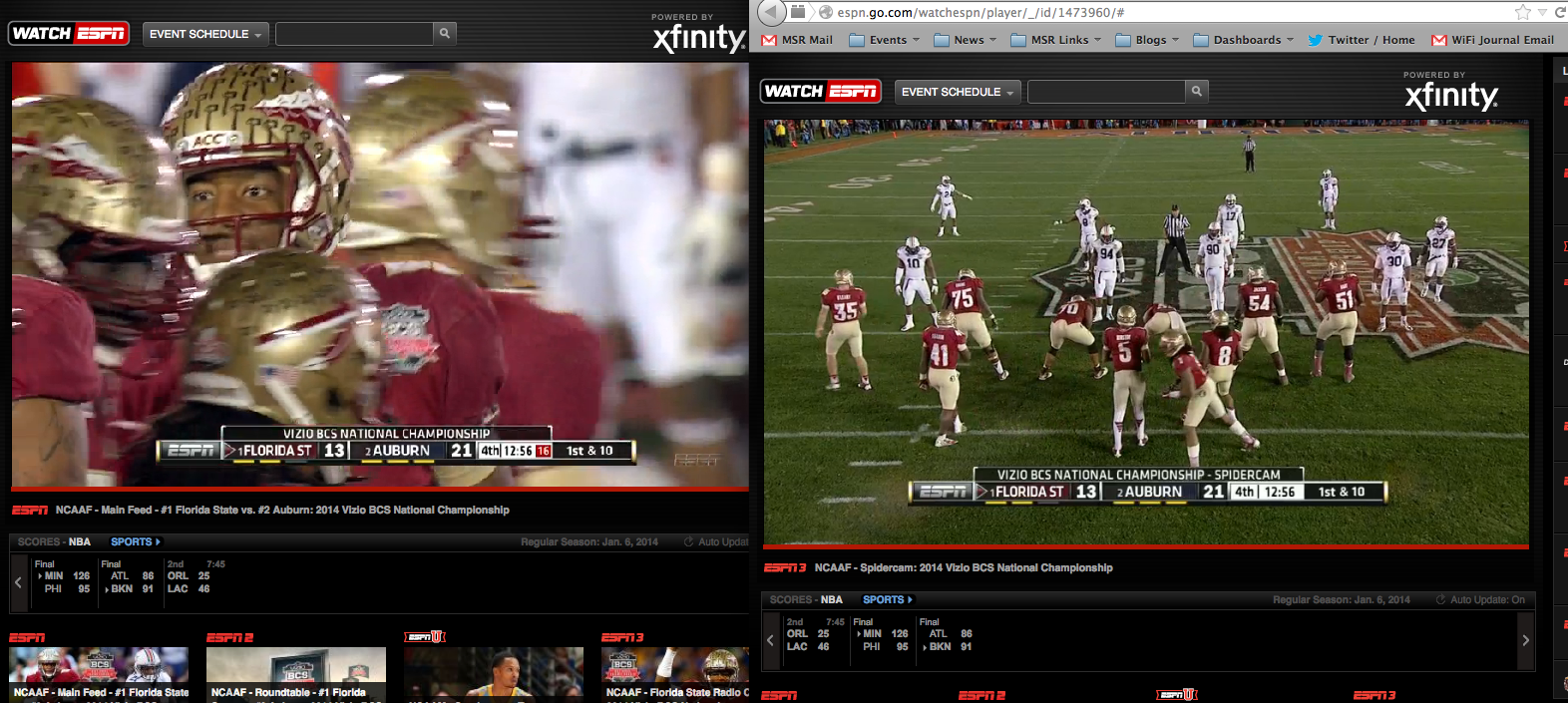
Side by side ESPN Megacast screens during BCS

Side by side ESPN Megacast screens during BCS

My favorite moment from Monday’s stupendously good BCS championship game came during a break at the start of the fourth quarter, when FSU quarterback Jameis Winston told his offensive teammates, one by one, that “you want it more” than Auburn. If you were watching the game on TV on the main ESPN feed, you missed this extremely cool exchange. But I saw it, and heard it, courtesy of the ESPN Megacast experiment.

My guess is that the Megacast experiment — in which ESPN used multiple broadcast channels to air different views and commentators on the game — was probably only experienced by a small amount of hard-core fans with digital chops. (And purported sports-site editors who call Jameis Winston “Wilson” in Twitter-speed error.) But I think it’s the wave of the future for big-event broadcasts, since it addresses the too-common problem of boring or annoying announcers and one single view of the action.

The bit where Winston was talking to his teammates came courtesy of the “Spidercam” channel, which simply showed fans what the robot camera that hovers above the field was seeing. What was unadvertised was the fact that that camera also has a microphone — in addition to the Wilson pep talk the spidercam caught coaching conversations on the sidelines during breaks, and also gave you a real in-the-arena feel of crowd noise. My new favorite digital sports moment came when I realized I could open more than one Megacast window and had the main feed running next to the spidercam feed on my desktop Mac. Nirvana. I felt like I was in the broadcast truck, deciding exactly how much info the audience of one — me — wanted to see.

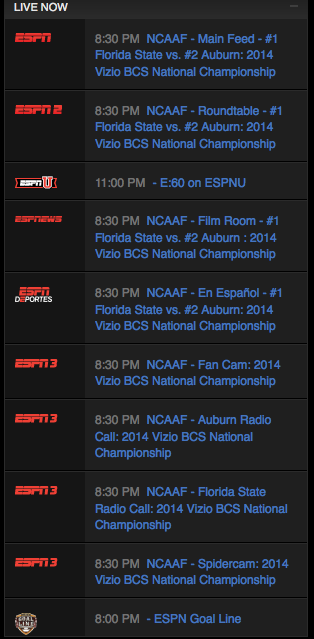
Screen shot 2014-01-06 at 8.45.47 PMSome of the people I follow on Twitter really liked the channel that provided a panel of coaches watching and commenting on formations and things like that, a kind of chalk talk in real time. I wasn’t that thrilled with it because the coaches were all “aware” and tried to act too scholarly. A roundtable discussion channel had participants with a bit more life, but the “Fan Cam” channel was a fail, especially the FSU fan who looked like Zach Galifianakis — dude, you wore a red vest and texted for all of us to see?

Some other parts were hit and miss as well — the Goal Line channel had the excellent radio feed audio with Mike Tirico, and an instant replay after every play, which was great. But it also had two cameras that remained focused on the coaches, something I never need to see again in my lifetime. There was also a Spanish language feed and the home team radio feeds for each team, which I didn’t spend a lot of time on. Still, the breadth of choices was for me the amazing part and I hope it gets copied often and improved on.

I mean — imagine the possibilities! ESPN blew it by not having Jason Dufner and Charles Barkley, two Auburn alums who are hilarious, on some kind of screen or feed. Dufner’s Twitter feed during the game was 10 times more entertaining than the Fan Cam, and he was spot on in calling out the refs for missing multiple holding infractions on FSU. I also nominate the SB Nation crew to do a live commentary on their hilarious Brent Bingo if Musberger comes back for one more year on the title game crew.

You’ve also got to think that beer companies will get in on this act soon, showing R-rated commentary from sports humorists from some sponsor tent on site. The beauty of having multiple audio or complementary video feeds online is the cost of producing them has got to be a fraction of the cost that is already sunk for the main TV production. ESPN could pull this off for TV since it has multiple channels in ESPN2, ESPNU and the like. But any broadcaster could do this more easily by putting all the extras online only.

There were some apparent production glitches — viewing online, the different channels weren’t in sync, so if you tried my two-window experiment you quickly noticed that the spidercam was a few seconds ahead of Brent and Herbie. And the spidercam window could use a floating info-window that tells you down and distance, since it’s not always apparent from the behind-the-play angle the camera usually takes. Keep the live microphone, though! Moments like the one of Winston in the huddle are a priceless view into the games we care deeply about. And that, in my mind, makes the Megacast a win in its first time out. Well played, ESPN. Now everybody else, please copy it.

New Year’s Prediction: No wireless data record at 2014 Super Bowl

Even though the steady march of smartphone and tablet use at sporting events seems to show no sign of decreasing anytime soon, I am going to go out on a small limb here on the last day of 2013 and predict that we will NOT see a new record for mobile data use at the upcoming Super Bowl XLVII.

Why? Because it’s outside, in New Jersey, and it will very likely be cold or snowy — so the lucky fans who get to freeze their behinds off will most likely keep their fingers inside their gloves or mittens, and not expose them to the elements just to text, post photos or view handheld video. Well, some if not many people probably will, since MetLife Stadium has (reportedly) one of the better Wi-Fi installations in the NFL. And maybe there will be a power outage, which is always good for more wireless use. But still — it’s not such a stretch to think that fewer people will be using their phones at MetLife than at the Superdome from last year, right?

Or will new records be set anyway, since probably more fans will have more devices and more people now know that they can get a decent signal inside a stadium? If you are reading this blog you are probably among the select crowd who cares about such statistics, so stay tuned and we will provide you with updates since we usually get them from the cell providers and stadium operators the week after the big game. For now, happy new year to all and here’s to a great 2014 in stadium technology and mobile sports.