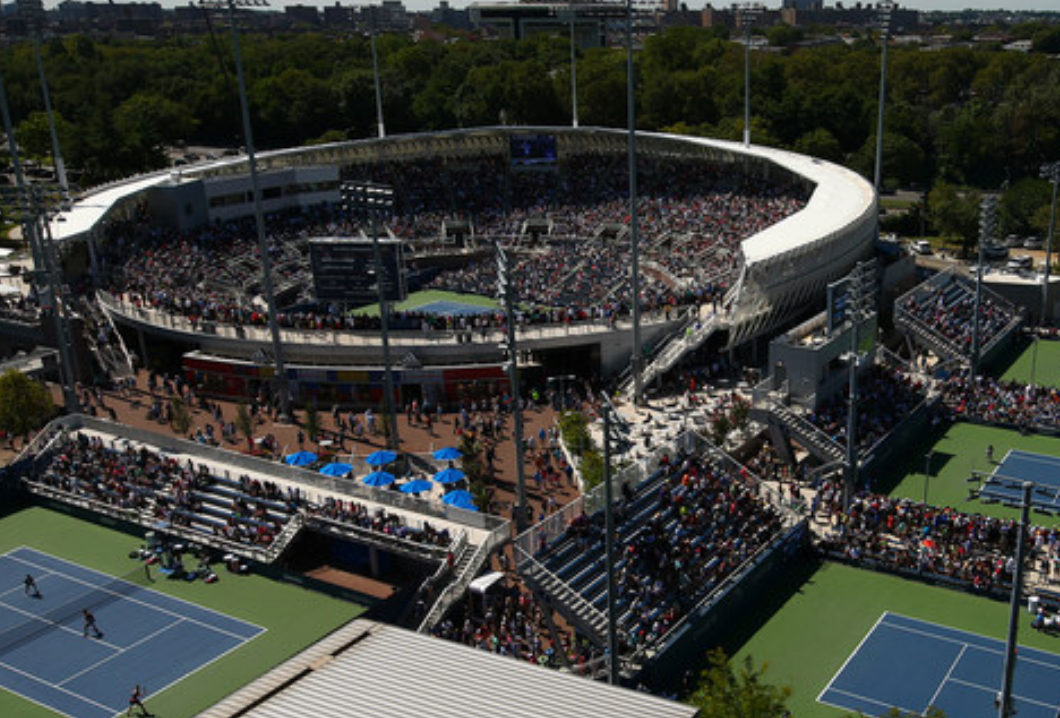
Verizon’s new DAS is in play at U.S. Open

A new DAS from Verizon is covering the grounds at the U.S. Open tennis championship this year.

Fans at this year’s U.S. Open tennis championship should have a solid swing at cellular connectivity, thanks to a new distributed antenna system (DAS) deployed by Verizon at the USTA Billie Jean King National Tennis Center in Flushing, N.Y.

According to Verizon, the deployment was added to the U.S. Open facility during the past year, and includes coverage not only in and around the main playng facility — the 23,771-seat Arthur Ashe Stadium — but also among the numerous other courts and fan-gathering areas in the sprawling facility.

Mike Haberman, Verizon vice president of network support, said the venue’s DAS was “a little bit different” than a traditional stadium DAS since it was spread out among multiple buildings, like the smaller (14,000 seats) new Louis Armstrong Stadium and all the side courts. But with more than 20 sectors deployed, and 155 DAS antennas used, he said coverage is strong across the venue.

Previously, Haberman said Verizon used to cover the tournament with portable cellular antennas. But to meet the ever growing bandwidth demands of mobile device users, Verizon built a neutral-host system in the venue to provide more consistent coverage. Haberman said AT&T is also on the DAS at the tennis center.
Why is venue parking still mainly low-tech?

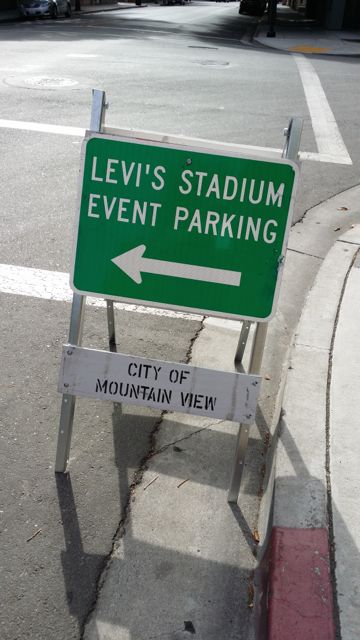
Mountain View city sign to parking lots

If it’s not the number one pain point for a fan’s game day experience, parking is at least in the top five headaches list for any venue, and from where we sit it’s a puzzle as to why we haven’t heard more success stories about technology-based parking systems. Is it mainly due to lack of control of real estate and venue services contracts, or is it just a low priority that is still an overlooked possible money maker?

For every press release or story we hear about charging fans extra for an in-stadium “experience” like meeting team members during a practice or shootaround, I’m confused as to why there aren’t similarly numerous stories about premium parking plans that are available to the everyday fan, and not just season-ticket holders. At just about any venue we’ve been to, it’s easy to spot where the club-level patrons get to park their late-model imports: Right near the door.

No parking perks for regular fans

Editor’s note: This essay is from our latest STADIUM TECH REPORT, an in-depth look at successful deployments of stadium technology. Included with this report is a profile of a new MatSing ball DAS deployment at Amalie Arena, a new under-seat DAS deployment for the San Francisco Giants at AT&T Park, and a look at the new DAS at Wrigley Field! DOWNLOAD YOUR FREE COPY now!

That’s an obvious perk for those who are scratching big checks, but what about the thousands of “regular” fans whose best bet is often just to arrive hours before game time to get a better spot? Why aren’t there more systems that would allow the upper-deck crowd to spend maybe 10 or 20 bucks more to guarantee a closer spot, or one with other amenities (close to the exit, bathrooms, etc.)? Is it because teams may not have control over lot spaces, or is it just due to lack of interest and/or creative thinking?

Maybe we need to dig deeper to find these stories ourselves, but if this kind of thing is happening at your venue, let us know. Though I don’t qualify for handicapped status, on some days a flareup in my surgically repaired back would make it extremely worthwhile for me to pay extra to be closer to the stadium, or to park in a lot that has a shuttle or pedicab service. I’d also pay a premium to be able to reserve a spot next to a friend, to make sure we can tailgate together.

Uber, Lyft causing cellular overload?

I also throw ride-sharing services like Uber and Lyft into the mix here, and wonder if any venue has successfully solved what I call the “Uber overload” problem. Even as most venues now have a set-aside area for Uber and Lyft dropoff and pickup, I have now twice heard of a problem I’d bet is duplicated in many other venues: Namely, ride-share services that are screwed up because there isn’t enough connectivity outside the stadium to handle the crush of fans seeking that final connection with their driver.

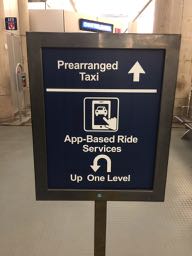
Can you find your way to the Uber pickup at MSP? Credit: Paul Kapustka, MSR

In one place I heard of this happening — AT&T Stadium in Arlington, Texas — the Uber driver I was with said that many drivers had the experience of getting a ride request, only to be unable to find (and confirm) the ride because neither driver nor rider could connect outside the stadium walls. Maybe that’s improved lately (this conversation was a year ago) but the driver told me an interesting workaround — drivers en route to AT&T Stadium would first head to a fast-food restaurant on the parking lot fringes and use the restaurant’s free Wi-Fi signal to tell riders to meet them there. Anyone else out there have this problem and/or found a solution? Let me know. I will also start trying to check ride-sharing services and parking at stadiums in our profile visits, so stay tuned.

In forward-thinking places like the Westfield-managed Century City Mall we’ve seen parking technology installed with priority status, perhaps because a guaranteed place for the car is of higher importance to shoppers than to eventgoers. We have seen some parking startups help teams and venues shift payment systems to digital platforms, which has produced savings in time and money from the inevitable failures of cash-based transactions through a car window. But that seems like just the start. If your team, venue or startup has a story to tell here, you know where to find us.

VenueNext names Orlando’s Perez as new CEO

Anthony Perez

Anthony Perez, former chief marketing officer for the Orlando Magic, has been named the new CEO of stadium- and team-application developer VenueNext, replacing founding CEO John Paul.

According to a VenueNext press release, Perez had been with the Magic for the past 10 years in “various leadership roles,” including executive vice president for strategy and CMO, a title he gained in 2017. According to the release, Perez helped develop the Magic’s virtual currency strategy which has been one of the big successes for VenueNext as its app powers the program. The Magic were VenueNext’s first NBA customer and the second customer overall after the San Francisco 49ers.

Former CEO Paul will remain as vice chairman on VenueNext’s board, and according to the release will assist the company on future moves like a planned expansion into European markets. A longtime computer industry veteran, Paul led VenueNext’s charge into the app market for stadiums and arenas with a strategy based more on enabling services like ticketing, loyalty programs and mobile concession ordering and delivery, with the Niners’ new Levi’s Stadium as its proof of concept platform in 2014.

With $24 million in venture funding as of 2016, VenueNext appears to be in good shape, even if it is still a ways away from reaching its publicly claimed target of 30 customers that Paul said it would have three years ago. While the company’s website does not have a full list of customers, VenueNext has said in the past that it does have clients signed already in the healthcare and hospitality markets, but cannot name them due to confidentiality agreements.

First CBRS steps: Boingo deploys test network at Dallas’ Love Field

Even though its regulatory status is still uncertain, the untapped promise of the spectrum band known as CBRS is already spurring public technology trials, including one announced by Boingo Wireless today that will be used to test back-of-house business applications at Love Field airport in Dallas.

CBRS, also known as Citizens Broadband Radio Service, is the acronym shorthand for a 150 MHz-wide swath of wireless spectrum at the 3.5 GHz range that can support communications using the LTE standard. While the final rules for CBRS use in the United States are still pending final FCC approval, the expected availability of the spectrum sometime soon has service providers, gear vendors and other interested parties scrambling to get the technology up and running to kick the tires ahead of any commercial offerings. Like Wi-Fi, the CBRS spectrum will essentially be free to use, making it an potentially attractive space for providers of wireless services to large public venues and stadiums.

In Boingo’s case, what’s different about its trial is that it has partnered with the tech team at Love Field not to offer any services airport travelers might notice, but instead mainly to “push the envelope” on CBRS networking, according to Derek Peterson, Boingo’s chief technology officer.

With FCC permission to test devices in the CBRS spectrum, Boingo and the Love Field team are “taking advantage of [the test approval] to get used to CBRS, to take a first stab at it,” said Peterson in a phone interview.

Though widespread support for the radio chips necessary to connect via 3.5 GHz bandwidth is not yet available, Peterson said Boingo was able to find a mix of phones, dongles and other devices to be able to start playing around with the spectrum in a live environment. Verizon, one of the wireless carriers aggressively pursuing CBRS, has publicly said it expects to see CBRS-capable devices out before the end of the calendar year.

Jared Miller leaves Falcons for Madison Square Garden

Jared Miller, former chief digital officer for the Atlanta Falcons, has moved to a new job with Madison Square Garden. Credit: Paul Kapustka, MSR


In a personnel move that may have some technological impact on the upcoming year’s Super Bowl, former Atlanta Falcons chief digital officer Jared Miller is now executive vice president and chief operating officer at Madison Square Garden Ventures, according to Miller’s LinkedIn page.

We haven’t yet spoken to any of the principals involved, so more details will have to come at a later time (maybe at next week’s SEAT conference in Dallas, where the greater world of the sports technology marketplace regularly gathers). Miller, as those who read MSR know, was the point person for all technology deployments at Mercedes-Benz Stadium, the new roost for the Falcons that opened last summer and is scheduled to host Super Bowl 53 in February, 2019.

If history is any guide, the networking teams at MBS are likely already busy preparing for the NFL’s big game — in the recent past, carriers have used the offseason before a Super Bowl date to update the DAS inside Super Bowl venues, a task likely already underway in Atlanta. What’s not known is how Miller’s departure may or may not affect technology strategy decisions, either on the DAS side or on the Wi-Fi side of things. After touring MBS during a press day last summer, MSR did not receive any network-performance updates during the 2017 football season, despite repeated requests to stadium representatives, including Miller.

Mercedes-Benz Stadium also hosted the College Football Playoff championship game this past season, but for the first time in years the stadium hosting the game did not provide Wi-Fi usage statistics.

Connect the DAS: Enhanced cellular finally arrives at Wrigley Field

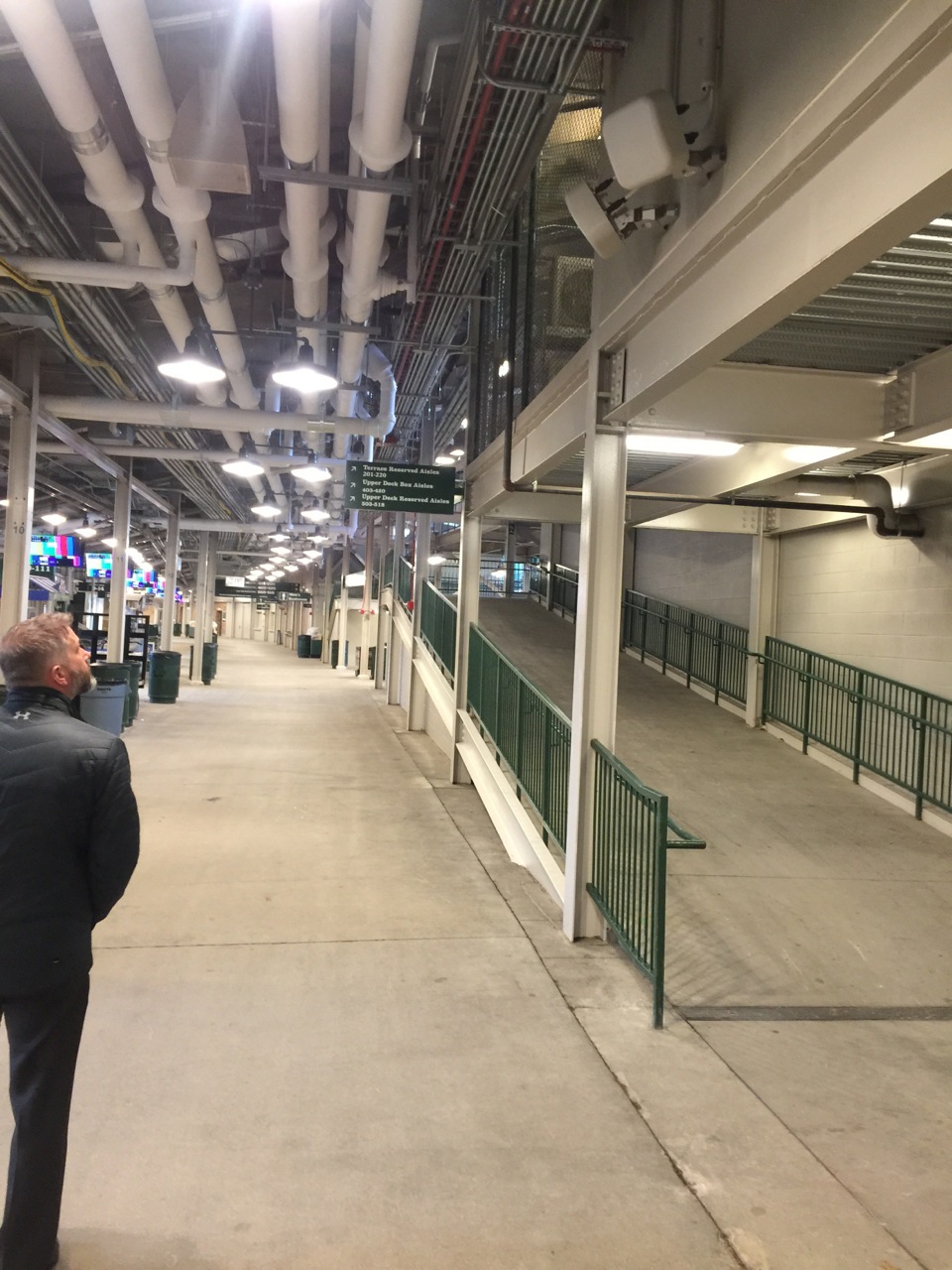
Cubs VP of IT Andrew McIntyre looks up at some new DAS antenna placements in the main level concourse. Credit all photos: Paul Kapustka, MSR (click on any picture for a larger image)

When it comes to sports fans and their beloved stadiums, change is sometimes hard to take, especially at historic venues like the Chicago Cubs’ beloved Wrigley Field.

The last ballpark in the major leagues to get lights (in 1988), fans of the iconic Wrigley with its ivy-covered outfield walls put up some fierce resistance to some of the latest changes brought to the ballpark by the team’s latest owners, the Ricketts family, ove the past few years. An expansion of the bleacher seats, some new video boards behind the stands in the outfield and construction of a hotel and office building adjacent to the stadium all had their naysayers, some of whom would still prefer the old to anything new.

But this season, Wrigley is finally unveiling a part of its renovation that everyone can get behind — better cellular connectivity inside the park thanks to a new neutral-host distributed antenna system (DAS) built by DAS Group Professionals (DGP) for the Cubs. Delayed a couple years from its originally planned deployment due to the Cubs’ World Series title run in 2016, the new system has contracts with all four of the major U.S. wireless carriers, and should help fans share more memories from the Friendly Confines in the seasons to come.

Success on the field makes waiting OK

Editor’s note: This profile is from our latest STADIUM TECH REPORT, an in-depth look at successful deployments of stadium technology. Included with this report is a profile of a new MatSing ball DAS deployment at Amalie Arena, a new under-seat DAS deployment for the San Francisco Giants at AT&T Park, and a look at the networks inside the new Banc of California Stadium in Los Angeles! DOWNLOAD YOUR FREE COPY now!

First announced in 2015, the plan to bring the new DAS as well as a new Wi-Fi network to Wrigley was pushed back until this season, mainly because of the Cubs’ new-found success on the field. In addition to the World Series title in 2016 — as everyone knows, the Cubs’ first in 108 years — the Cubs also went deep into the postseason in both 2015 and 2017, reaching the NLCS in both those years. As the extended seasons pushed back all kinds of renovation construction schedules, the arrival of the new connectivity options was pushed back a season longer than expected — a delay that was felt but perhaps not minded all too much by the celebrating Cubs fans.

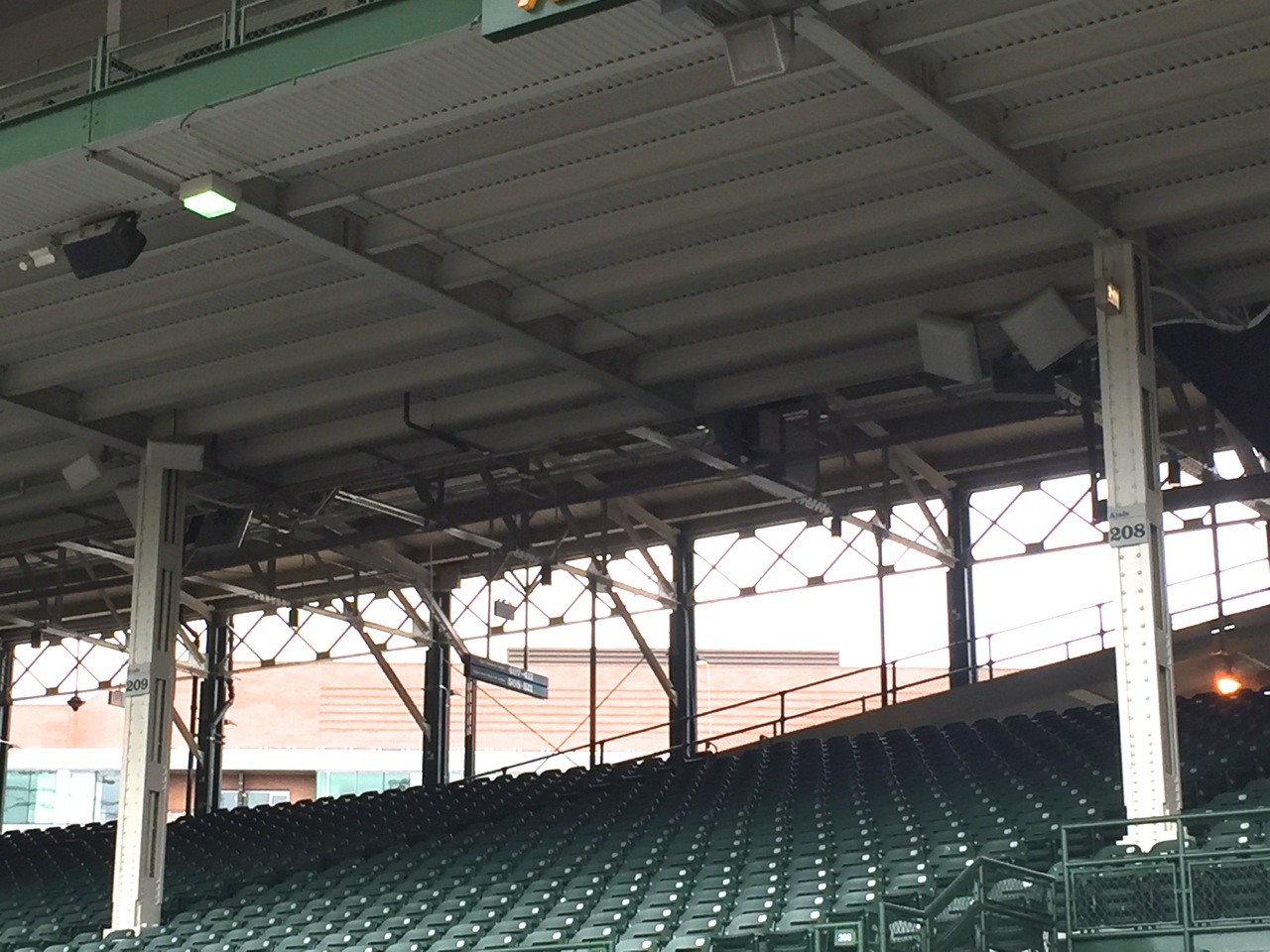
DAS antennas visible near tops of stanchions in lower seating bowl

Since deployment of the DAS was (mostly) fairly straightforward — the DGP deployment uses entirely overhead and side-structure antenna placements, thanks to Wrigley’s multiple overhangs — it was finished in time for opening day. The Wi-Fi network, however, will be rolled out as the season progresses, mainly due to the need to place APs under seats in the lower seating sections.

Much of the engineering to get both systems inside the stadium faced more than the regular share of stadium conflicts, as this past offseason saw the Cubs pull out almost all the lower-bowl seats and dig 60 feet down into the dirt to clear room for some under-seat club areas, one of which is already open. Even though the DAS network wasn’t powered up until about a week before the season’s first pitch, deadlines were met and the new celluar system was ready for opening day.

“We definitely put scheduling and timing to the test, but we got it done,” said Andrew McIntyre, vice president of technology for the Chicago Cubs. “By the All-Star break, we should have both systems online,” McIntyre said.

The DAS system deployed by DGP uses JMA equipment, just like DGP’s other big-stadium DAS deployments at the San Francisco 49ers’ Levi’s Stadium and the Sacramento Kings’ Golden 1 Center. Steve Dutto, president of DGP, acknowledged the challenge of the Wrigley buildout, including one instance where DGP technicians needed to set up scaffolding to mount antennas but couldn’t because instead of a concrete floor there was a 60-foot hole in the ground.

“We worked around all that and got it done,” said Dutto.

New club spaces get new flat antennas

Mobile Sports Report traveled to Chicago for a mid-April visit, hoping to get some sense of the new network’s performance on a full-stadium game day. Instead, we got a lonely and chilly tour when sub-freezing temperatures caused that day’s game to be canceled. One positive was that with empty stands, it was easier to get around and see all the DAS antenna placements.

New flat-panel DAS antenna blends nicely in club space.

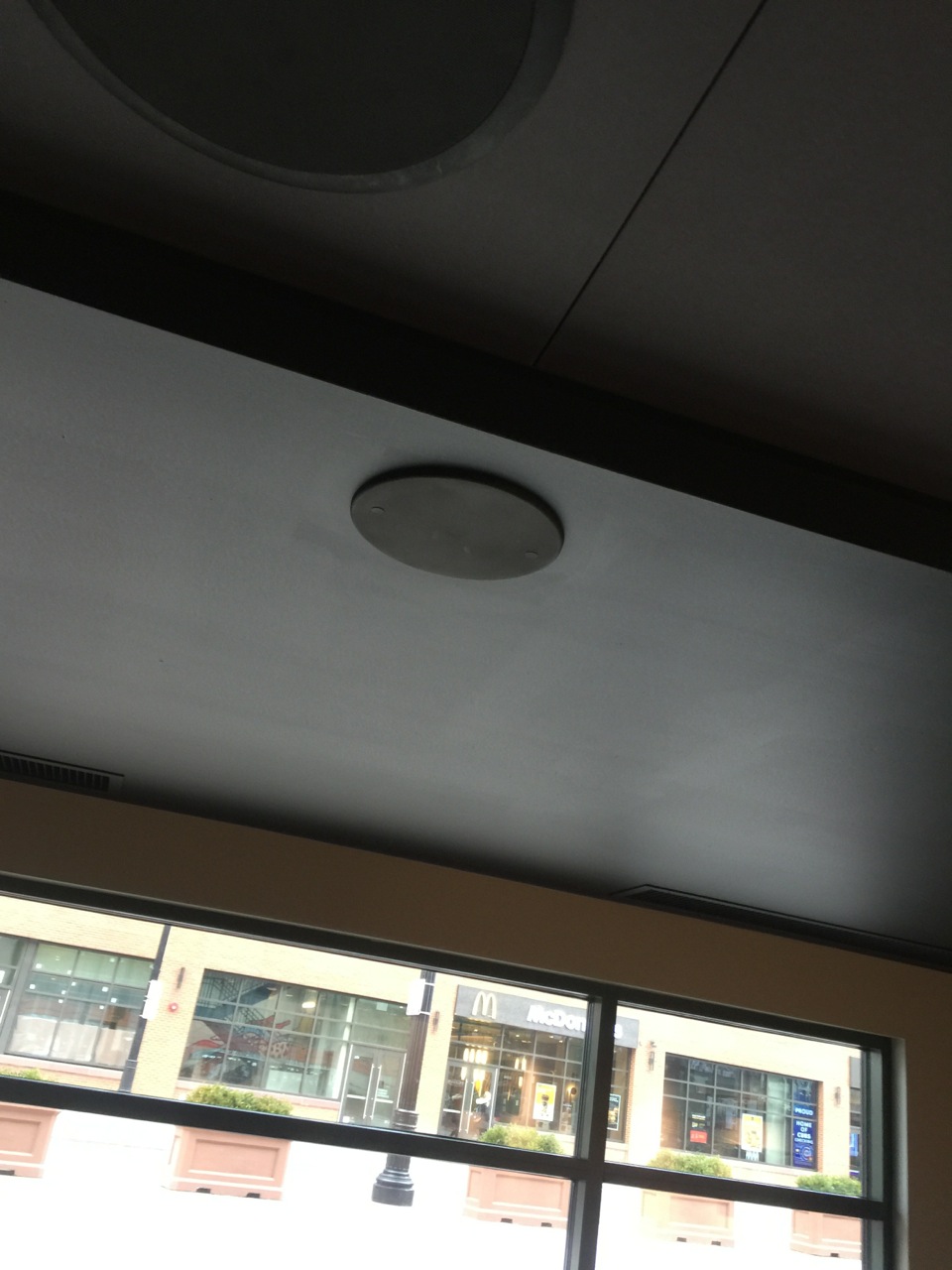
The first part of our tour was a trip underground to the new 1914 Club (for the year Wrigley opened) that sits directly under the seats right behind home plate. With the feel of sports bar-meets-speakeasy, the classy premium-seat space has great connectivity even while underground, thanks in part to a new flat-panel disc-shaped omnidirectional DAS antenna from Laird Technologies that DGP used in both indoor and outdoor placements.

With nobody in the club, we got an off-the-scale speedtest of 139 Mbps down and 46.7 Mbps up, proof on one level that the system is ready to go. Since it was freezing outside (did we mention it was cold?) MSR didn’t stop to take our gloves off to get many more tests, but we did get marks in the high 30 to high 40 Mbps range pretty much anywhere we did stop, including the upper decks and the bleachers. Even out in the middle of the adjacent plaza (where the Cubs’ networks are designed to cover) we got a DAS speed mark of 38.2 Mbps / 44.0 Mbps.

“The new DAS is much more higher performance grade than in the past,” McIntyre said.

The premium-seating club spaces, which were previously nonexistent at Wrigley, will expand next year when the Cubs finish out two more underground spaces, along each base line. According to McIntyre fans in those clubs will be able to watch players using the underground batting tunnels to tune their swings mid-game.

The last phase of the current Wrigley renovations will also see the addition of some more open gathering and club areas on the upper deck level, including party porches on the outside of the stadium walls overlooking the plaza (now called Gallagher Way under a sponsor-naming deal with the Illinois-based insurance brokerage). Gallagher Way, which hosted an outdoor ice rink in the winter, is set to hold concerts and other gatherings like movie nights this summer.

Old overhangs perfect for new technology

Sometimes in stadium wireless retrofits, you get lucky and the old stuff blends pretty well with the new. Take Wrigley Field’s classic metal-and-wood overhangs, which provide shade and rain cover for fans on the lower back and upper decks. According to DGP vice president of engineering Derek Cotton, getting DAS antennas in the right spots for a good signal there was half easy, half hard.

On the top levels, DGP was able to install the JMA gear out where it could offer the best connection — at the edge of the roofs, pointing backward toward the stands. With aesthetics a top concern at Wrigley, the roofs were a perfect place to “hide” some of the 420 total antennas in the deployment.

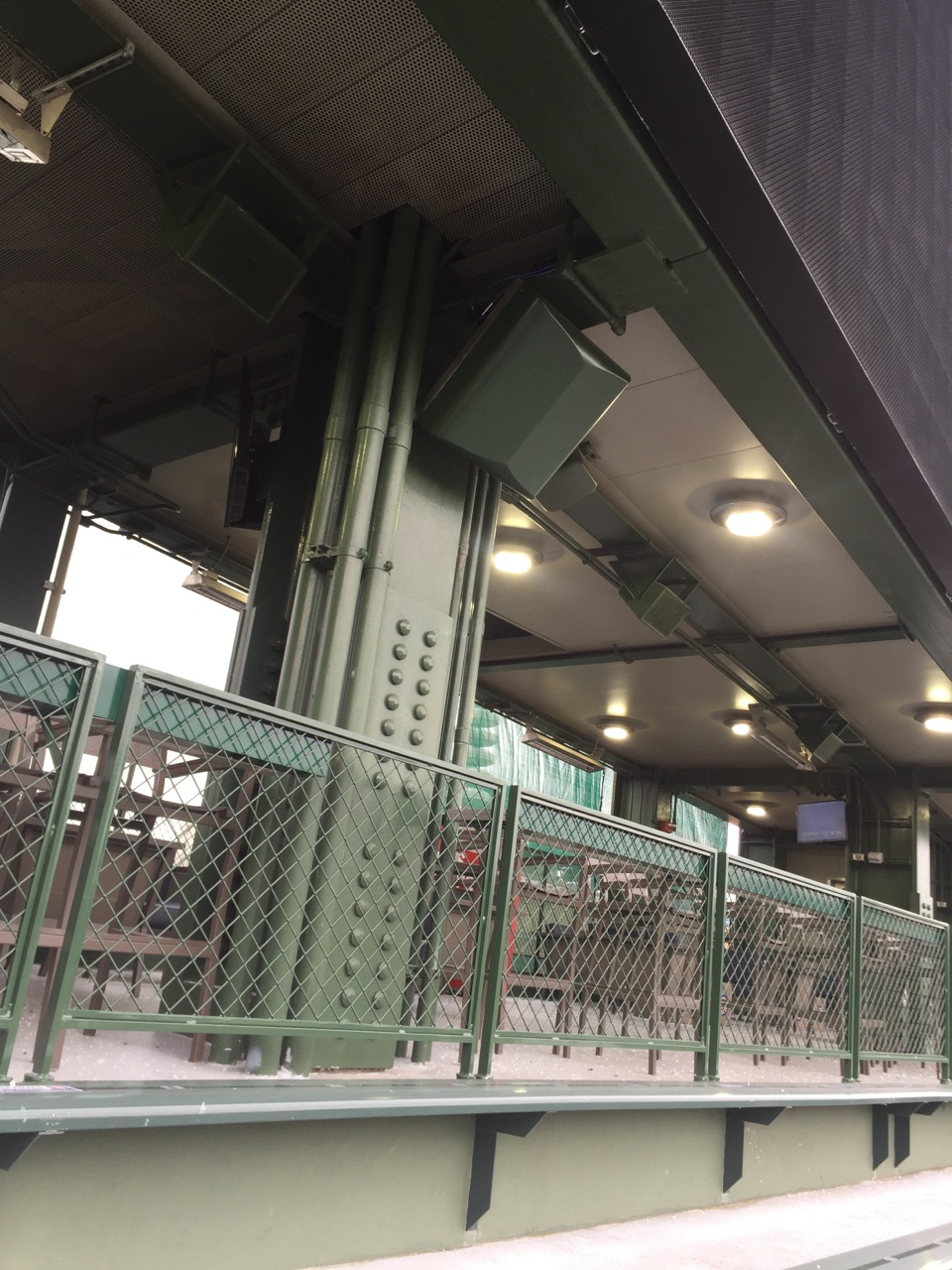
Green-painted DAS antennas point toward stands from back of bleachers club area

But on the lower-level roof, DGP and the Cubs had a concession to make that will be fixed during the upcoming offseason. Because of the deep pits dug into the box seat and field level, Cotton said DGP couldn’t get a scaffolding set to reach the outer parts of the lower roof — so instead DGP put those antennas in toward the backs of the roofs, and will move them out to the edges this winter. Some other antennas installed this year will have to be taken out and replaced while the rooftop party decks get built; and by next year the Cubs hope to have all the marooned gear from an AT&T Wi-Fi deployment from 2012 removed — but if you have sharp eyes this summer you can spot some of the old “Pringles can” Wi-Fi radios still nestled up in the rafters.

‘Creativity’ needed for bleachers

If DAS deployment in the main seats at Wrigley was fairly straightforward, for the venue’s unique and famous bleacher seating DGP’s Cotton said “some creativity was needed” to find places to mount antennas.

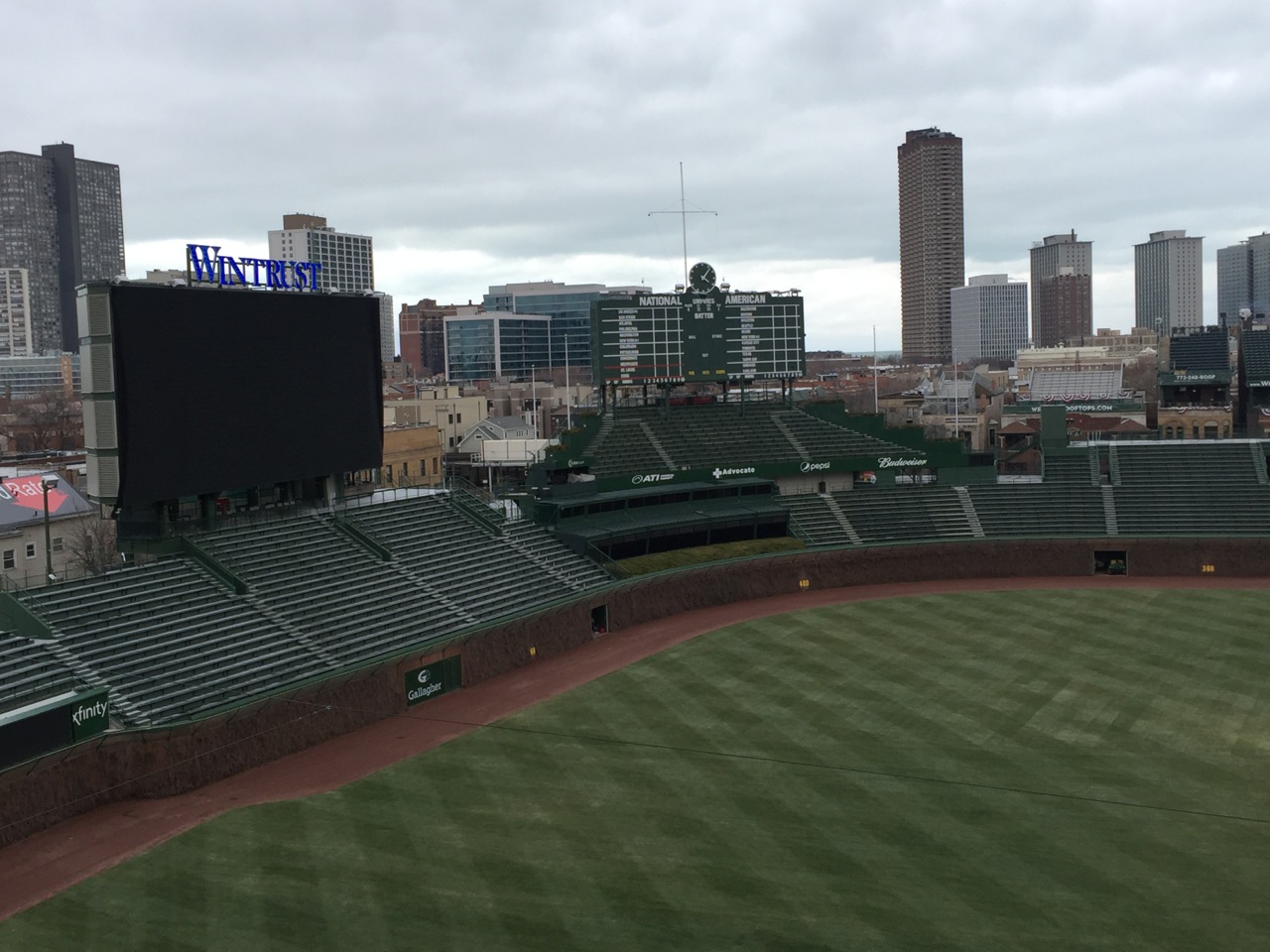
With no overhead structure and only the historic, manually operated scoreboard in the back, Wrigley’s bleacher seating now has DAS coverage from a wide array of antenna placements that took use of just about every kind of mounting area available. Some gear hangs from the back of a sponsor’s sign in left field; other antennas are tucked underneath the bottom of the scoreboard, pointing out from a small club area there; and still others are concealed in the tall grass of the planters that go up the sides of the centerfield seating section, just next to the poles that carry the Cubs’ World Championship flags from 1907, 1908, and most recently, 2016.

Other more normal antenna placements are found around the back side of the bleachers, where recent renovations added a concessions area and more stairways.

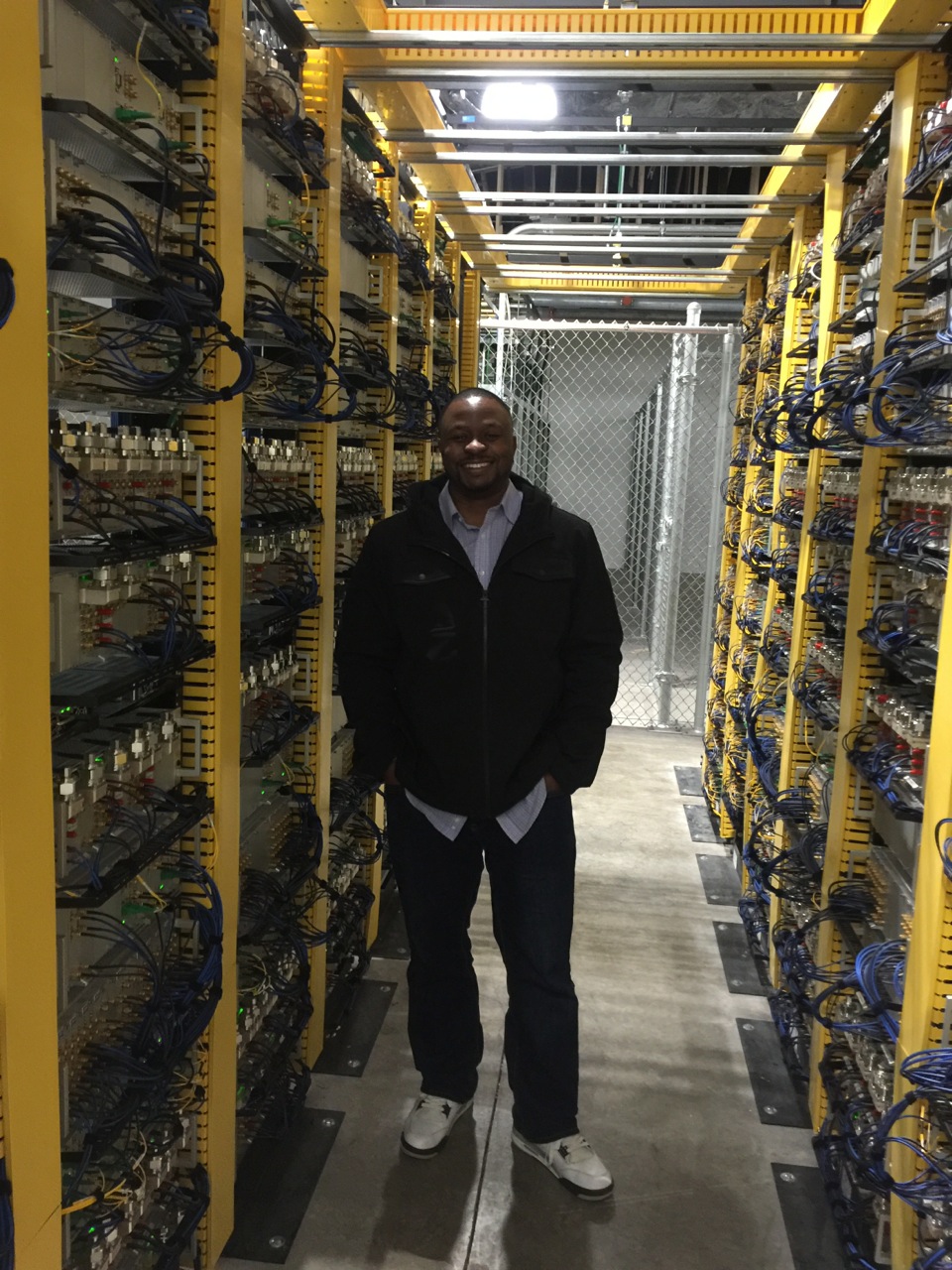
DGP’s Derek Cotton inside the Wrigley head end room

Moving outside the park to the plaza, artistic concealment continues with antennas hidden on light poles that surround the triangular plot of lawn. According to McIntyre, the club’s wireless coverage extends across Clark Street to the new Hotel Zachary, named for Wrigley Field’s original architect, Zachary Taylor Davis.

The hotel, which has retail shops on the street level — including a McDonald’s franchise that replaces a standalone McDonald’s that used to sit in the parking lot where the plaza now stands — has DAS coverage on all floors, with Wi-Fi planned for public spaces on the first floor and second floor, where the main lobby and lobby bar reside. In the lobby bar comfortable couches provide a great place to look over the plaza and at Wrigley; and in fact the Extreme Networks Wi-Fi gear visible on the ceilings is already operative there, though purposely limited in throughput to 7.5 Mbps up and down for now.

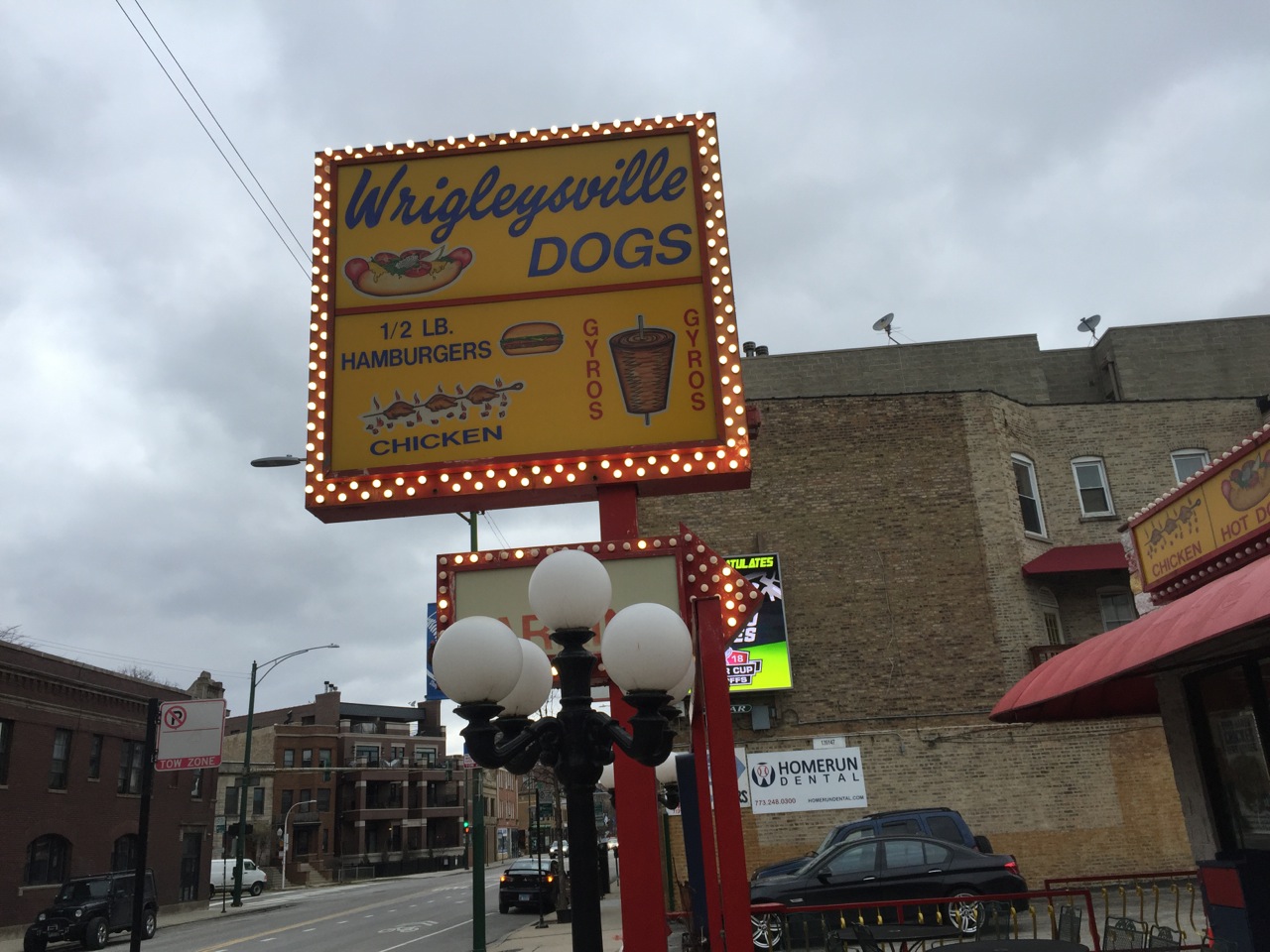
Most of all the wiring for the new networks comes together in a small brick headend building about a block north on Clark, behind the Wrigleyville hot dog stand. Unless you knew what was inside, you’d be hard pressed to guess why there are huge strands of red, white and blue cabling coming through one wall. Just before the start of the season, the Cubs announced a deal with Comcast Business that will see a “XfinityWiFi@Wrigley” label on the Wrigley Wi-Fi SSID. According to McIntyre Comcast will bring in twin 10-Gbps pipes to power the Wrigley Wi-Fi network.

When the Wi-Fi network comes online later this season, there will be even less of a reason to believe there will be any more grumbling about connectivity at the Friendly Confines. The new era starts with the DAS deployed by DGP, which was picked by McIntyre and the Cubs several years ago, after hearing of DGP’s deployments at Levi’s Stadium and over face-to-face meetings at the SEAT Conference.

And while Cubs fans didn’t have to wait for new wireless as long as they did for a world championship, they can now start enjoying the ability to connect to the world outside the ivy.

“When it’s fully done our fans will have a real ability to share, in a modern way, from one of the most iconic and historic venues,” McIntyre said. “It’s a whole new world.”

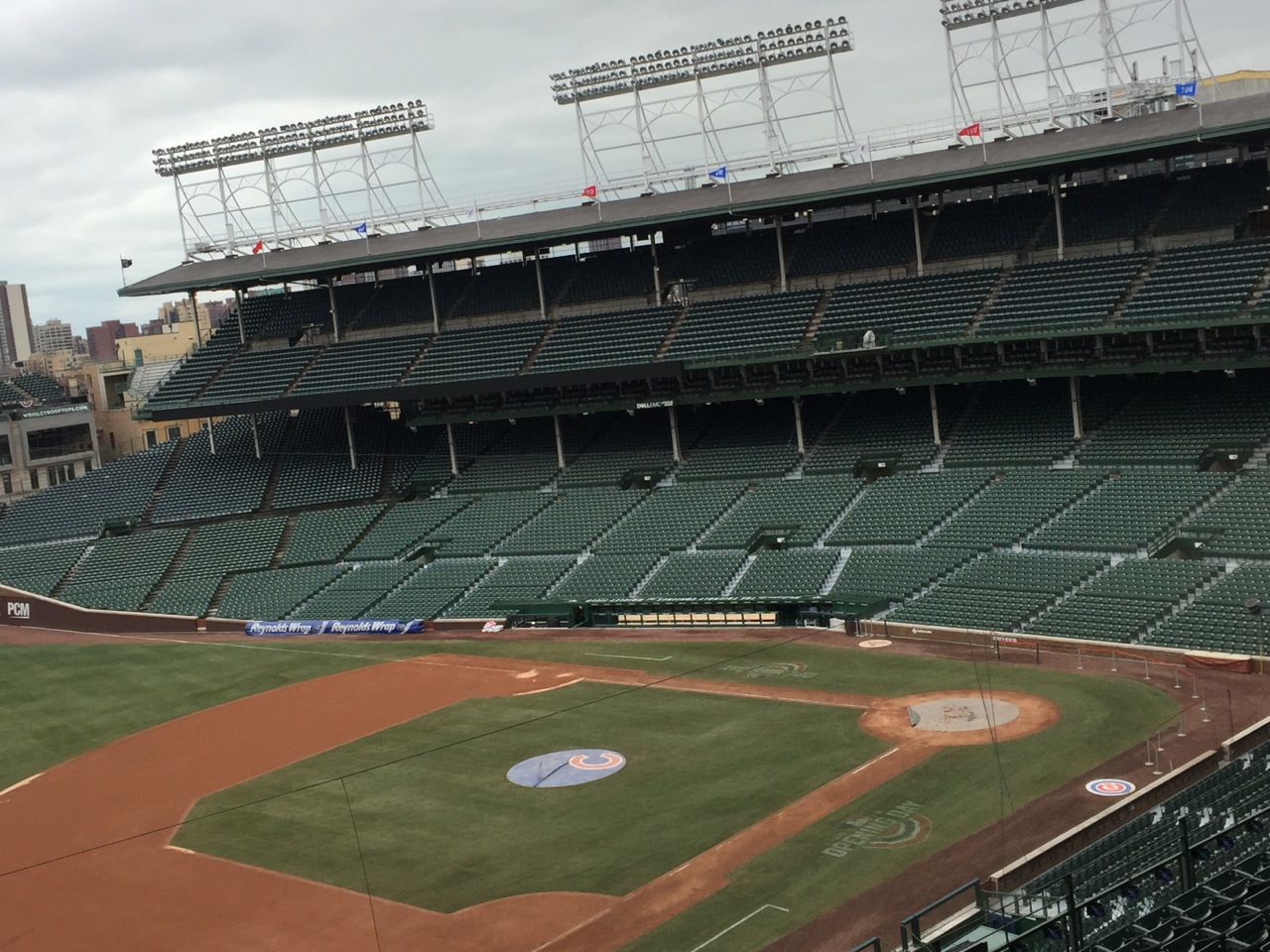
This look at the main seating shows the multiple overhangs where DAS antennas were mounted

This look at the Wrigley Field bleachers shows the lack of any structures to hang antennas from

If you get hungry while at the Wrigley Field head end, this fine dining establishment is just outside the door

“How often does the train come by?” “So often you don’t notice.”