Built.io formally announces sports-app business

Screenshots from Built.io’s under-development mobile app for the NBA’s Miami Heat. Credit: Miami Heat

Built.io, the startup behind the Sacramento Kings’ new team and stadium app, formally announced its “fan experience platform” today, putting the company more directly in competition with market leaders YinzCam and VenueNext.

A San Francisco-based company, Built.io did not have a standalone sports-app business when it was selected by the Kings to be the base app technology for both the Kings’ team app as well as the app for the Kings’ new home, the Golden 1 Center. Since that arena’s launch last year, Built.io has also signed the Miami Heat as a customer, ahead of today’s formal launch of the sports-app platform.

In the larger sports world, YinzCam is by far and away the company with the most apps developed for teams and stadiums, with many of its content-focused developments used by numerous pro league teams as well as many large colleges. VenueNext, which entered the world as the app developer for the San Francisco 49ers’ new Levi’s Stadium a few years ago, has since signed up multiple pro teams like the NHL’s San Jose Sharks as well as entertainment entities like Churchill Downs, home of the Kentucky Derby.

Of the two market leaders, Built.io’s platform-based approach to app building — where third-party components for features like wayfinding and parking can be added via an API structure — is more like VenueNext’s, though YinzCam also has the ability to add third-party components as needed. The challenge for all stadium- and team-app builders, as well as for venue owners and teams, is to get fans to download and use the apps, so that teams can take advantage of the opportunities afforded by digitally connected customers.
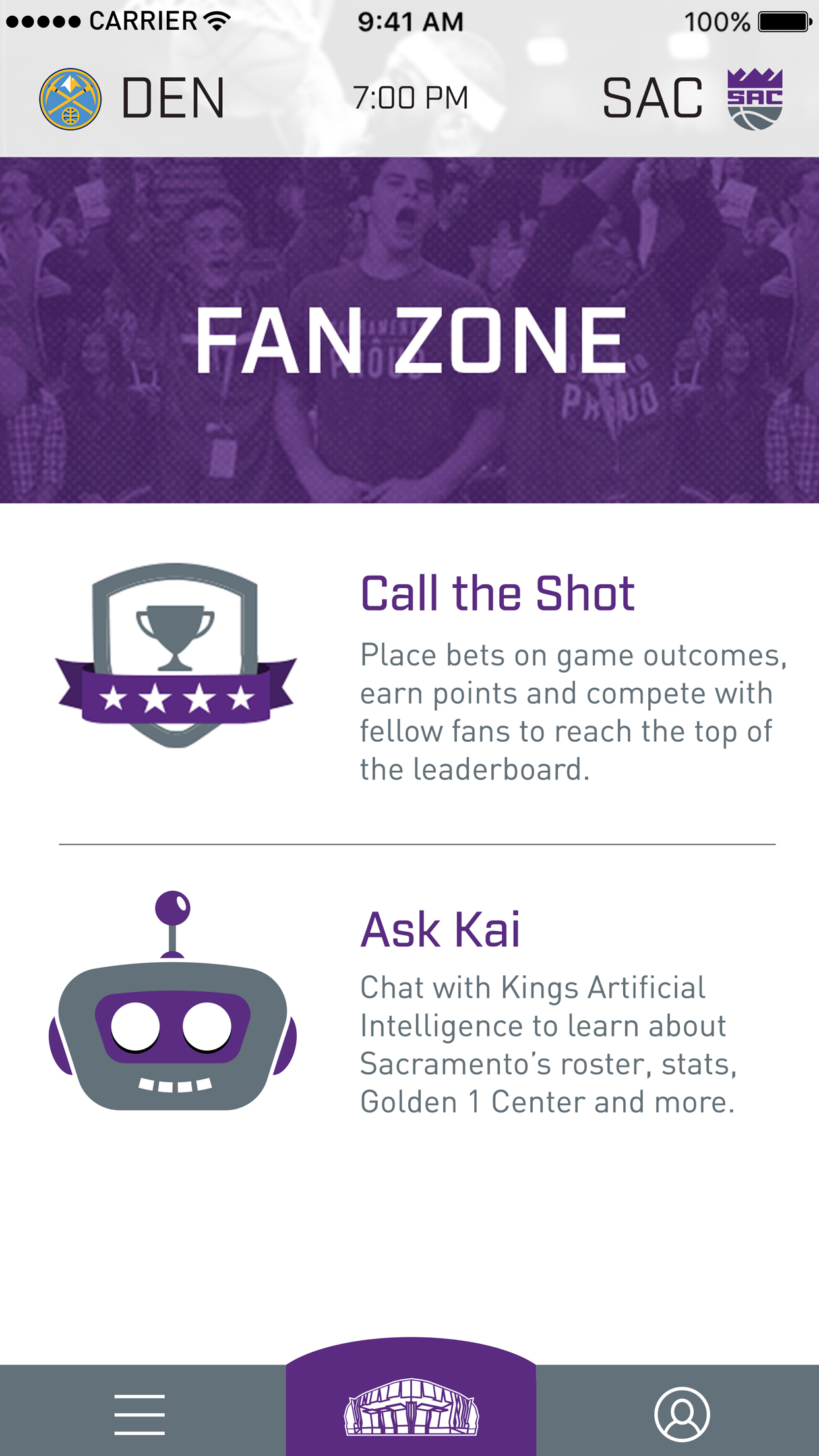
Screenshot of part of the Built.io app for the Kings.

While there is plenty of promise and perceived opportunity in team and stadium apps, the current reality sees fans at stadiums using public social-media apps like Facebook, Snapchat, Twitter and Instagram, or other tools like email and search, far more often than team- or stadium-specific apps. However, by driving fans to use apps for digital ticketing and other necessary service transactions, team and stadium apps are likely to be more used over time, following the adoption curves for other businesses like coffee shops and airline tickets.

Though still small, Built.io has been around for a bit, as it was founded in 2007. The company has previous experience connecting larger enterprise businesses, experience founder Neha Sampat told us will work well as stadiums and teams become more connected in all their businesses.

“What the Kings are trying to do is a large-scale enterprise use case,” said Sampat in an interview last year. “There are a lot of big-data analytics and so much personalization that is dependent on data.”

Sampat said Built.io’s model of a “back end as a service” and its ability to quickly connect other programs’ APIs should be a good fit for the Kings, as well as for other teams looking to blend more services and functions into team and stadium apps.

‘Right opportunity’ led Rushton from IBM to LA Chargers job

Jim Rushton

Jim Rushton, who held one of the most high-profile jobs in the sports network business market as leader of the stadium-technology group at IBM, said it was a “once in a lifetime chance” at the “right opportunity” that led him to leave Big Blue to become the new chief revenue officer for the Los Angeles Chargers.

Rushton, who started his new job this week, spoke with Mobile Sports Report last week on the phone after what he described was a “whirlwind” of activity, which ended up with him at one of the top-level business spots for the former San Diego Chargers, who are in the midst of a move up the coast.

“The chance to help rebuild and evolve an NFL franchise in a market like Los Angeles doesn’t come up very often,” said Rushton. “It really was a once in a lifetime career opportunity.”

Part of that opportunity will be to help figure out how to remake the Chargers franchise as part of a joint tenant agreement at the yet-to-be-built new Los Angeles NFL stadium, a venue being built by LA Rams owner Stan Kroenke. Rushton said that fan data and anayltics will me a “massive part” of his new purview, and that as a partner in the stadium operations the Chargers will be part of “joint decisions” on technology matters inside the new venue.

Rushton, who held a similar position with the NFL’s Miami Dolphins before moving to IBM, said his post with the Chargers will have more responsibilities.

On his short but productive IBM tenure — during which IBM came from pretty much nowhere to becoming one of the leaders in the stadium-networking integration space — Rushton said he felt he was leaving the operation improved from its initial inception.

With IBM-led deployments at Texas A&M, Atlanta’s new Mercedes-Benz Stadium and the forthcoming LA Football Club venue leading the way, Rushton said IBM’s tech-integration business now has a “signficiant [deal] pipeline across the world.”

One of the more interesting features of Rushton’s new job is the fact that the Chargers will play home games the next two seasons at the StubHub Center, a 27,000-seat soccer stadium in Carson, Calif., that will become the NFL’s smallest venue starting this fall. Though it’s not clear whether or not the stadium will improve its technology offerings before the Chargers play, Rushton was excited by the prospect of a scaled-down experience.

“It’s going to be terrific — it’s like having only premium seats, because everything will be lower bowl,” Rushton said.

AT&T sees 13.6 TB of cell data used for Kentucky Derby weekend; Verizon hits 7.17 TB on Derby Day

Race winner Always Dreaming. Credit: Coady Photography /Churchill Downs

Once again, fans at the Kentucky Derby used more wireless data than they did the previous year, with AT&T seeing a total of 13.6 terabytes of cellular data over the racing weekend at famed Churchill Downs.

For the muddy Derby race day itself, AT&T said its customers used a total of 8.1 TB of data on the in-venue DAS, the temporary COWs (cell trucks on wheels) and the AT&T macro network in the area. That number surpassed the 6.7 TB AT&T saw on Derby Day last year.

With an additional 5.5 TB of traffic seen on the “Kentucky Oaks” race day Friday, AT&T saw a total of 13.6 TB for the race weekend, a 19 percent increase from last year’s AT&T total of 11.4 TB for the weekend.

UPDATE: Verizon Wireless said it saw 7.17 TB of traffic on Kentucky Derby Day, up from 5.5 TB the year before. For the full three days of racing (including Thursday’s “Thurby” events), Verizon said it saw a total of 14.27 TB of traffic, meaning that this year’s events handily surpassed last year’s combined-carrier mark of 20.15 TB. In the venue, wireless carriers run on a DAS deployed by Mobilitie.

T-Mobile joins DAS at Texas A&M’s Kyle Field

Corning ONE DAS headend equipment at Texas A&M’s Kyle Field deployment

The DAS network at Texas A&M University’s Kyle Field will now support T-Mobile cellular customers, according to an announcement from the school.

According to Texas A&M, T-Mobile will pay $3.5 million to have its signals carried on the DAS inside the 102,512-seat Kyle Field. Previously, AT&T and Verizon Wireless had paid $5 million each to be the first carriers on the stadium’s new DAS, which was installed ahead of the 2015 football season as part of a network deployment that cost north of $20 million according to school officials.

The network, one of the highest-performing deployments in U.S. sports stadiums, saw an 8.2 terabyte traffic day for a game this past season against Tennessee, with 3.8 TB of that traffic on the DAS network.

LA Chargers name IBM’s Jim Rushton as chief revenue officer

Jim Rushton

Jim Rushton, the former Miami Dolphins exec who became the leader of IBM’s stadium technology-integration program, has now joined the Los Angeles Chargers as the team’s chief revenue officer, according to a post on the team’s website.

We’re still trying to reach out to Rushton for more info, but it’s unclear yet as to what effect his departure will have on IBM’s stadium networking business, which directed projects at Texas A&M as well as at the Atlanta Falcon’s new Mercedes-Benz Stadium, due to open later this year. IBM was also tapped to lead technology deployments at the forthcoming Los Angeles Football Club soccer facility.

Kentucky Derby app adds more content for version 2.0

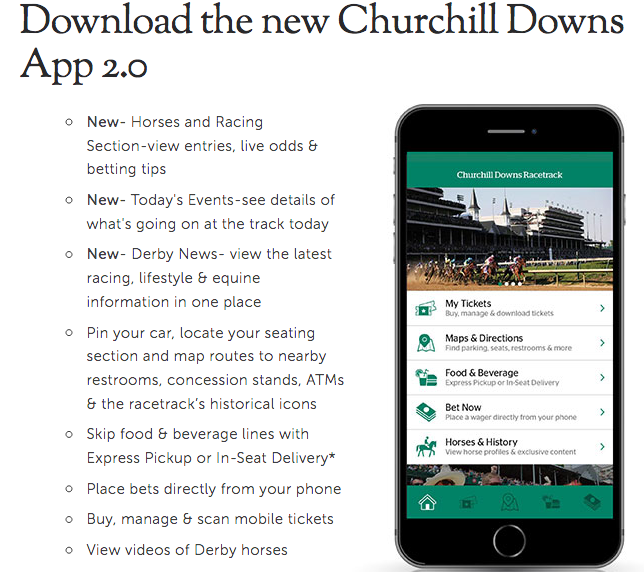
Call it a content-focused refresh — the Kentucky Derby app developed for Churchill Downs by VenueNext will add several new features for race-day fans, including live odds and betting tips.

The mobile app, which debuted at last year’s race, will once again offer the ability to place bets from within the app, so the new content may help produce more winners if the betting tips are correct. Also new to this year’s version of the app are a “today’s events” section which will detail what is happening at the racetrack throughout the Kentucky Derby weekend, as well as a “Derby News” section which will, in the words of Churchill Downs, provide “racing, lifestyle & equine information in one place.”

Like last year, the app will also support mobile ordering for in-seat food and beverage delivery or express pickup, but only in certain selected sections of the venue, which will see somewhere near 170,000 attendees over the race weekend. Last year, the track made delivery available to 500 seats in its Turf Club section, and express pickup available to another 15 sections of seating areas. We don’t have any details yet whether or not those services expanded for this year’s race, but stay tuned.

We’ll also be watching to see if this year’s wireless activity surpasses last year’s totals of 12.2 terabytes of cellular data for Derby Day and 20.15 TB for the weekend, numbers from the combined traffic of AT&T and Verizon Wireless customers.