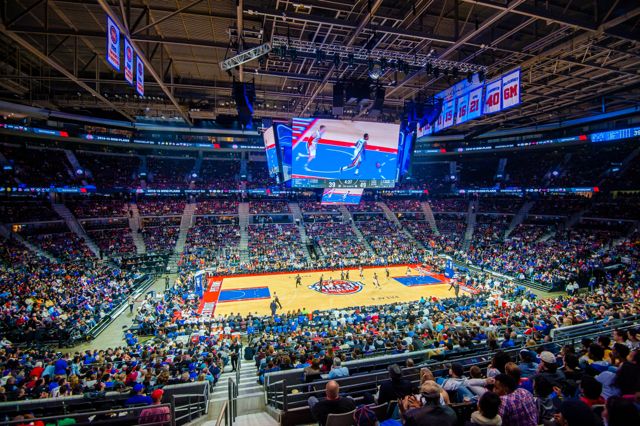
Stadium Tech Report: Wireless connectivity brings fans and business benefits to the Palace at Auburn Hills

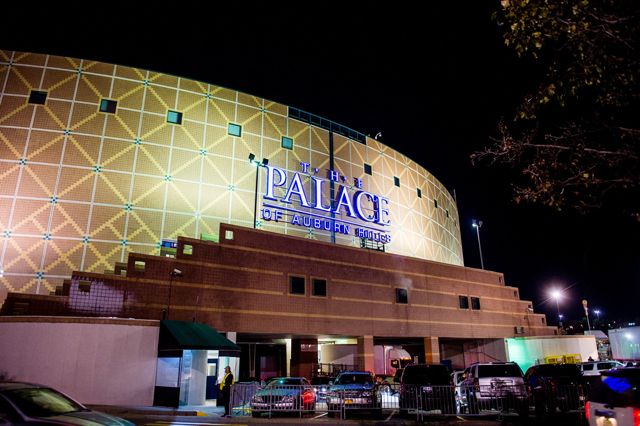
The Palace at Auburn Hills. Credit all photos, Palace at Auburn Hills (click on any photo for a larger image).

The Palace at Auburn Hills. Credit all photos, Palace at Auburn Hills (click on any photo for a larger image).

Not too long ago, a marketing executive who was new to the Detroit Pistons’ ownership team tried to post a tweet during a game at the Palace of Auburn Hills. But to get the message to send, he had to … step outside the building.

Fast forward a few years, and the situation is completely reversed. Not only is there a storm of wireless connectivity inside the Palace, that same Wi-Fi and cellular traffic is keeping fans inside, bringing new fans in and giving the Pistons management team better insight into what all those fans want.

Using technology as an “accelerant,” the Pistons have changed the game for the fans and for themselves, seeding a process that seems destined to help the team build business success as their fan base evolves into one that expects and delights from an always-connected experience.

In a story-telling twist, we’ll tell you one of the early ends to this tale now: Even though the Pistons have suffered on the court of late, finishing the 2013-14 season with a 29-53 record, the team this year had a season ticket renewal rate above 80 percent, according to the Pistons management. Either there’s massive optimism in Motor City, or the Pistons ownership team is doing something very right in making the game-day experience something fans want to keep experiencing.

If you want to believe more in the latter reason, then listen to what Dennis Mannion, president and CEO of Palace Sports and Entertainment and the Detroit Pistons, has to say: There are a lot of smart programs now in place and some that are just starting to take off, but none of it happens, he said, without a solid communications core.

“It always comes back to the great accelerator, technology,” Mannion said.

Building the network inside the building

Editor’s note: This profile is part of our new Stadium Tech Report HOOPS AND HOCKEY ISSUE, available for free download. In addition to this story it contains additional profiles and team-by-team tech capsules for all 30 NBA teams. Download your copy today!

Mannion, who joined the Pistons in 2011 following a long career in sports management that included time as the Los Angeles Dodgers’ president and COO, and stints with the Baltimore Ravens, Denver Nuggets and Philadelphia Phillies, said the new commitment to technology started at the Pistons’ ownership level, where they knew things needed to change.

“When I came in to the job we knew there needed to be some technology improvements [at the Palace],” Mannion said. “We needed to make games more of a happening for our fans.” As part of an overall stadium renovation project that cost somewhere between $13 and $15 million, the Pistons started bringing the Palace into the world of wireless connectivity.
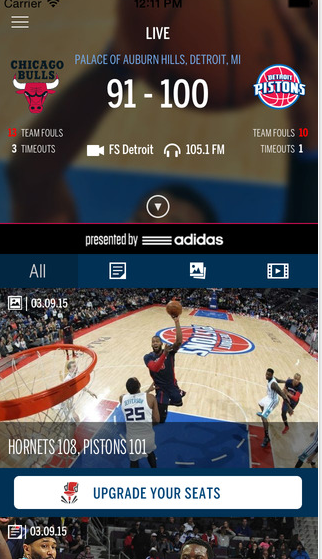
Screen shot of Pistons app

Screen shot of Pistons app

For help, Mannion and the Palace team enlised a Detroit sports-stadium technology consulting firm called Nuvuz Sports, run by CEO Scott Wruble, a former tech exec with the NBA and MLB, and chief marketing officer Jim Wolski. According to Wolski, when the technology revamp of the Palace started in 2012, there was a bit of a connectivity hill to climb.

“The entire building had nine cable modems, total,” Wolski said.

The first step was to start with a DAS, or distributed antenna system, to make sure cellular carriers could connect with their customers. The Palace team wound up picking Verizon Wireless to act as lead on a neutral-host DAS deployment, which is currently in the process of adding AT&T and Sprint to its system.

Opened in 1988, the Palace had some physical challenges when it came to wireless technology, including the omnipresent question of retrofits — where do you put the DAS head end? In the Palace’s case, the solution was a new building built outside, in a Palace parking lot.

Verizon helped on the next step in the deployment process by bringing in their longtime technology partner Ericsson to deliver the gear for the building’s Wi-Fi network. Though somewhat of a newcomer in the stadium Wi-Fi space, Ericsson’s long history in telecommunications equipment showed through with the Wi-Fi deployment, according to Mike Donnay, vice president for brand networks at Palace Sports & Entertainment.

“The performance from the Ericsson [Wi-Fi] equipment is super high,” said Donnay, who was the exec who had to leave the building to send the tweet before the renovation happened. Now, with 238 Wi-Fi access points in the venue (which seats 22,076 for basketball) Donnay doesn’t have any problems tweeting.

Nuvuz’s Wolski said that in addition to providing fan Internet access, the internal Wi-Fi network also powers the game-day ticketing operation as well as concession point of sale. It also is the base for a large suite of fan engagement platforms, which are hyper-targeted to the many different types of Pistons or other event fans who walk in the doors.

Clusters within the clusters

Kevin Grigg, vice president of public relations for the Pistons, said Mannion’s “big picture” ROI is to use technology to engage fans in a one-on-one relationship.

“The biggest challenge [in the past] has been if you are a fan and you buy a ticket, we didn’t know who you are,” Grigg said. “Now, we’re in a position to identify people during the engagement.”

Nuvuz’s Wolski concurs.

“It chages the game when you know who they [the fans] are,” Wolski said.

Mannion said the Pistons’ IT team is already well into the implementation of an elaborate fan-engagement system that breaks the fan base into multiple segments that can each be targeted with programs tailored to their wants and needs.
palace2a“We have different fan bases, from those who buy courtside seats, to those in corprate suites to families,” Mannion said. “We have affinity groups, like ‘future Pistons,’ women’s groups, and people interested mainly in attending concerts. We have clusters within clusters. And we use a combination of media, memories and merchandise for each cluster.”

On the team side, Mannion said that “even perceived ‘inside access’ is a real turn-on. Fans like to join, belong and brag.” Some ways fans can get “closer” to the team is to use the stadium app’s seat-upgrade feature (powered by partner PogoSeat) to purchase seats closer to the action, or by special access like post-game shootarounds on the court floor.

There is also a big focus on Pistons-related content, both from the team as well as from fans themselves. And increasingly, fans are turning to social media to share this content. The Pistons have responded with tricks like putting selfies tagged with the #pistonspride hashtag right onto the new huge center court video board.

The tech team also just added beacon technology to the Palace, and are already offering beacon-powered features like seat upgrades to fans who have seats in the upper levels, and discounts on merchandise to fans who are walking right outside the team shops. There are also scoreboard trivia contests and real-time fan polling, all of which keep fans engaged with the team and game even as they stare at their mobile devices.

“We wouldn’t be able to do all this without a connected arena,” Donnay said.

Connected now and for the future

Right now, Donnay said that approximately one-third of a regular Pistons game audience uses the Wi-Fi network, a take rate among the higher of reported crowd participation numbers. The Palace team also uses the Wi-Fi network to connect to 30 “smart carts,” which are mobile food carts that can be moved around (even outside the building) to take advantage of being where hungry fans are.

“It’s interesting to watch the heat maps of how the building is filling, and being able to tell concessions where to beef up,” Mannion said. In the past, he noted, many such game-day operations were decided by “gut feelings,” which could be right or could be wrong. Now, he said, there are facts and figures to back up the guesswork.

“Now you can still act on gut feelings, but you also have ways to prove what’s going on,” Mannion said. “You can do a digital promotion for food and beverage, and immediately measure the impact. That’s really fascinating.”

Even as they build on early successes, the team behind the Palace’s new tech operations knows that these are early days, and much work lies ahead. One current “big drag,” Mannion notes, is the plethora of social-media sharing platforms, a mix that includes Twitter, Facebook, Instagram, Vine, Snapchat and others, almost too many to track coherently.

There’s also a big challenge to keep pace with all the potential partners and digital features that could be added, like instant replays or food ordering for the stadium app; Mannion noted: “The question is, how do you create the right kind of [feature] incubation system, without spending too much money?”

At the very least, the Pistons team has grabbed a leading position in the connected-arena future, one where having advanced connectivity and engagement programs is table stakes to attract new potential season ticket buyers.

“We’ve seen colleges experience heartaches” when their fans leave because the stadiums don’t have connectivity, said Donney. “That’s the fan base that’s coming to the NBA. They’re going to expect that technology, so we’re going to have to be very good at it.”

So far, the Pistons and the Palace seem to be ahead of the curve of the new era of connected stadiums and the fans who fill them. Mannion, for one, knows he’s now in a much different business than the one he’s spent most of his career in.

“It’s a lot different now,” he said, “than just opening up the window and selling tickets.”
NCAA Tournament Wi-Fi and DAS: Send us your stats!

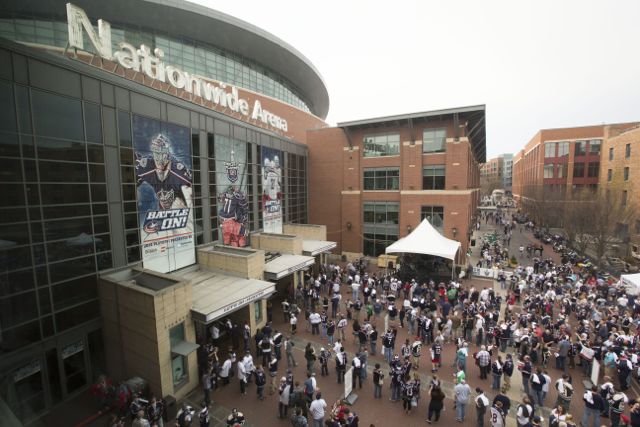
Nationwide Arena. Photos Credit: Columbus Blue Jackets

Nationwide Arena. Photos Credit: Columbus Blue Jackets

Given that the games are numerous and spread out far and wide, it’s our guess that wireless-data consumption totals from the NCAA Men’s Basketball Tournament regional sites are not quite approaching the “big game” numbers of say, a Super Bowl or the recent College Football Playoff championship game. Still, there are probably some interesting peaks and totals so as an open request to all involved, please send us any and all Wi-Fi and DAS stats from the weekend’s games and we’ll compile a list of what we get next week.

AT&T, as usual, was in with some early numbers, namely the DAS stats for the AT&T network in place at the University of Dayton Arena, where the first-round play-in games were held earlier this week. According to AT&T it saw 144 gigabytes of data used on the DAS during the four games over two days, again not Super Bowl numbers but still a big chunk of data and something to think about if your facility is planning to host a similar “big event” in the near future.

So who’s got Wi-Fi and who doesn’t for the NCAA sites? Our unofficial list is as follows:

Wi-Fi for fans available:
KFC Yum! Center, Louisville, Kentucky
Consol Energy Center, Pittsburgh
Moda Center, Portland
Time Warner Cable Arena, Charlotte
Nationwide Arena, Columbus, Ohio
Carrier Dome, Syracuse, N.Y.
Quicken Loans Arena, Cleveland
Staples Center, Los Angeles
Lucas Oil Stadium, Indianapolis

No Wi-Fi
Jacksonville Veterans Memorial Arena, Jacksonville
CenturyLink Center Omaha, Omaha, Nebraska
KeyArena, Seattle
NRG Stadium, Houston

If any MSR readers are out at the games, send us a speedtest…

Braves sign Comcast for network deal at new SunTrust Park

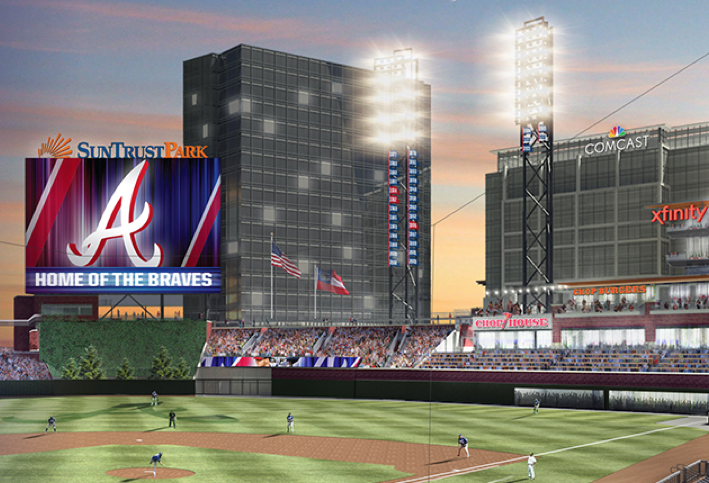
Screen shot of artist rendering of new Atlanta Braves ballpark, with Comcast office building over right-field wall. Credit: Atlanta Braves

Screen shot of artist rendering of new Atlanta Braves ballpark, with Comcast office building over right-field wall. Credit: Atlanta Braves

The Atlanta Braves and Comcast announced a deal that will see the cable giant providing back-end networking bandwidth to the team’s new SunTrust Park in Atlanta, along with an associated campus of buildings that includes a Comcast-branded structure that will peek over the right-field wall.

Like other deals it has signed at stadiums like the San Francisco 49ers’ Levi’s Stadium, the Tennessee Titans’ LP Field and the Wells Fargo Arena, Comcast will mainly be in charge of bringing back-end Internet connectivity to the Braves’ new stadium, which is scheduled to open before the 2017 season. No word yet on which vendor will be chosen to use that back-end connectivity to bring wireless networking directly to fans, but with pledges to build an “all-fiber network” with “multi-gigabit speeds” throughout the ballpark and the adjoining 60-acre campus, it’s a good bet that Comcast’s pipes will be able to supply whatever bandwidth is needed.

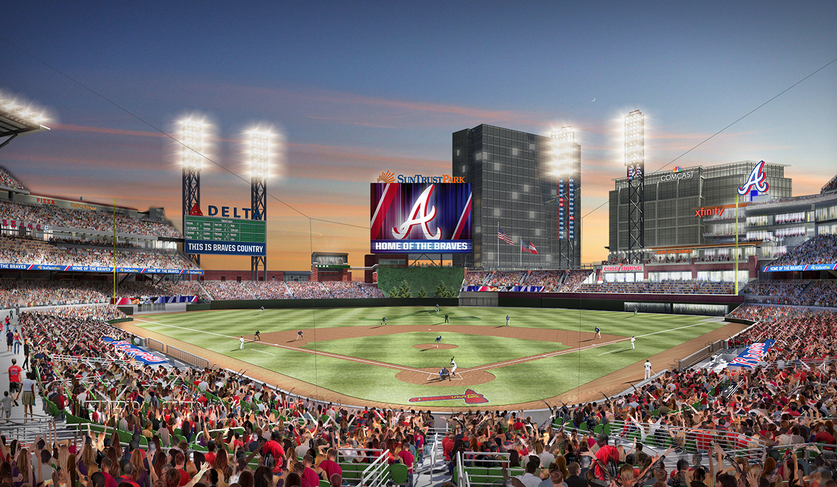
Unlike Levi’s, where Comcast signage is minimal, the cable giant will have a prominent place in the SunTrust viewshed, if construction goes according to the artist sketches provided with today’s news release. The question we have is whether or not left-handed pull hitters will be able to smash glass on the 9-story Comcast office building, which should be a great place to work late when the Braves have night games.

More gratuitous future ballpark art.

More gratuitous future ballpark art.

Stadium Tech Report: Blazing a Trail to Connectivity at Portland’s Moda Center

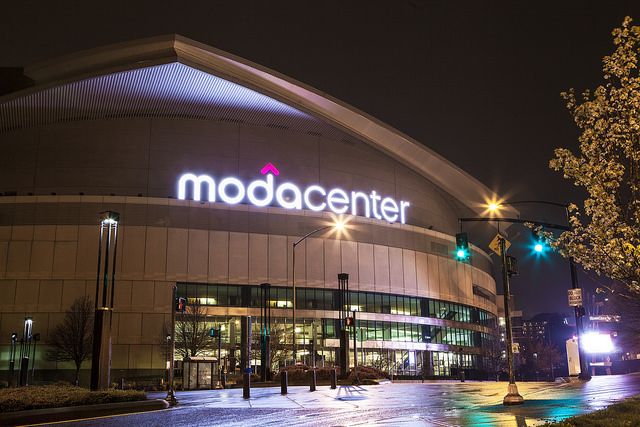
Portland's Moda Center, home of the NBA Trail Blazers. Credit all photos: Moda Center (click on any photo for a larger image)

Portland’s Moda Center, home of the NBA Trail Blazers. Credit all photos: Moda Center (click on any photo for a larger image)

When it comes time to build a stadium network there are two obvious choices of how to get it done: You let someone else build and run it, or do it yourself.

When neither of these options appealed to the Portland Trail Blazers and their planned networking upgrade at the Moda Center, they went with a third option: Using a neutral host provider for both DAS and Wi-Fi.

After turning to neutral host provider Crown Castle to build out the enhanced cellular DAS (distributed antenna system) network as well as a fan-facing Wi-Fi network, Portland’s home at the Moda Center now has a level of wireless connectivity that mirrors the team’s excellent on-court performance — challenging for the NBA lead and looking to keep improving.

With Wi-Fi gear from Aruba Networks and an app developed by YinzCam, fans at Trail Blazers games can use the stadium Wi-Fi to gain access to live-action video streams, player stats and even a radio broadcast of the game. The app also supports seat upgrades, a feature powered by Experience.

Now in its second year of existence, the network and all its attributes are a big hit with Portland fans, according to Vincent Ircandia, vice president for business analytics and ticket operations for the Trail Blazers, and Mike Janes, vice president of engineering and technology for the Trail Blazers.

“We do a lot of fan surveys, and the approval [for the network] continues to go up,” said Janes. “We want to figure out what we can do next.”

Third-party the third and correct choice

Editor’s note: This profile is part of our new Stadium Tech Report HOOPS AND HOCKEY ISSUE, available for free download. In addition to this story it contains additional profiles and team-by-team tech capsules for all 30 NBA teams. Download your copy today!

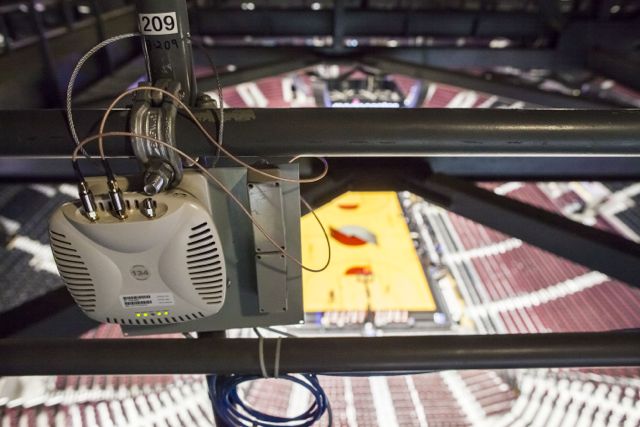
Aruba Wi-FI AP in the rafters at Moda Center

Aruba Wi-FI AP in the rafters at Moda Center

If you dial the clock hands back a few years you would find an arena in Portland with not much connectivity at all, and fans who made their displeasure over the situation known, loud and clearly.

“Trail Blazers fans are not shy about letting us know how they feel,” Ircandia said. “Two years ago we learned that fans didn’t have much connectivity here [at the Moda Center]. That was a real gap in the customer experience.”

Janes said the top two methods of bringing a network in — allowing a carrier to build and operate it, or to build and run it themselves — both had significant drawbacks.

“You could hand it over to a carrier [to be a neutral host] but I’ve seen that before, where one carrier has to ride on another carrier’s DAS,” Janes said. “That’s not a good solution.”

The DIY option, Janes said, would mean that the Trail Blazers team would have to build the networks themselves, and hire someone to manage it.

“That would mean we would have to deal with the [multiple] carriers directly, and we didn’t want to do that,” Janes said.

In the end, Portland went with the neutral host option, with Crown Castle building and running the DAS and installing a Wi-Fi network as well. With its wide experience in building and managing DAS deployments, Crown Castle already has AT&T and Verizon as tenants on the Moda Center DAS, with Sprint coming on soon and possibly T-Mobile joining in the near future.

And on the Wi-Fi side, the team itself “owns” the network and the associated data — “and that’s good, because we are starting to take deeper dives into that,” Janes said.

And how’s it all operating?

“No complaints [recently],” Janes said. “The fans are pretty quiet when it’s just working.”

User numbers flat, data use doubles

Maybe those users are quiet because they are busy posting pictures to Instagram or posts to Facebook, two of the leading applications being used at the Moda Center, according to the Trail Blazers. According to Ircandia, what’s interesting about the usage patterns from last year to this year is that while the number of fans using the network has remained fairly stable (at about 25 percent of attendees), the amount of wireless data consumed has just about doubled from last season to this season, meaning that people are doing more things on the network.

Toyota pregame show on the Moda Center concourse

Toyota pregame show on the Moda Center concourse

Some of that may have to do with a redesigned app, which added four live streams of video action, as well as live radio broadcast coverage.

“We didn’t leave [interaction] to chance,” Janes said. “We spent a lot of effort improving the app and redesigning the web presence to make it more enticing and robust.”

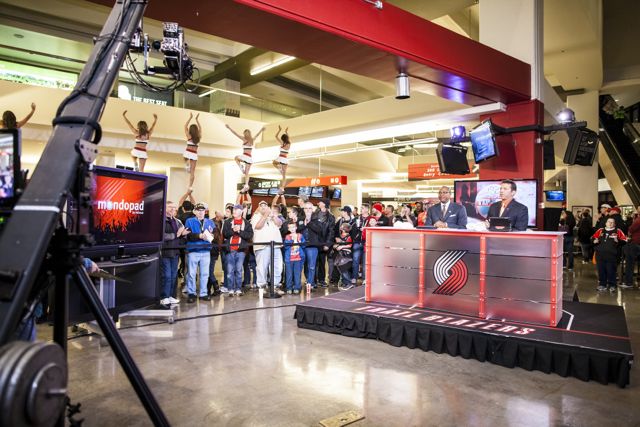
While having more features is always a good step, a big part of the challenge for any team is just getting fans to use the network and the team app. At Moda Center, there is a unique method of network promotion, which also directly benefits the team: By selling the “sponsorship” of the network to local-area Toyota dealers, the stadium operators now have a partner who actively promotes the network to fans walking into the building.

According to Ircandia, the Toyota dealers also sponsor a pregame show, set on the arena concourse with the team’s dancers in attendance to help attract attention. “They [Toyota] want to sell cars, so they have a lot of signage [about the network],” in addition to the show, Incardia said.

If there is such a thing as a good problem, there is one involving the ticket upgrade feature: Since the Trail Blazers have such passionate fans and are doing so well, there aren’t many available seats to offer for upgrades. “It’s a bit of a constrained inventory,” Janes said. Still, the team is using the Experience feature to offer last-minute ticket deals to students in the area, alerting them that there are seats available that may have a chance to be upgraded.

“They [students] have the time to drop whatever they’re doing to come over to the game,” Janes said.

Retrofitting an old flower

Previously known as the Rose Garden, the arena, which was built in 1995, clearly wasn’t initially designed with wireless connectivity in mind.

“We were retrofitting for technology that didn’t exist [when the building was built],” Ircandia said. “That’s where creativity comes in.”

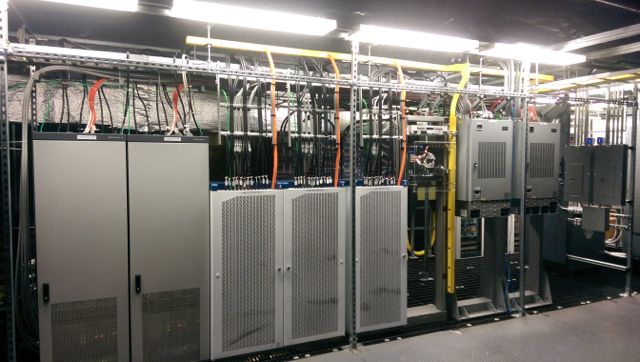
DAS headend gear

DAS headend gear

Some of the creativity in network design included separate Wi-Fi antennas for 2.4 GHz and 5 GHz transmissions, so that older devices didn’t have to compete with newer devices for the best Wi-Fi connection. Ircandia also said that the Moda Center “created” some new DAS headend space up in the highest reaches of the building.

“We built catwalks above the catwalks,” Ircandia said.

Looking ahead to what’s next, Janes said the network team is looking to use wireless to connect to food and beverage carts, so that point of sale operations don’t need to be tied to a plug in the wall.

“If we go wireless we can move the carts around, even put them outside, which gives us a business case improvement with no impact to the fans,” Janes said.

And now that those fans know what is possible, they will want what they have now, and more.

“That’s their expectation now,” Janes said, “that it will work when they walk in the building.”

Avaya boots Ruckus from San Jose Earthquakes’ new stadium Wi-Fi deal

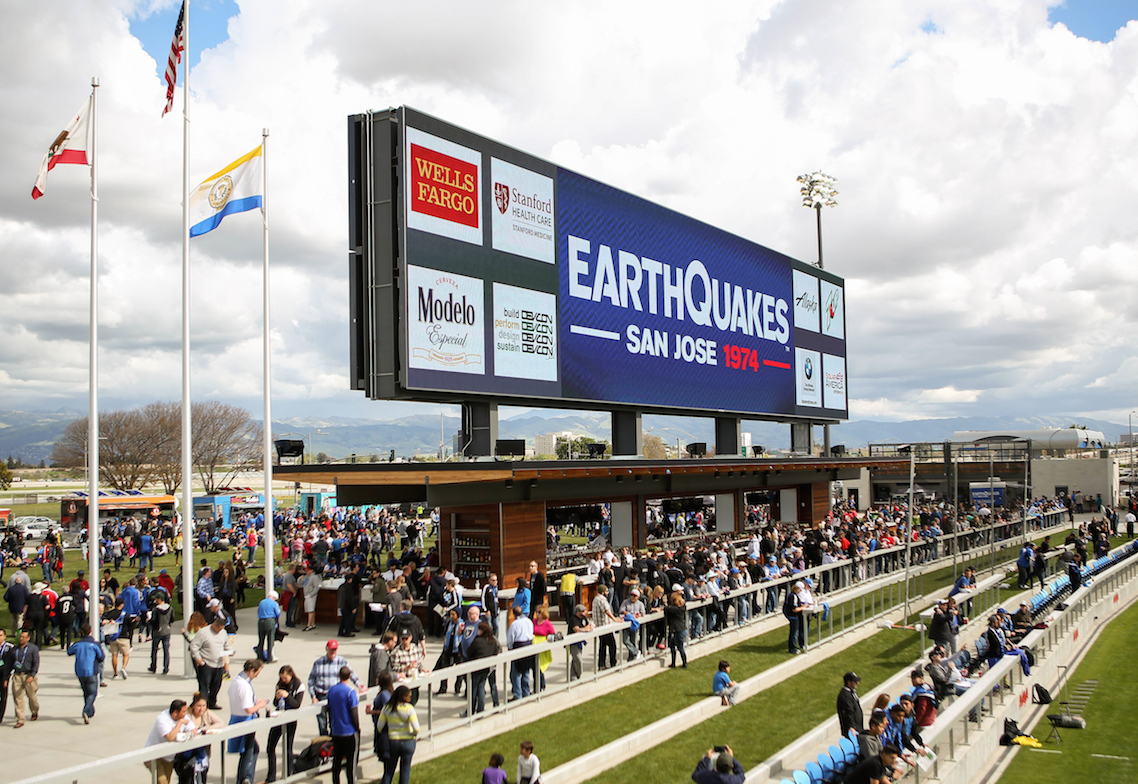
Crowds at Avaya Stadium during the venue's first game on Feb. 28. Credit all photos: Avaya

Crowds at Avaya Stadium during the venue’s first game on Feb. 28. Credit all photos: Avaya

While it hasn’t been announced publicly, the year-ago agreement to have Ruckus Wireless provide the Wi-Fi gear at the new San Jose Earthquakes stadium got the boot when networking gear and services provider Avaya stepped up with a $20 million naming-rights deal that also apparently includes using Avaya equipment, not Ruckus, for the in-house wireless network.

Since we haven’t yet been to the new Avaya Stadium we weren’t able to look around to see whose label was on the Wi-Fi APs when we reported that the network was live for the team’s “soft” opening, a preseason game on Feb. 28. As it turns out, we erroneously said Ruckus gear was being used for the network but have since been contacted by Avaya folks who told us that wasn’t the case. According to an Avaya spokesperson, the entire Wi-Fi network at the stadium, including APs, is Avaya gear.

When we asked a Ruckus spokesperson earlier this spring about the network, the only thing that person said was that the Earthquakes asked Ruckus not to comment on the network; until today, Ruckus had not announced publicly that it was no longer the Wi-Fi supplier at the now-named Avaya Stadium.

Here was the email reply we got today from Mark Priscaro, global public relations manager for Ruckus:

The San Jose Earthquakes recently consummated a naming deal for their new stadium, and it’s our understanding that Avaya is in charge of all networking, including Wi-Fi. It was a marketing deal on behalf of the Earthquakes, and not technology-driven. Avaya, with the approval of and authorization from the San Jose Earthquakes, chose to deploy their own Wi-Fi network infrastructure, which does not include Ruckus Wireless products or technology.

The Avaya spokesperson said the Wi-Fi network at the new arena worked well for the preseason opener, and will be fully operational at the team’s MLS home season opener on March 22. Mobilitie is the neutral host provider for the stadium’s DAS deployment, which is still under construction.

March Madness online: All 67 men’s tournament games available to cable/pay TV subscribers on any platform

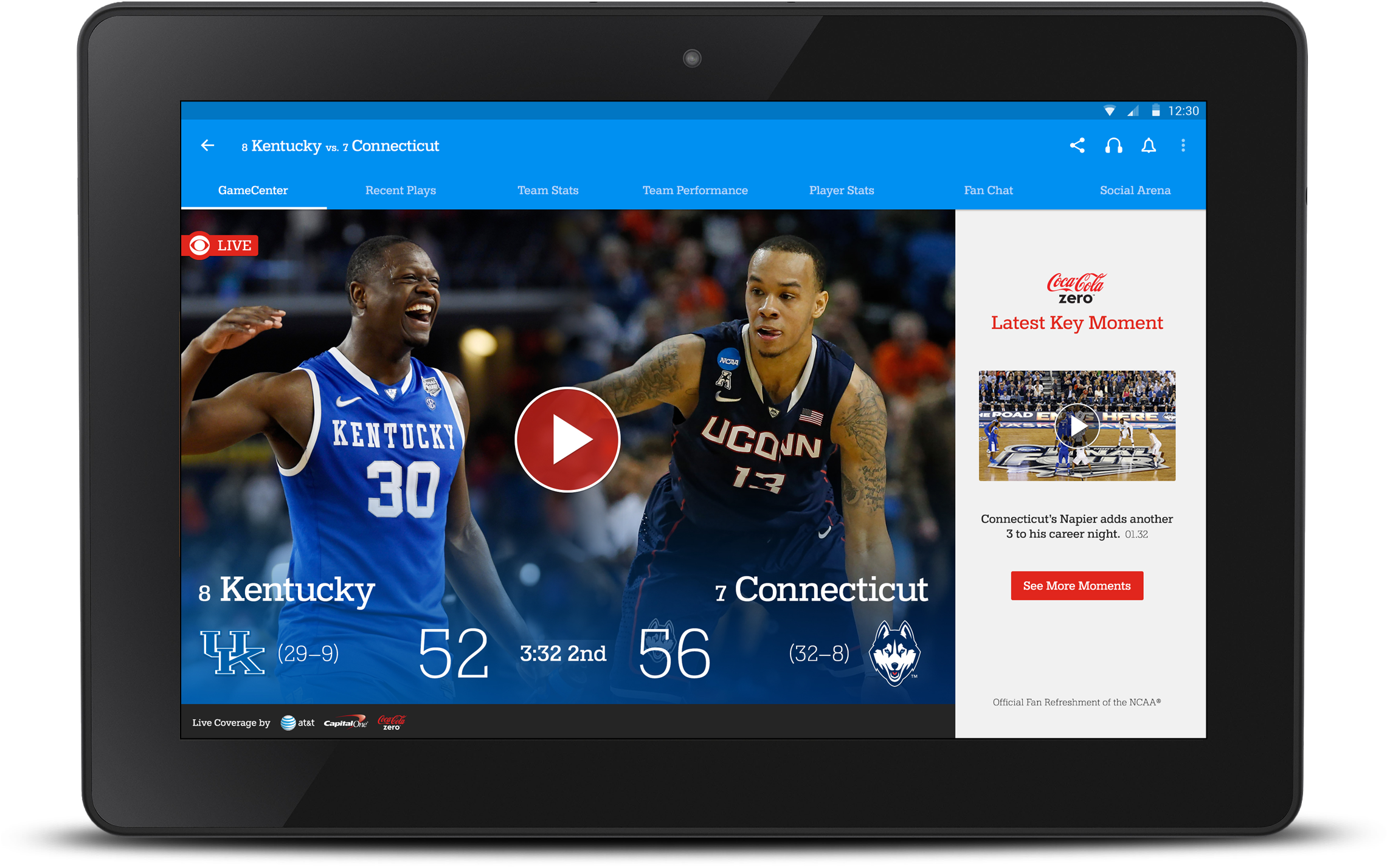
NCAA hoops on a Kindle? Sure!

NCAA hoops on a Kindle? Sure!

I’m not that old, but I am old enough to remember when the men’s NCAA basketball tournament was on broadcast TV only, and not online mainly because the Internet and world wide web were just getting started. I even can take credit for being one of the first to ever try to put live tourney scores online, a battle that started between my outfit and a little place called Starwave Sports that eventually was bought by ESPN. That’s a funny story but you already know the ending.

Fast forward to 2015, when all 67 games of this year’s tournament will be available live, online, streamed to just about whatever device you want — as long as you have a qualifying cable or pay TV contract. With a revamped March Madness Live app, the powers that be behind the tournament broadcasts — Turner Sports, CBS Sports and the NCAA — are promising to deliver the “ultimate digital destination” for live tournament access.

There’s some new games, new social media stuff and other goodies that you can check out at the March Madness site — including a Rhianna video for some reason — but the key thing for most hoops fans will (and always will be) the games themselves, which this year start on March 17. If you have a cable contract you are set, since all you need to do is log in with your account information and you will be able to get “unlimited live streaming coverage and on-the-go access” to all games, which should make it easier than trying to find the truTV channel on your cable guide.

If you don’t have a cable contract you can still watch all the games that are broadcast on CBS; there will also be temporary “preview pass” for other games, which might be all the time you need if, say, you tune in for the last 2 minutes. Also, the games will be available online at the TBS, TNT and truTV sites, as well as CBS, for those like me who watch sports on their big-screen computer monitor while the other family members are holding the TV hostage.

We’ll do another post as the tournament start gets closer, but for now just revel in the fact that you don’t have to worry about whether or not the games will be available, or whether you will have to shell out $3.99 or $10 more like we did in the not-so-old days to watch the tourney online. It’s the fitting end to a long journey. Grampa Internet says you’re welcome.

UPDATE: Some press-photo looks at the new app and bracket app from March Madness Live below.

Game Center view

Game Center view

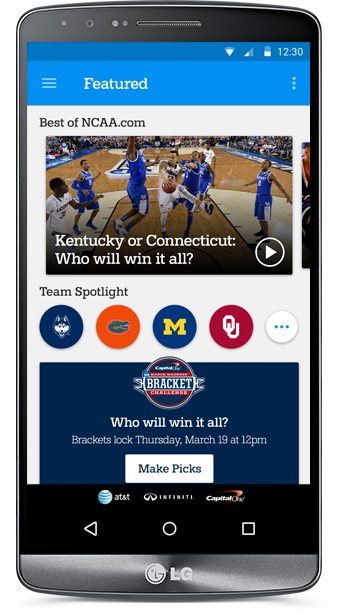
Android smartphone look at new app

Android smartphone look at new app

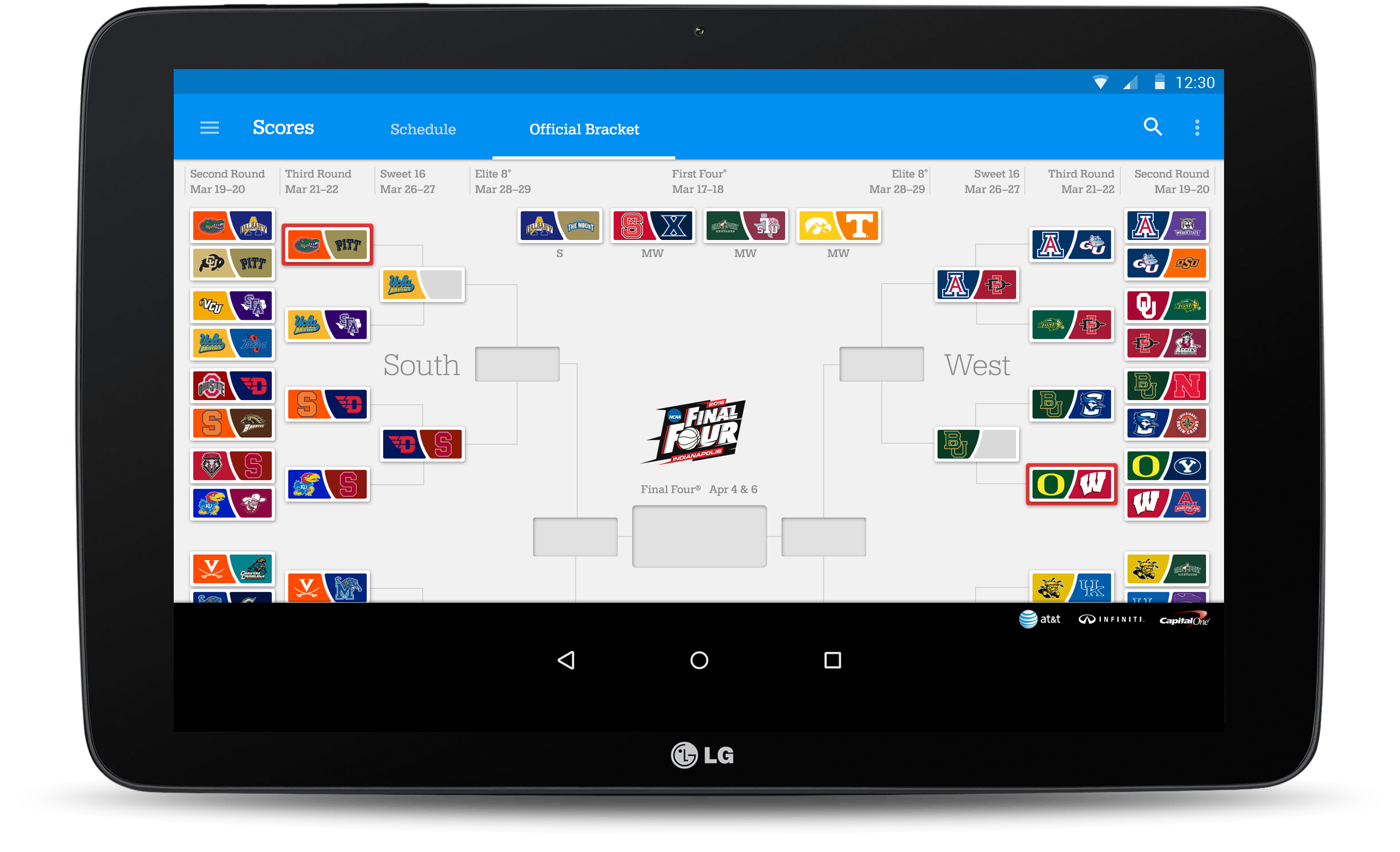
Android tablet bracket view

Android tablet bracket view