Wi-Fi Whispers: Is Time-Warner Cable Deal With WeFi About Mobile Sports Content?

The news that came out last week continued an interesting question: why would a cable company want to expand its free Wi-Fi services? Could it be that a big cableco sees free Wi-Fi as a way to keep its current cable customers — by making sure they can watch sports content wherever and whenever they want?

Nobody knows for sure yet, but in all the numerous news reports of the recent deal between cable giant Time-Warner Cable and Wi-Fi aggregator startup WeFi, there were a lot of details on the what but hardly any on the why.

Like other cablecos, TWC has been moving forward aggressively with a Wi-Fi hotspot deployment. By tapping WeFi’s capability to help people find free hotspots, TWC is buying rather than building, taking advantage of the idea that private networks may get built out farther and faster than even the biggest service providers could manage. But the question still lingers — why?

GigaOM’s Kevin Fitchard in the story linked above touches a bit on an idea — he quotes a WeFi exec’s idea that “cable providers want to encourage their customers to access their broadband connections and video programming outside of the home, making those services that much stickier.” But I don’t think it’s just about the sticky. I think it’s about maximizing the access to the content that is king over all other types, namely live sports content.

Sports remains the far and away No. 1 reason people watch TVs — just go find a list of the top viewed programs ever. Or check out stats from this summer’s Olympics. And a lot of that viewing is going to move to mobile screens, like tablets. So why is TWC putting Wi-Fi hotspots on the beaches of Southern California? Surprise, surprise, TWC last year paid $3 billion to snag the rights to L.A. Lakers basketball games. So now Lakers fans who are TWC subscribers can watch the games while they’re on the sand. But most importantly to TWC — they won’t cancel their cable subscriptions, meaning that TWC doesn’t have to shell out the $500 or so that is the estimated cost of finding a new subscriber.

Since it’s LA those subscribers may also be watching things like Dancing With the Stars or American Idol, but don’t kid yourself — you don’t see anyone ponying up billions in just rights fees for reality shows. And people don’t cancel cable subscriptions or buy pricey ones just to watch those shows. They do for sports, and I’m betting that cable’s big move to provide free Wi-Fi is all about making sure sports fans can watch the content they’ve already paid for — instead of, say, paying Verizon $5 extra a month to watch NFL games on your phone.

Here’s the news coverage of the TWC/WeFi deal:

Jeff Baumgartner at Light Reading
Todd Spangler at Multichannel News
Kevin Fitchard at GigaOM

And the LA Times story about sports rights, also a good read: Joe Flint and Meg James, LA Times (HT to Spangler’s Twitter feed for the link)

Wednesday Wi-Fi Whispers: Lots of Networking at F1 Race in Austin

If you are a fan of F1 racing you might be headed down to Austin, Texas this weekend for the Austin Grand Prix at the new Circuit of The Americas course. From what we can deduce, it should be a good place to connect with your mobile device, since we have seen two press releases over the past weeks talking about wireless deployments at the track. But will there be free fan Wi-Fi? Probably, but we’re not sure yet.

We’re not sure because the main press release — from our friends at AT&T — talks mainly about how Ma Bell wired this place for high capacity data transfers, which we are guessing means lots of fiber for set video camera positions and the whole boatload of car-performance stats that regularly fly around the ether at any big-time motorsports event. From the sounds of it the new AT&T network should support fan Wi-Fi — but unfortunately neither AT&T nor the course/race website makes any mention of whether or not there will be free Wi-Fi for fans.

In case you’re wondering, we think such information omissions are a big mistake. But we are checking with AT&T and the race folks to see what’s up.

In the meantime, if you are a Verizon customer your cell phone should also work better at the track, thanks to an independent Distributed Antenna System (DAS) infrastructure put in place by our friends at ExteNet, a company that has built similar deployments at other sporting stadiums, like the new Barclays Center in Brooklyn. According to ExteNet its DAS will improve cellular reception around the track, mainly for Verizon customers this year since Verizon is the only cellular provider using the ExteNet solution right now. Since ExteNet builds independent networks — which means any provider can sign up and pay ExteNet to carry signals from their customers — other providers like Sprint or T-Mobile may join up for future events. Our guess is that AT&T won’t have to. The cool thing is, fans should be able to share photos and videos of the F1 racers as quickly as possible. And that is a good thing.

Mobile Sports Report TechWatch: Apple Patent News

Google Ventures, the investment arm of Google has received an additional $100 million in funds to invest in startups. The group had been budgeted to invest $200 million in past years but that number has been bumped up to $300 million according to Tom’s Hardware.

Apple loses latest round in patent fight with Google/Motorola
Apple has lost an important ruling last week when a Federal Judge threw out its lawsuit against Motorola Mobility over patent licensing practices. The suit claimed that using 2.25% of the selling price of the item was too high, but the judge dismissed it without comment.

However, according to Wired, the Federal Trade Commission has recommended that the U.S. Justice Department pursue an antitrust investigation into Motorola Mobility in order to determine if it reasonably offered licensing of its industry-standard technology or used that licensing to block rival hardware from competitors Apple and Microsoft.

Speaking of Microsoft and Motorola
The two have also been fighting over the 2.25% per device issue and Microsoft wants to look at the FRAND pricing based on previous pricing. According to Microsoft it should pay somewhere in the vicinity of around $1.2 million a year for rights to use the patents that are in dispute, while of course Motorola thinks that its number, which would result in a significantly higher return, is just fine.

A look at Huawei’s MediaPad 10 FHD tablet
Huawei, as has already been reported, is entering the 10-inch Android driven tablet space with its MediaPad 10 FHD offering. The tablet features a display with 1920 x 1200 resolution, a Huawei-built quad core 1.4GHz Cortex-A9 processor and will be available in 8GB, 16GB and 32GB versions. For more details head over to Slash Gear.

Apple and HTC bury the patent hatchet
In one of the rare the resolutions in the patent wars that looks like it will be final, Apple and rival smartphone maker HTC have settled all of their outstanding patent disputes globally. The resolution includes a ten year cross patent licensing agreement. Any other terms of the arraignment were not disclosed. They originally tussled in court on the patent issue in 2010 when Apple filed a patent infringement case against HTC with the U.S. Federal Trade Commission.

iPad Mini component costs pegged at $188
Ever wonder how much it costs to make something? Well lucky for you, and the rest of us, a number of companies take the time to break down devices and analyze them, and the latest results are from IHS iSuppli Teardown Analysis Services.

It found that the iPad Mini, which starts at retail at $329 costs $188 for the bill of materials and an additional $10 to actually build for a model that features just Wi-Fi and 16GB of storage. The single most expensive component is the tablet’s 7.1-inch display at $80.

Apple to drop Intel chips?
Stop me if you have heard this one before but the rumor that is again making the rounds is that Apple will jettison the Intel processors that it now uses in its Macintosh computers in favor of its own developed chips that it currently uses in its iPads. However the reports, apparently started by Bloomberg but picked up elsewhere, are very hazy as to when such a change might occur.

Giants Fans at AT&T Park Sent Lots of Texts During World Series, But Also Watched the Game

Our friends over at AT&T sent us some interesting wireless network stats from last week’s first two games of this year’s World Series, which were played in the San Francisco Giants’ well-wired home, AT&T Park. With the stadium’s state-of-the-art wireless infrastructure, it’s perhaps no surprise that fans consumed multiple gigabits of data, both sending and receiving.

We’ll include all the raw stats below — including some fun ones like the 53,000 SMS text messsages sent in the 6 p.m. hour of Game 1, the time span during which eventual Series MVP Pablo Sandoval hit his second and third home runs of the game — but what jumped out at us was the fact that voice calls peaked before the games started and data traffic peaked within the first hour. To us, that meant what happened was what we’ve believed all along: That fans do like to send a picture or a photo of themselves at big games, or call friends who aren’t there, but then once the games start they’re watching what’s happening on the field.

So even in Tweet-happy and iPhone-crazy San Francisco, the great fears of fans only looking at their phones and forgetting to cheer isn’t something that’s going to happen anytime soon. If nothing else, the players on the Detroit Tigers and St. Louis Cardinals can tell you that fans at AT&T Park were certainly paying attention and directing all their attention to the field, quite loudly at times. It might be some time before others believe cell phones and sporting events can co-exist, but we’re here to tell you it’s already happening now.

(Stats and figures below courtesy of AT&T, describing the stats their network folks compiled based on fans’ usage of our network during Games 1 and 2 of the World Series at AT&T Park in San Francisco.)

2012 World Series – games 1 & 2

· Fans still love the long ball – More than 15 percent more data was uploaded and nearly 20,000 more texts were shared on our network inside the park (between the hours of 4-9pm PST) during game one than game two of the 2012 World Series at AT&T Park.

· A text speaks 1,000 words – AT&T mobile users sent and received more than 350,000 texts across our network during the first two games of the World Series (between the hours of 4-9pm PST).

· Hush up, the game’s about to start – For both of the first two games of the 2012 World Series at AT&T Park (between the hours of 4-9pm PST) the most calls made on AT&T’s Network occurred during the hour directly preceding the game’s first pitch (4-5 pm PST).

· Fastest fingers – The hourly data upload and hourly total data peaks occurred in the first hour (5-6 pm PST) of both game one and two (between the hours of 4-9pm PST). Data uploaded as well as total data volumes decreased during each hour the game went on (between the hours of 4-9pm PST).

Additional Data

Game 1

· The hourly data upload peak of 16.2 GB (between the hours of 4-9pm PST) occurred in the hour in which Pablo Sandoval hit his first home run

· The peak point in hourly total data consumption (between the hours of 4-9pm PST) happened in the first hour of the game with a total volume of 35.3 GB passing through AT&T’s Network.

· AT&T subscribers downloaded the most data – 18.3 GB – during the 6 pm hour (between the hours of 4-9pm PST)

· AT&T mobile users sent and received the most texts (between the hours of 4-9pm PST) during the 6pm hour, the hour in which Pablo Sandoval hit his second and then his historic third home run, with more than 53,000 SMS texts sent and delivered across AT&T’s Network. That’s more than one text for every fan in the stadium. (Total attendance – 42,855)

· For the opening game of the 2012 World Series at AT&T Park (between the hours of 4-9pm PST) the most calls made on AT&T’s Network occurred during the hour directly preceding the game’s first pitch.

Game 2

· The hourly data upload peak of 13.8 GB (between the hours of 4-9pm PST) occurred in the hour in which the first pitch was thrown

· The peak point in hourly total data consumption (between the hours of 4-9pm PST) happened in the first hour of the game with a total volume of 33.1 GB passing through AT&T’s Network.

· AT&T subscribers downloaded the most data – 20.6 GB – during the 6 pm hour (between the hours of 4-9pm PST)

· AT&T mobile users sent and received the most texts (between the hours of 4-9pm PST) during the 7pm hour with more than 42,000 SMS texts sent and delivered across AT&T’s Network. That’s nearly one text for every fan in the stadium. (Total attendance – 42,982)

· For the second game of the 2012 World Series at AT&T Park (between the hours of 4-9pm PST) the most calls made on AT&T’s Network occurred during the hour directly preceding the game’s first pitch.

Microsoft Moves Windows 8 into Smartphone Territory

Microsoft continued its move into a more digital, mobile software provider today with the debut of its Windows Phone 8 smartphone operating systems, offering a very much revamped OS along with a number of its partners’ latest offerings.

Microsoft is looking to leverage changes it has made in its operating system , with its Windows 8 OS introduced just last week, and will now be providing a similar look and feel with the same technology core used in both platforms.

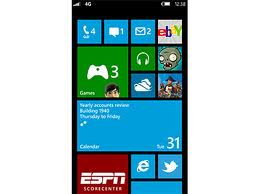
The look and feel of the OS appears to be very different from what is offered from its rivals- no static icons but rather what Microsoft is calling Live Tiles, a technology that has the apps that you use in a tile format.

The nice thing about Live Tiles is that a user can customize the startup page and place the apps and functions that they want right there, rather than being stuck with a large number of predetermined apps.

A key attribute of many of the apps is that they are live, that when you look at the phone or start it up an app such as Facebook will be up to date, even if it is still in lock screen mode.. They are also sizable with three formats and you are provided with 20 options for colors.

Microsoft has also been working on developing a much healthier app ecosystem, an area that it has received criticism in the past. Its Windows Phone Store now has 120,000 apps including most of the top rated. In the future it will have Pandora, the leading Internet radio service, in early 2013 with one year of ad-free music.

There is a feature called Data Sense that helps prevent you from going over your data plan by automating and in some cases delaying tasks. It can compress images, or defer tasks until free Wi-Fi is available. It can monitor how much data apps use and inform you when you are nearing the limit. This is used in conjunction with carriers and Verizon is expected to be the first to support it.

One clever piece of software is it’s “Kid’s Corner” an app that enables children to play games on the phone without deleting information, ordering apps or calling Peru.

Along with the Windows Phone 8 OS, Microsoft had a trio of partners delivering new phones. There will be several options available from Nokia, Samsung and HTC, that will go on sale in November at AT&T, T-Mobile and Verizon in the U.S., as well as at carriers and retailers around the world.

The move comes just hours after Google announced an update to Android, now at 4.2, along with a new Nexus phone and a revamped Nexus 7 and a new Nexus 1 tablet. Apple had a new iPhone out a few weeks back and a new iPad Mini last week.

I think that, depending on real world performance when the phones are available, Microsoft has a strong story simply because all of its products- PC OS, tablet OS and smartphone OS are compatible with each other and using Microsoft’s SkyDrive cloud service a user can start projects on one device and finish them seamlessly on another- a compelling usage model IMHO.

Google Expands Hardware Offerings with Latest Trio

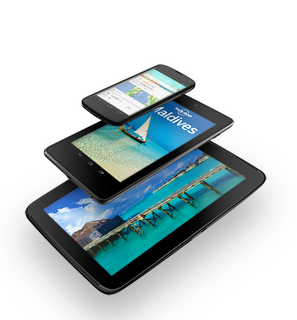
Google did not let the cancellation of its New York event due to Hurricane Sandy get it down and came to market today with a trio of new products including a pair of tablets as well as a new smartphone all running the latest version of Android.

Starting smallest first is the latest in its smartphone lineup, the Nexus 4, built by partner LG. It features a quad core processor, a 4.7-inch 320 ppi screen with wireless charging capabilities. On the software side there are several new or enhanced products starting with the latest version of its Android operating system, Jelly Bean 4.2., support for Gesture Typing and a new photo technology called Photo Sphere.

The 8GB version is available for $299 while the 16GB for $349; available unlocked and without a contract on November 13. The 16GB version will also be available through T-Mobile for $199, with a 2-year contract

It has revamped its existing Nexus 7 to make it slightly thinner and lighter and with expanded communications capabilities with HSPA+ mobile data plans from carriers such as AT&T. The Wi-Fi-only versions will larger storage options: 16GB for $200 for the original version or 32GB for $250. The 32GB HSPA+ version of the tablet will cost $300.

The company has also broken into the 10-inch tablet space with the debut of the here’s also the Nexus 10, built in partnership with Samsung. With a high end display with a 2560 x 1600 resolution display and a battery than can support nine hours of video playback. It has a range of interesting features including support for multiple users with their own profiles and apps. The Nexus 10 will be also be available on November 13 in two storage capacities- the 16GB for $399 and the 32GB for $499.

The move comes days after Microsoft entered the 10-inch tablet space with the first of its Surface tablets. A host of third party Windows 8 tablets are expected in the next few weeks and months. Apple has also just expanded its iPad franchise with the release of the iPad mini last week. It was just a few weeks ago that Amazon expanded its Kindle lineup.

One thing is for certain-consumers looking for a tablet this holiday season will have a much broader, much better built lineup of products from a much bigger range of developers.