AT&T running ads about DAS in stadiums… MSR approves

Sure this is an AT&T ad. But an ad about putting in DAS at a stadium? Who would run a copy of this except us? Enjoy all you antenna geeks out there. And… there’s gotta be work for the fan, maybe conduit work? C’mon DAS dudes, let me in on the fun!

You had me at “Do you know how to optimize a 9-beam multi-beam antenna system?”

AT&T, Aruba behind new Wi-Fi network at American Airlines Center in Dallas

We’d heard this project was underway but now it’s official: AT&T and Aruba Networks are the forces behind a new Wi-Fi network at the American Airlines Center in Dallas, a 21,000-seat facility that is home to the Dallas Mavericks of the NBA and the Dallas Stars of the NHL.

According to an AT&T press release put out today the new Wi-Fi network will have 315 access points, bringing more connectivity to the AT&T DAS that has already been in place at the arena since 2012. For AT&T customers the network should be fairly simple since the company is supporting automatic authentication, which means no logins or setup screens. Fans who have phones from competing providers will also be able to use the network for free, after visiting a login page.

We haven’t yet been able to talk to AT&T folks or the IT department at the arena, but look for a Stadium Tech Report in the near future. We do know from reporting on our upcoming quarterly long-form Stadium Tech Report that the people running the arena weren’t making any small plans, so it will be interesting to hear about the breadth and depth of the deployment. From a business perspective it’s a big win for Aruba, especially since pairing with AT&T could lead to more stadium deals down the road.

It’s also always interesting to hear about AT&T getting behind a Wi-Fi deployment, since the company can often seem of two minds about Wi-Fi in stadiums. From the sounds of it, this is one of those “big name” deals where AT&T likes to get involved from the bottom up — and since it’s in AT&T’s home turf it makes sense that AT&T would want a big part in any wireless deployment close to its corporate offices. Here’s a quote from the press release:

“Providing Wi-Fi at premier venues like American Airlines Center is part of our strategy to mobilize everything for our customers,” said Aaron Coleman, AVP, AT&T Wi-Fi Solutions, in the AT&T press release. “By working with stadium venues to strategically design and deploy an in-stadium network we can satisfy the connectivity demands of the business and enhance the way teams and venues engage with their fans.”

As we said, we hope to have more details soon so stay tuned.

Could pCell score a big win in stadium wireless?

pCell antenna from Artemis Networking

pCell antenna from Artemis Networking

With a pretty impressive scheduled media blitz a new company called Artemis Networks hit the scene today with a technology that if it works as advertised, could bring a welcome revolution to stadium wireless networking.

Fronted by entrepreneur Steve Perlman, perhaps best know for his development of things like QuickTime and WebTV, Artemis claims to have solved one of the most vexing problems for large public-venue wireless, namely the congestion caused by a lot of cellular devices in a small geographic place. Though no details are yet available to explain exactly how it works, the company says its pCell wireless technology turns conventional cellular infrastructure on its head, using cell interference to amplify signals to each device.

We are reaching out to the company and to other cellular industry types right now to get reactions to the announcement. In the meantime, if this plan really works it could potentially make stadium and other large-venue wireless networks a lot easier and cheaper to deploy. Some good details can be found in this EE Times report.

Here is the company’s simple explanation of what its technology does:

“pWave radios transmit signals that deliberately interfere with each other, combining to synthesize tiny pCells, each just one cm in size. Every mobile device has its own pCell, a “Personal Cell,” each getting the full spectrum capacity.”

A little bit farther down its explanation page, the company adds more details, apparently pegging its strategy of mesh deployment of antennas as a cloud-based radio access network, or C-RAN.

“pCell is a pure software-defined radio C-RAN. Linux-based servers scale linearly with capacity. Fronthaul is conventional IP. pWaves self-synchronize. Seamless handoff to cell networks if desired.”

And just to tease more, the company also hints that it could set up its own networks, instead of just making cellular work better. Again, we will need more technical details about how pCell works to figure out its exact impact, but this statement is also interesting:

“Concurrently with LTE devices, pCell supports “pCell-native” devices, at far lower cost and power, each with its own pCell in the same spectrum. pCell-native devices can be faster than LTE with fiber-class latency. For example, an iPod-class device could be made pCell-native with minimal additional cost at the same size and power, and would provide better than LTE mobile performance in pCell coverage areas. This opens the door for low-cost pCell-native smartphones, wearables, UltraHD TVs, laptops, appliances, etc.: a broadband Internet of (inexpensive) Things.”

Our guess is that the reality of this design will mean some kind of client software or chip necessary to allow devices to connect to the pCell network; anyone with any details on the device or network, please chime in!

NFL Mobile users watched 10.3 million video streams during Super Bowl week

Remember the Football on your phone video from last August? Pretty funny, right? Imagine, people wanting to watch football on their phones, no matter where they go. Well last week a whole bunch of them did just that. According to the NFL, more than 10 million video streams were watched on the Verizon NFL Mobile platform during Super Bowl week, a jump of more than 400 percent from the year before.

Football on your phone? You bet!

For some reason we can’t get the league’s media arm or Verizon Wireless to provide the one stat we really want — how many people watched live Super Bowl action on a smartphone? Verizon at least is consistent — they have never provided any kind of statistic on NFL Mobile usage. Today the NFL Media folks issued a press release with all kinds of “record” numbers (we will post the whole thing below if you want to dig through it), but no discrete number for the game itself. We’ll get to the reason for that in a bit. But for the overall stats, we can sum up the numbers quickly: If there was football programming available last week, a lot of people watched it. And if it was available online or to mobile devices, so much the better.

What really drove traffic across all NFL Media properties this year was the NFL Mobile package. Remember, this year the “NFL Mobile from Verizon” app was actually available for smartphones from any carrier; the catch was, you could only get live game action if you were a Verizon subscriber and paid $5 more a month. Everyone else, including Verizon customers, could see highlights and NFL Network video content, like features and reports from Super Bowl week. The opening up of the app is probably the biggest reason why unique users of NFL Mobile properties during Super Bowl week increased 88 percent this year versus last, 11.2 million users compared to 6.0 million, according to NFL statistics.

Here’s where the stats get interesting: While it’s impressive that video streams across all NFL Media properties during Super Bowl week increased 56 percent this year compared to last, 34.0 million to 21.8 million, what’s really mind-boggling is that 10.3 million of those streams this year were consumed via the NFL Mobile app, a 416 percent increase over last year.

To repeat: Almost ONE-THIRD OF ALL NFL MEDIA VIDEO STREAMS were watched last week… on a phone.

One possible reason why neither the league nor Verizon wants to release actual game-day live action viewing numbers for NFL Mobile is that they may not be that impressive. Remember, only Verizon customers who ponied up the $5 extra “premium” fee could have watched the Fox simulcast on their phones, so it’s a smaller subset to begin with. And really, for the big game itself, most likely you were on a couch watching a big screen. (We here at MSR HQ did find the NFL Mobile live feed effective for when we had to roam into the kitchen for more snacks, or for other “breaks” necessary during the game. But we didn’t watch more than a few minutes of the game on the phone.) Plus, the Fox stream was available to tablets using its app or for PCs or laptops watching online, so that probably took away some potential phone-watchers of live game action.

During non-game times, however, smartphones appear to be leading the mobile video explosion. Even though tablets seem to make more sense for watching sports while mobile, it’s pretty clear that people are watching a lot of NFL video on the thing that never leaves their pocket or purse — their phone. Are other sports taking note? And now do you know why the NFL is pushing toward NFL Now? Stay tuned. And keep your phone and checkbook handy.

(full press release content below)

COVERAGE OF SUPER BOWL XLVIII SETS VIEWERSHIP & TRAFFIC RECORDS ACROSS NFL MEDIA

Wall-to-wall coverage of Super Bowl XLVIII produces double-digit spikes for NFL Network, NFL.com, and NFL Mobile

NFL Media’s 11th year covering the Super Bowl produced record-breaking results across all platforms.

NFL NETWORK

Providing expert analysis, the latest news and reports, special guest appearances, and matchup-related programming leading up to Super Bowl XLVIII, NFL Network served up 140 total hours – including a record 86 live hours – of programming from 12 sets in eight locations across New York City and New Jersey, utilizing a roster of 40 on-air personalities with a combined 17 Super Bowl rings.

For Super Bowl week*, NFL Network averaged 175,000 viewers in Total Day and 226,000 viewers in Primetime – up +20% and +31%, respectively, compared to last year making this the most-watched Super Bowl week ever on NFL Network.

With more than 41 hours of Super Bowl coverage, SUPER BOWL LIVE averaged 141,000 viewers and up +60% over last year’s average audience (88,000 viewers).

On Super Bowl Sunday, NFL GAMEDAY MORNING averaged 657,000 viewers – up +10% over last year’s telecast (596,000 viewers), making this the most-watched NFL GAMEDAY MORNING ever.

NFL Network’s postgame audience peaked from 10:30PM-11:00PM with an average of 1.14 million viewers, up + 25% over last year’s highest postgame peak (906,000 viewers)

NFL Network averaged 313,000 viewers in Primetime on Super Bowl Sunday – up +52% compared to last year’s performance.

For the entire 2013 postseason, NFL Network averaged 148,000 viewers in Total Day – up +13% compared to last year’s performance (131,000 viewers) making this the most-watched postseason ever on NFL Network.

NFL DIGITAL MEDIA

Across all internet-connected devices, including PC’s, tablets, and smartphones, the official digital properties of the National Football League delivered original video programming, the latest news and information, as well as unprecedented access to players, celebrities and musicians. NFL Digital Media’s offerings included NFL Mobile from Verizon which provided fans access to live, streaming video of Super Bowl XLVIII and NFL Network, including exclusive Super Bowl content and commercials.

For Super Bowl week, visits to NFL Digital Media properties increased 24% versus last year, bolstered by a 149% increase in visits to NFL Mobile.

Unique users of NFL Digital Media properties rose 22% during the week versus last year (27.8M vs. 22.8M), driven by 88% growth in NFL Mobile Properties (11.2M vs. 6.0M).

Unique users and visits to NFL Digital Media properties were driven by an array of content around Super Bowl XLVII. The two highest performing long-form NFL Digital Media features were:

Ø Judy Battista’s piece on Super Bowl XLVIII’s impact on Peyton Manning’s legacy

Ø Mike Silver’s story on the Seahawks dominant defense being fueled by the tight bond amongst the ‘Legion of Boom’

Video Streams during Super Bowl week across all NFL Digital Media properties increased 56% versus last year (34.0M vs. 21.8M).

Video consumption to NFL Mobile from Verizon reached 10.3M streams for a 416% increase over last year’s Super Bowl Week.

The highest performing video of the week featured NFL Network analysts making predictions for Super Bowl XLVIII. The video was viewed more than 800k times.

Seen in 195 countries, NFL Game Pass consumption grew 49% year-over-year across all devices and 57% on desktop.

*Super Bowl Week is defined as January 27-February 2, 2014

— end press release —

And yes, we know the Football On Your Phone video was a promo for DirecTV’s Sunday Ticket, which is neither here nor there when it comes to Verizon NFL Mobile numbers. But the video is funny enough to watch again:

AT&T Super Bowl Sunday stadium wireless traffic jumps 60 percent to 624 GB; Verizon claims 1.9 TB

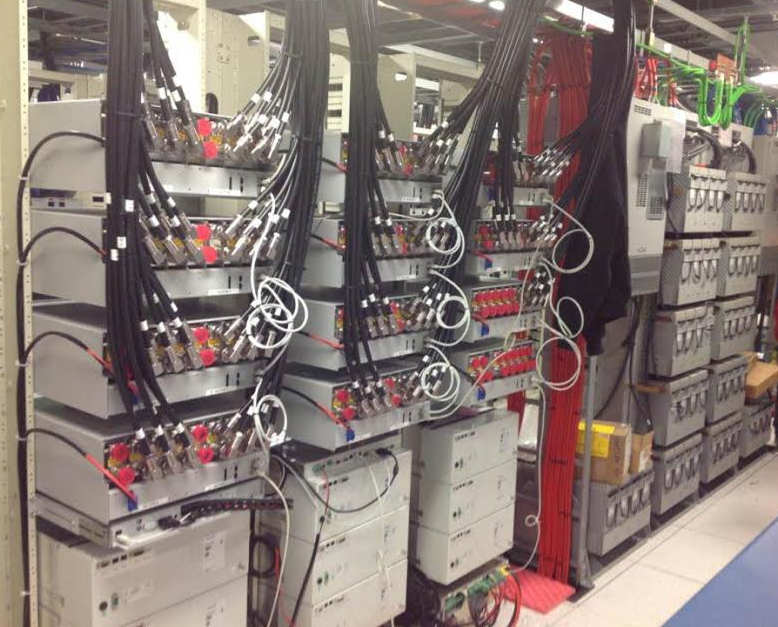
Inside the AT&T head-end building at MetLife. Cables! Credit: AT&T

Inside the AT&T head-end building at MetLife. Cables! Credit: AT&T

Well, our prediction that this year’s Super Bowl might not set new wireless data records was about as solid as the Denver Broncos’ performance in the big game. According to AT&T, its wireless network in and around MetLife Stadium on Super Sunday saw 624 GB of traffic, a 60.8 percent increase from last year’s 388 GB total at the Superdome in New Orleans.

Part of the gain no doubt came from the fact that MetLife Stadium holds approximately 10,000 more fans during a football game than the Superdome, 82,566 to 72,003. But AT&T’s numerical evidence — including a new peak-time high of 119 GB during the hour before kickoff — shows that the desire to access mobile devices inside stadiums is still growing, especially at big games like the Super Bowl.

Verizon Wireless, which like AT&T spent more than a year getting MetLife’s network ready for Sunday’s game, also said it had experienced record traffic on its networks, claiming a total of 1.9 TB of cellular traffic inside MetLife Stadium. During the game Verizon Twitter accounts said new traffic records were set before halftime; however we still have no figures from Verizon for previous years’ data for comparison.

Verizon also claimed its peak hour usage was “800 percent” greater than last year’s, but again, we don’t have exact numbers so can’t confirm the accuracy of such claims. Still unkown is how much traffic was carried by the stadium Wi-Fi network which Verizon manages (and was free to all MetLife fans), since Verizon did not provide Wi-Fi traffic numbers. Our guess is it saw similar traffic leaps as AT&T’s and Verizon’s cellular nets.

Another interesting note from the AT&T data is a trend toward more mobile data use, and fewer voice calls. Fans at the game Sunday made 55,000 voice calls on AT&T networks, down from 73,000 calls in 2012. Some of that might have to do with the fact that last year’s game had a lengthy power outage, which no doubt prompted many “I’m OK” calls to loved ones. But still — a 20,000 call dropoff in the face of more than doubling data traffic seems to show that people are using their phones more, even if they are talking less.

How to watch the Super Bowl online, or on your phone

Just in case your TV goes on the blink this weekend, don’t worry, you can still watch Sunday’s Super Bowl XLVIII between the Denver Broncos and the Seattle Seahawks — either via an online stream, or via your smartphone if you are a Verizon customer.

SUPER BOWL XLVIII KICKOFF: 6:30 p.m. ET

TV: FOX

WATCH THE SUPER BOWL LIVE ONLINE HERE

Fox, which is showing the game on regular TV, will also make the broadcast available online via its Fox Sports Go app and website. Usually, you need a pay TV subscription to see the Fox feed, but it will be free to all viewers on Super Bowl Sunday. The same feed will also be available at NFL.com and at SuperBowl.com, just in case you need an alterate website address. If you want to watch on an iPad, you will want the Fox Sports Go app.

Smartphone viewing via Verizon NFL Mobile

Remember, you can’t watch the game on a smartphone via the Fox app. That’s because Verizon Wireless has the rights to live action on smartphones, via its NFL Mobile app. To view the game live, you must A) be a Verizon customer, B) have the NFL Mobile app installed, and C) have paid the $5 per month premium NFL Mobile fee.

HERE IS THE VERIZON NFL MOBILE INFO PAGE

Remember, both the Fox website feed and the NFL Mobile app feed will be significantly behind the live TV broadcast, anywhere from 20 seconds to more than a minute. And, no, you won’t be able to watch the live feed if you are at the game.