MSR Profile: San Francisco Giants, AT&T Continue to Push the Wireless Envelope at AT&T Park

It’s fun to look back at the news from 2004 to see just how novel an idea it was to put a Wi-Fi network into a ballpark. “SBC Park a hot spot for fans lugging laptops,” said an article in the San Francisco Chronicle, complete with a photo of a fan hunched over a laptop. According to the story, some 200 fans per game might have used the network right after it was launched. Woo-hoo!

Fast forward to 2012, and here are some eye-popping stats from a recent Giants homestand against the Cubs: According to the Giants and AT&T, at one game there were 10,000 fans using the stadium’s Wi-Fi network, and another 10,000 connecting via the various cellular antennas — all using a data app, not even counting phone calls. Still think this is just something for power geeks trying to program in between innings? Or has the wireless fan finally become mainstream?

As impressive as those totals are, what’s a more compelling story is the fact that the Giants and AT&T were ready for that bandwidth demand, with a layered cellular and Wi-Fi network that overdelivers, instead of dropping connections. Why did they put the network in, and how did they make it a success — and a role model for stadiums and teams everywhere? To get the answer to those questions, Mobile Sports Report recently spent a couple hours at the ballpark with Bill Schlough, senior vice president and chief information officer for the San Francisco Giants Baseball Club, and Terry Stenzel, vice president and general manager for Northern California and Reno for AT&T, to hear about lessons learned and where wireless and sports are headed in the future.

The Super-Connected Fans of San Francisco and Silicon Valley

Back when AT&T was still known as SBC, the ballpark with its name seemed as likely a place as any to put in a wireless network. Though it wasn’t even the first in the Bay area — Candlestick Park, former home of the Giants and still host to the football 49ers, had some limited wireless access back in 2000 thanks to then-stadium-naming sponsor 3Com — the network that went live at the China Basin ballpark in 2004 was well received by the wired constituents of the greater SF Bay area. After all, this was Silicon Valley — where folks didn’t mind going to Best Buy to get a wireless LAN card to put in a PCMCIA slot.
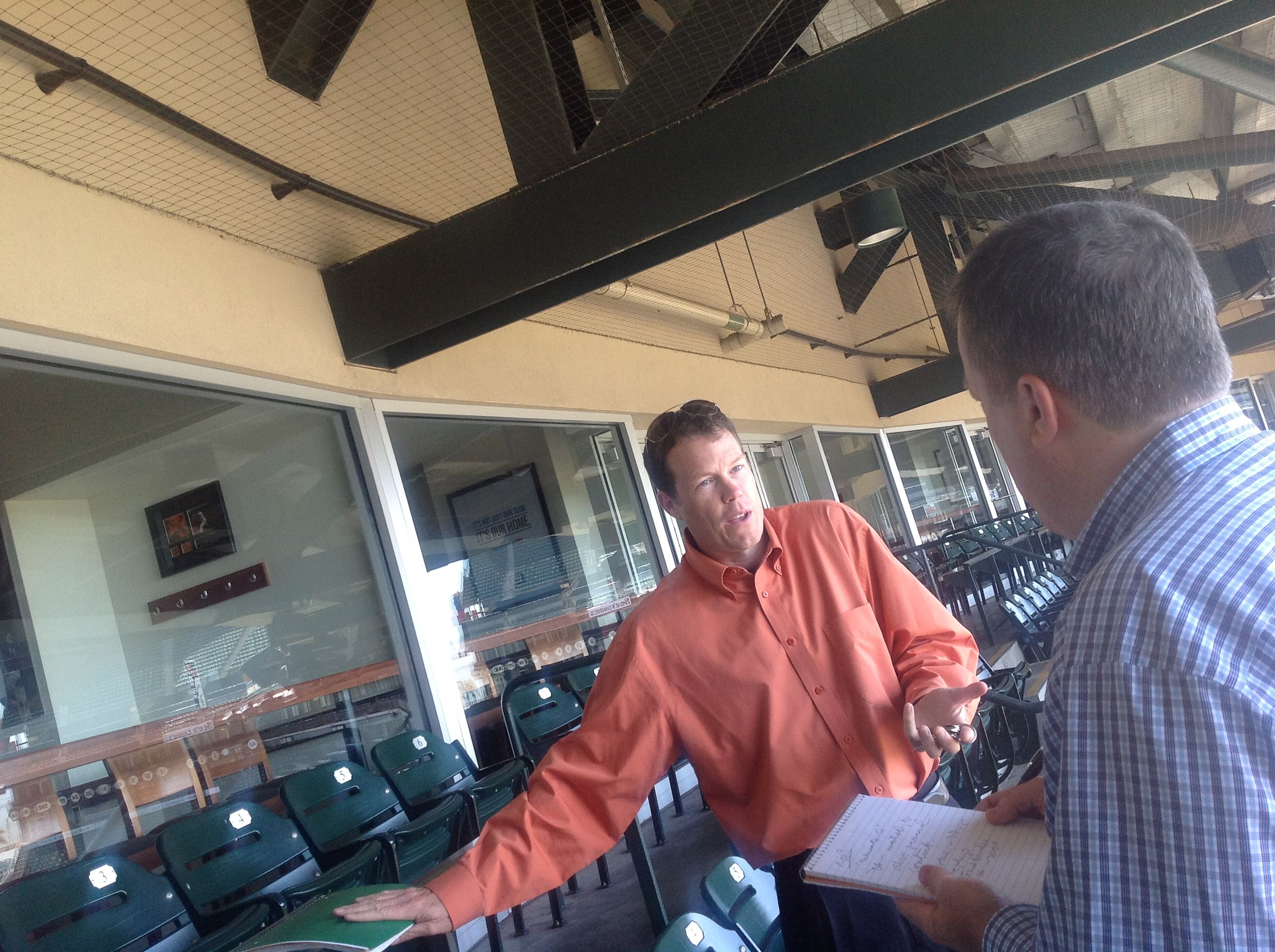
The Giants' Bill Schlough, in orange shirt, talks about stadium Wi-Fi. Credit: John Britton, AT&T.

For the Giants and Schlough, every year afterward it became apparent that the initial outlay of 121 Wi-Fi access points wasn’t going to be enough. The 50 bearded guys with laptops from the Valley became a few hundred a night, then pushed into the thousands. By 2010, the network-use number was up to 3,300 per game, with no end in sight to its growth.

“I point to the fans” when asked about where the vision for the network comes from, said Schlough. “In any other city it’d probably be different — anywhere else is probably a couple years behind [in network demand]. Fans here are making it apparent that if they can’t stay connected they’re going to stay home. What we need to do is stay one step ahead.”

Lately, that means staying ahead by blending cellular and Wi-Fi networks, using a “layered” approach that improves not only Wi-Fi coverage inside the stadium, but also reception for 2G, 3G and 4G LTE cell phones. It even means reaching out to rival Verizon Wireless, which is in the process of attaching its own wireless services to the Giants’ stadium network, so that Verizon customers can enjoy improved coverage just like AT&T customers do when in their seats. Even with network loads of 20,000 combined users, the Giants and AT&T right now seem like they’re ahead of the technology curve; but even fairly recently, that wasn’t always the case. Take the start of the 2009 season, when the network became, as AT&T’s Stenzel said, “an absolute disaster.”

A Network Brought to its Knees — by Apps and the iPhone

Perhaps fueled by the twin arrivals in 2008 of the iPhone 3G and the accompanying Apple Appstore, the fan demand for in-stadium bandwidth completely overwhelmed the AT&T Park network at the start of the 2009 season, an epic fail that was quickly noticed by many. The surge in wireless data demand — which also caught AT&T by surprise at that year’s South by Southwest Interactive conference, where iPhones and Twitter brought the network in Austin to a halt — was a harbinger of the future, forcing cellular providers everywhere to scramble to upgrade their networks.
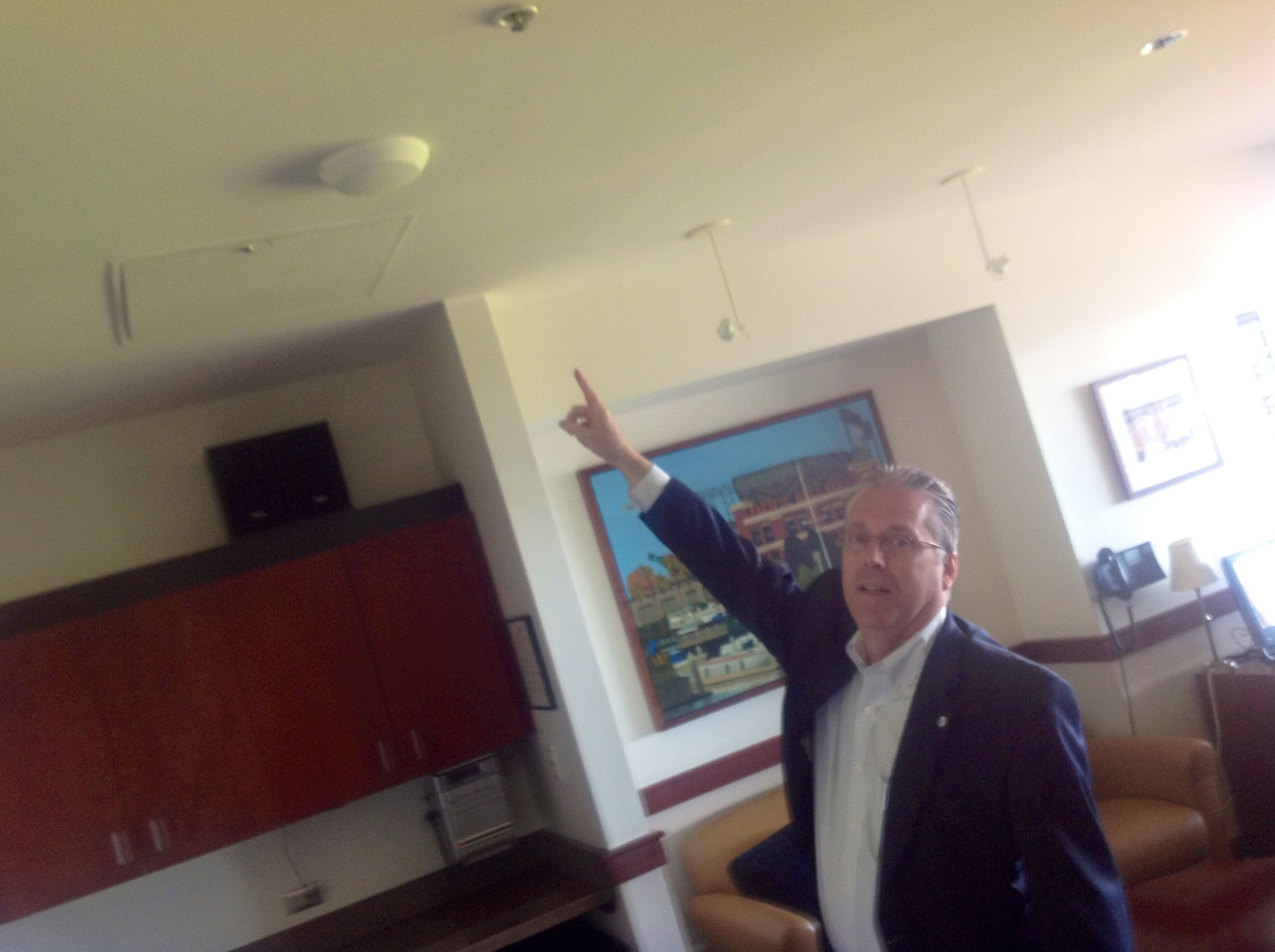
AT&T VP Terry Stenzel points to a Wi-Fi antenna inside a suite at AT&T Park. Credit: John Britton, AT&T.

While Schlough and AT&T responded by doing what they could to fine tune and increase wireless bandwidth, the duo also started installing what is known in the cellular industry as DAS — short for Distributed Antenna System, basically an array of small cellular antennas that improve coverage by bringing the wireless signal closer to the customer. For AT&T Park, that means as close as inside the hallway of the stadium’s suite level, where DAS antennas disguised by small plastic inverted cones keep the well-heeled fans and their inevitable iPhones connected to the outside world.

The DAS antennas help provide what Schlough and Stenzel call their “layered” approach to wireless connectivity, meaning that a blend of Wi-Fi and improved cellular is the best way to achieve the highest level of connectivity. With a layered approach, some fans can use the Wi-Fi network while others use the cellular network — hopefully, using the best signal where it is available.

“The stadium is the perfect example of what’s going on in the outside world,” said AT&T’s Stenzel, whose company of late is investing heavily in both DAS and Wi-Fi for public hotspots in cities, big buildings and campuses to offload some of its cellular-network demand. “You can’t build a network with Wi-Fi only or [4G] LTE only. You need layers of technology.”
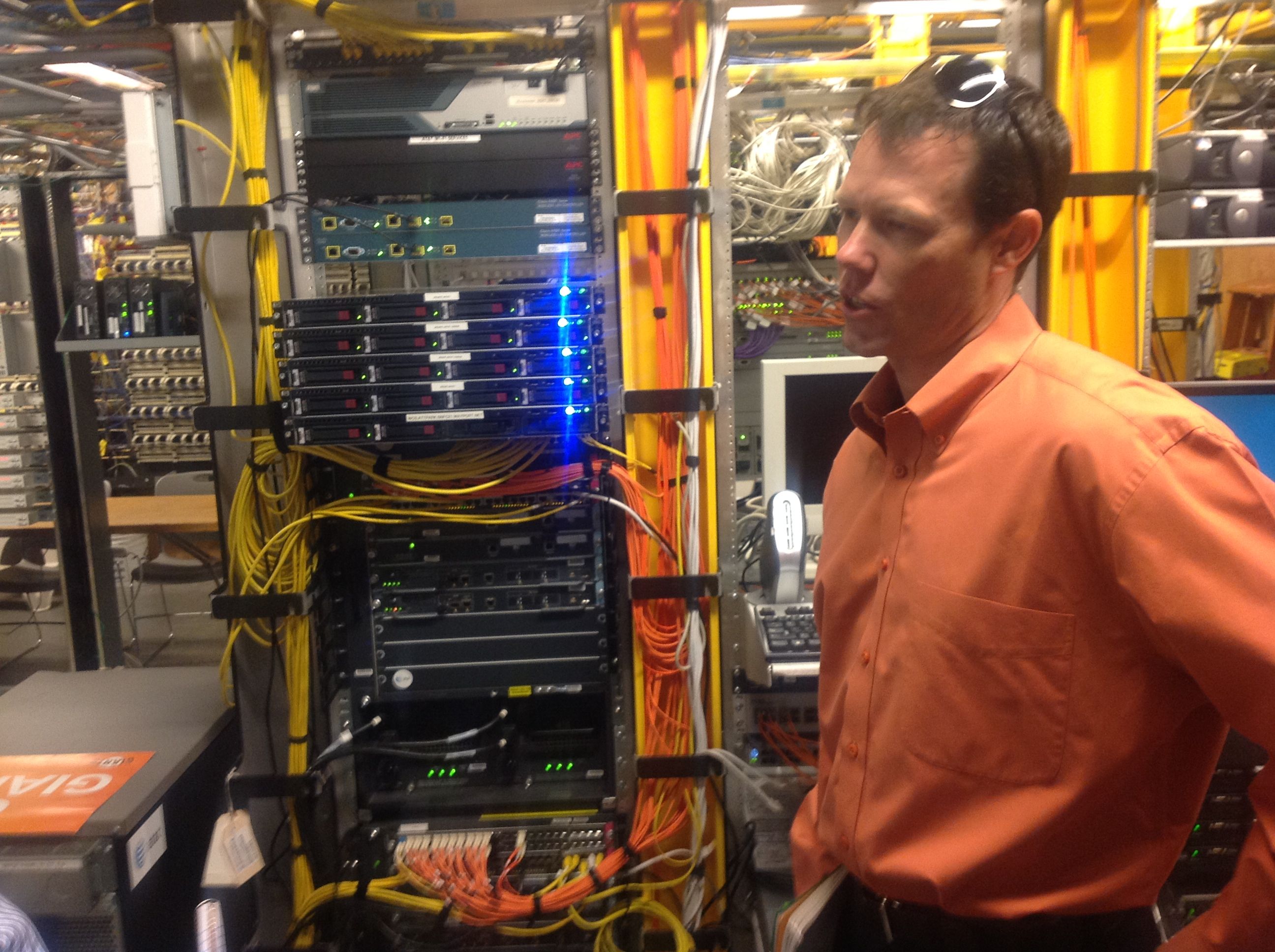
The Giants' Bill Schlough in front of some hard-working wireless network hardware. Credit: John Britton, AT&T.

“Cellular sometimes flows better around obstacles or people,” Schlough said. And he should know, since he said he’s always finding new ways to improve the network.

“Thank god we’re not football,” said Schlough. “This isn’t something that you plug it in and it works. We have 81 games a season here, and every day we’re learning something.”

Trials, Errors, and ‘Leaky Coax’

For Giants fans or even other visitors, Schlough has a wireless quest: “I’d challenge anyone to walk in here and find 100 antennas,” he said. With 334 Wi-Fi access points and 196 additional DAS antennas scattered about that seems like it might be easy. But even certified network geeks probably couldn’t spot the DAS antenna that Schlough said was in plain sight, providing access to the outdoor seats on the suite level.
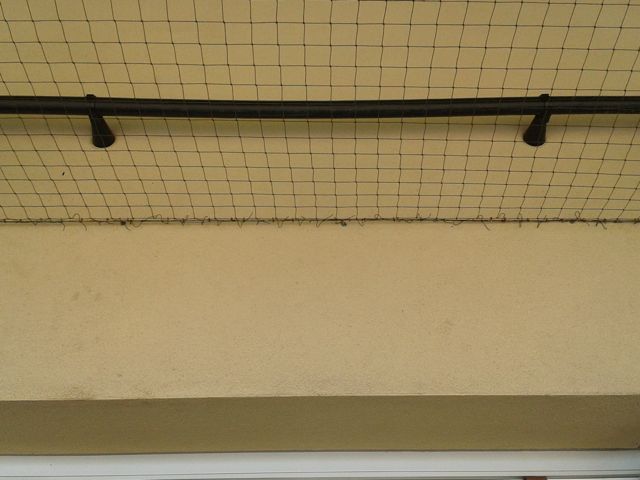
Can you spot the DAS antenna? Look inside the pipe. Credit: Paul Kapustka, MSR.

While your reporter valiantly looked for a telltale wireless box, it was in vain. Schlough finally solved the puzzle by turning us around and pointing at a black-painted conduit pipe just above the seagull net — inside which Schlough said was some leaky coax, or partially unshielded networking cable that allows a signal to pass through parts of its length, in essence acting as a long, thin “antenna.”

“You’ve got to get creative” to solve stadium networking problems, said Schlough, whose team needed to point Wi-Fi antennas upward to serve three rows of upper-deck seats that are located in front of a thick concrete wall. In some parts of the stadium, Wi-Fi antennas are painted dark green to match the stadium metalwork. In the suites, Wi-Fi antennas are tucked into plastic housings that look like smoke detectors, and some DAS antennas are inside small inverted plastic cones — all painted the same color as the ceilings to blend in like wireless chameleons.

“The biggest challenge may be in hiding all the wires” connecting the antennas, Stenzel said. “Nobody wants to see wires hanging down in a stadium.”

One App Will Rule Them All — Unless the Giants get to Tinker

Perhaps the only place where Schlough, the Giants and AT&T have had to take a step backwards — our opinion, not theirs — is on the application side. Until last year, the Giants led in the app innovation arena as well, with a service called “Digital Dugout” which provided lots of AT&T-specific information, like park maps, food ordering, and extended Giants video highlights, among other features. But as part of Major League Baseball the Giants are now in lockstep with the rest of the league and only offer MLB.com’s AtBat app as the in-game app of choice — a strategic move made by the league last year to increase the profitability of its flagship online app and service.
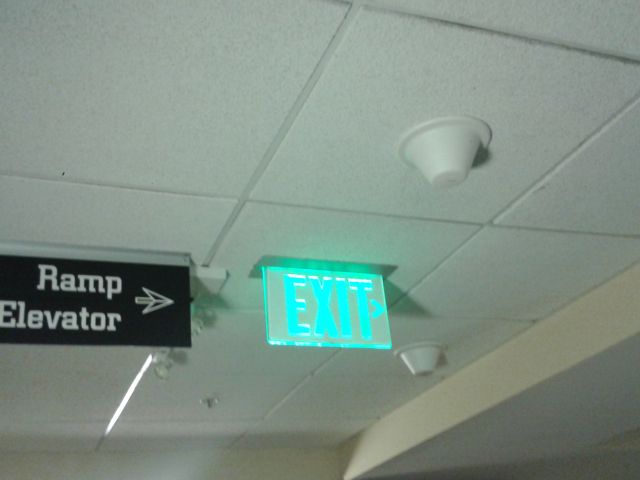
The white inverted cone? A DAS antenna in the AT&T Park suite level hallway. Credit: Paul Kapustka, MSR.

“When we were building the network up and had 3,300 users per game in 2010, there was nobody else doing what we did, and nobody had an eye on us,” Schlough said. Now, with in-game network usage nearing 30 percent plus, the moneymen of baseball aren’t just looking at in-stadium apps, they already have a strategy to put a network in every stadium, and get every fan there using AtBat. What Schlough hopes is that MLB will let teams leverage and add their own features and garlic-fries flavor to the AtBat app, an idea that hasn’t yet reached any conclusion.

“We’re working with MLB to see if we can add any [local] functionality to AtBat,” Schlough said. “We’re the first team to dip our toes into that water.”

Internally, the Giants have become big wireless users themselves. According to Schlough the team now uses its wireless network to run tasks like ticketing, some concession kiosks, the media needs and digital message boards. That’s probably why the team now has two full network-operation rooms in the bowels of AT&T Park, crammed with every flavor of telecom gear from 2G, 3G and 4G cellular to Wi-Fi controllers and a whole assortment of Internet routers, servers and other associated rack-mounted hardware sporting the logos of companies like Cisco, Juniper, Dell and HP.
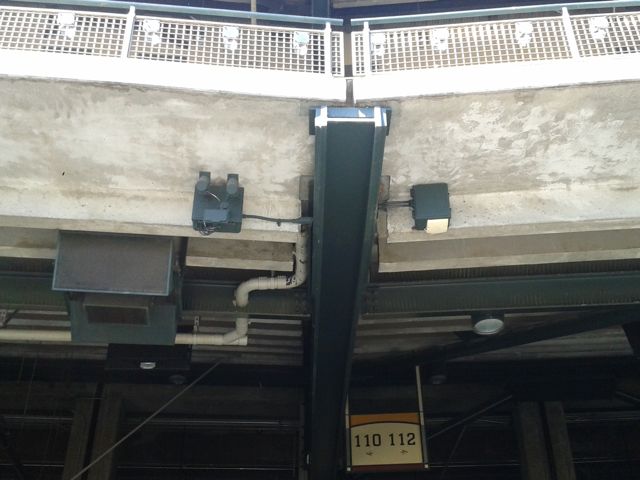
Can you see the Wi-Fi antenna? It's the green box on the left with two tubes. Credit: Paul Kapustka, MSR.

But after spending some $10 million to build the network over time — a cost shared by the Giants and AT&T, whose unique relationship is intertwined in the stadium sponsorship — in the end, it’s about the fan experience and ensuring fans stay for the experience that keeps Schlough, Stenzel and their teams running to stay in the lead.

“The most common app we see used at the games is maps,” said Stenzel. “It’s all about, ‘where am I going from here,’ for dinner or drinks. A ballgame is a social event, a fan experience that you’re going to remember.”

As long as you stay — and stay connected, that is.

“Now if the DAS goes down, people leave,” Schlough said. And you get the feeling that he was only half joking.
Ericsson Study Shows Mobile Will Rule Internet

People always say that it’s a small world, and with the Internet it seems smaller as everyone appears to be connected in one manner or another. Now Ericsson has taken the time to quantify how well connected everybody is in a recent report.

The company has just released its second annual “ Traffic and Market Report-On the Pulse of the Networked Society” that shows how connected the world is now and makes some predictions as to where it is headed.

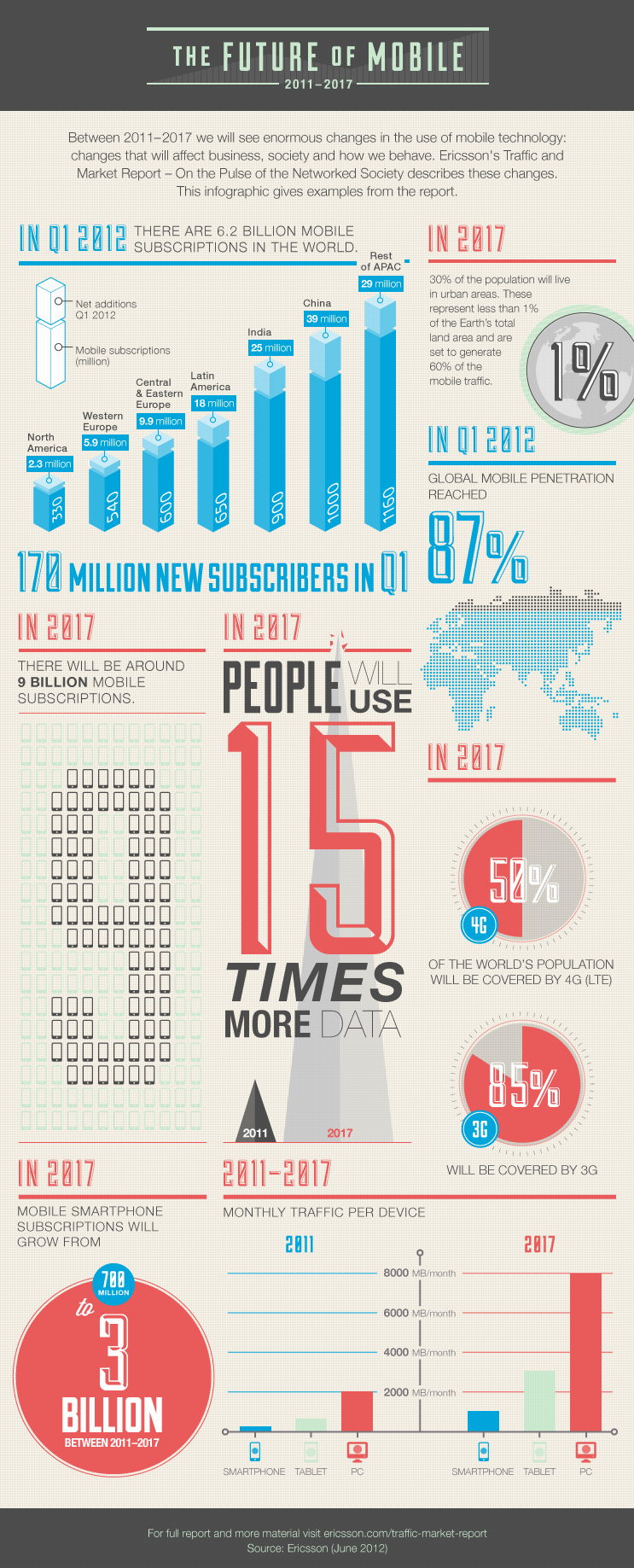
There is way too much information to provide any sort of thumbnail here but I will mention a few interesting factoids, at least ones that are interesting to me. Not too surprising is the growth of mobile subscriptions which will grow to 9 billion in 2017. How many people will there be at that time I wonder?

Anyway a few other interesting facts is that 50% of the world’s population will have access to 4G and 85% access to 3G by 2017, with 3 billion smartphone users in that year as well. Mobile data traffic is just booming and double from Q1 2011 to Q1 2012, with primarily video driving the growth. The report estimates that mobile data traffic will grow by 15 times between 2011 and 2017.

The overall conclusion of the report is that mobile is the wave of the future and that it s being driven by users that want anywhere, anytime connectivity to video, music and the Internet. This is great news for developer of mobile apps that are targeting sports fans. I suspect that in many ways sports fans are at the foprefront of this move and expect to see a growth in the number and quality of apps as opportunities in this space appear to be growing at a very good rate.

Wave of Tablets on the Horizon

I guess a toy store selling tablets targeted at children is a natural progression of life, and come to think of it after seeing several of my friends’ iPads being hammered on by 7-year-olds, it is now starting to make a good deal more sense.

Welcome to the Kurio7, a 7-inch tablet from Techno Source that will be first seen at Toys”R”Us and then hopefully move into greater distribution at a later point. A key selling point will be the built-in parental controls.

The customizable controls will help prevent children from downloading apps or visiting sites that they should not, and will allow them to surf safe sites on the Internet, read e-books and do the host of other functions that tablets are known for.

The tablet has built-in Wi-Fi and can support eight different logins, each with a different profile, password and controls. It comes preloaded with content that is targeted at children including games, videos and educational material.

Next Generation Transformer almost here

The Asus Transformer Pad Infinity TF700T, a 10-inch tablet that is the latest in this family is expected within the next few weeks as well. The TF700T lineup will come in two basic flavors, ones targeted at gamers and multimedia users and creators and those for communication and more traditional tablet functions.

The gaming version will feature a quad-core Nvidia Tegra 3 chip while for those looking for 3G/4G LTE connectivity it will be powered by a dual-core Qualcomm Snapdragon S4. It will feature an 8-megapixel camera on the back with LED flash, and a 2 MP front facing camera.

Pricing has not been yet released but it will be interesting to see where the company seeks to position the device. Its earlier version of the Transformer had very disappointing sales.

Google’s Nexus stats appear on benchmarking site
The as yet only rumored Google Nexus Tablet has not yet been announced but t appears that the devices abilities have been listed at benchmarking site Rightware. While the fact that Google was developing a tablet has already been announced by the company so far the details have not been made public.

According to the information the tablet will have a 7-inch display, will run the Android 4.1 (Jelly Bean) operating system and will be powered by a quad core Nvidia Tegra 3 processor. The display will have a 768 x 1280 resolution and it appears to be manufactured by Asus.

This is very likely the tip of the iceberg — Apple has a rumored new iPad, there are rumblings of updated offerings from Amazon and then later this year the release of Windows 8 is expected to open the floodgates for a new batch of tablets.

Mobile Data Consumption Set to Explode- Will Sports Cash in?

A recent report is highlighting the massive growth that is expected in mobile data consumption as users of smartphones increasingly use their devices for watching video, playing games, interacting with a variety of social media and other uses.

According a report from Informa Telecoms & Media, by the year 2016 mobile users will consume eight times more social media than currently, downloading 14 times as many megabytes of applications and browsing will increase six fold.

The two driving factors will be the increased use of smartphones, which currently are roughly half the handsets sold and the increase in overall mobile users. Not listed in the report but most likely also a driving factor is faster networks.

This presents a major opportunity not only for sports teams and leagues but also for the growing ecosystem of app developers involved in this space, from office league sponsored developments such as MLB At Bat 12 to sports aggregation news readers such as Recapp. With smartphones increasing in storage capacity app developers can also make larger, fuller featured products to grab users attention.

Currently mobile users can get access to a growing number of live sporting events including a wide range of college football, Major League Baseball, National Football League, National Hockey League and Soccer matches are all available, however they are often limited to a single carrier of you need to subscribe to the correct cable network.

If sports continue this path it seems that they will be missing out on a larger opportunity. It is nice that Verizon has hockey, but I don’t have Verizon. If I want NFL and hockey do I need two phones? To really cash in the leagues will need to come up with something other than exclusive deals with a single carrier, otherwise they are intentionally missing a huge segment of the market.

Friday Grab Bag: What Grades Did your Team’s NFL Draft Receive?

A report from ABI Research shows that while tablets such as Apple’s iPad and Amazon’s Kindle are constantly in the news as the latest and greatest laptop use is still strong, but does find that tablets are taking sales away from netbooks.

The research found that approximately 1/3 of those surveyed planned to buy a laptop in the next year while 16% planned on purchasing a media tablet in the same time frame. It looks like netbooks are being relegated to emerging markets and out of the US market.

Mustaches making a comeback in baseball?
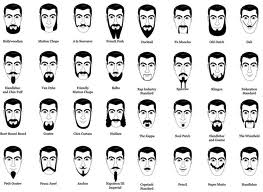
There was an amusing piece in The Wall Street Journal about a week ago talking about the return of the mustachioed man in baseball. In the modern era it probably reached its peak on the Oakland A’s of the Charles Finley ownership era and has since seemed to fade away.

However just last year John Axford, a reliever with the Milwaukee Brewers won the very coveted ‘Robert Goulet Memorial Mustached American’ from the American Mustache Institute, a notable win for a Canadian. No real insights here just kind of an interesting read- also I did not know that they were also known as Lip Sweaters.


Microsoft takes big hit in German court

A German court has ruled that Microsoft cannot sell its Xbox 360 game console and its Windows 7 operating system in the German market. The court, based in Mannheim, said that Microsoft breached an agreement that it had with Motorola Mobility in using certain video compression software in Microsoft products.

However Microsoft is not likely to remove its products from German shelves right away as Microsoft has won a ruling in U.S. District court in Seattle that

Do you have a social media will?
The joke that a friend will clear your browsing history if you die suddenly has some bearing in reality, or so I have heard. But do they know your passwords? The Government seems to understand the issues families of recently deceased trying to gain access to social media and has offered a bit of advice.

Posted here on the USA Gov blog it has a piece entitled “How and why you should write a social media will” that entails you giving passwords to a trusted person to close Facebook, email etc that are open in your name. And clear browsing history.

London Olympics to have world’s largest McDonalds?

I for one have always associated McDonalds with fitness and athletic excellence so this of course does not surprise me. The AP and Christian Science Monitor has reported that a two story McDonalds that can seat 1500 people will be built in Olympic Park.

According to the piece, it is just one of five that will be built for the Olympics, one just for the athletes. Guess who the official food sponsor is for the London Olympics.

Nokia planning tablets and hybrids
Departing Nokia Chairman Jorma Ollila said that the company is looking to expand into tablets and hybrids, but did not give any type of timetable or details on the move. The company just lost its crown as the top handset maker after a 14 year run to rival Samsung.

It has invested heavily in developing for the emerging Microsoft Windows Phone standard and it seems likely that it might expand that partnership to include supporting Windows 8, Microsoft’s tablet OS when that is available.

iPad 4G claims false?
Apple is facing some heat from Australia and the United Kingdom on the claims that the recently released iPad works on 4G networks. The battle about connectivity has been going on for some time down under but now the U.K. has joined the fray, Red Orbit reports.

The UK’s Advertising Standards Authority (ASA) claims that the ads are misleading since the iPad does not connect at the frequency that the fledgling 4G networks in that country operate, the same problem it has in Australia. In Australia Apple simply removed references to 4G and is expected to do the same in the UK.
You would think that something this basic would have already been found bulletproof prior to releasing the device but who knows?

Target boots Amazon’s Kindle
Target, one of Amazon’s largest brick and mortar partners has opted to cease carrying Amazon’s Kindle tablet. The issue is that customers visit the stores and look at the devices and then return home and buy them direct according to the New York Times.

Amazon even encouraged its customers to do so, offering a discount f they purchased a product direct from Amazon after scanning it n a store. So instead Target will increase Apple’s presence and other tablets including Barnes & Noble’s Nook ereader.in its 1,800 stores

Kickstarter favorite Pebble gets first app
Pebble, the watch that connects to your smartphone now has its first app, one from RunKeeper. The details for what exactly the app will do are not available yet but RunKeeper develops programs that track workouts. The company said that when the Pebble is commercially available it will have the RunKeeper app available as well.

Grading the NFL draft graders
Now that the NFL Draft is over and the wait begins for the start of the regular season there is still one NFL stone that appears to be untouched-looking at how all of the major NFL pundits team grades compare.

Now you could arm yourself with a spreadsheet and spend time traveling to all of the various web sites to garner what they said and how it compares to their rivals prognostications, but the good folks at Football Outsiders have taken it upon themselves.

They took the posted grades from nine NFL writers and draft experts and show how they rating each team, how that compares to what the competitors said, and how teams ranked overall. It is well worth a read.

Lotsa Luck: Colts will Have Live Mobile TV Cam Following Top Draft Pick

In a new, mobile twist to the 24/7 NFL Draft coverage idea, the Indianapolis Colts will have a live, mobile TV camera following top draft pick Andrew Luck from the moment he’s picked Thursday throughout his Friday welcome-to-Indy activities.

Partnering with mobile camera technology supplier LiveU, whose camera modems are finding more fans in the sports world, the Colts will be breaking new ground by providing a Luck’s-eye-view to the hoopla surrounding the top draft pick. No info yet on where the feed will be posted, but you can check the Colts’ official website as well as the LiveU Facebook page, where more info is sure to be posted.

UPDATE: Here’s the link to the streaming page. Apparently not quite 24×7, but still cool.

The Colts will also host a Google+ hangout with luck, according to this release. We will also update this post with more info as we get it, so stay tuned for live, mobile coverage of Andrew Luck’s million-dollar-plus day.

The Colts are also not the only NFL team taking advantage of LiveU’s technology, which is basically a bunch of cellular modems in a backpack (or a beltclip) that allows users to broadcast live, professional video content from just about anywhere at the fraction of the cost of using a satellite truck. Though LiveU couldn’t name the teams, several more are expected to be broadcasting their own draft news and views live Thursday, so check your team’s home page to see if they have a LiveU feed running. For fans of always-on info, the revolution has now reached the broadcast TV market.