Olympics Wireless Network Gets Overloaded on Day 1: Organizers Ask Fans Not to Tweet

Well, despite lots of planning and press releases, it turns out that the folks behind the wireless networks at the London Olympics weren’t prepared for the smartphone revolution. According to a Reuters story today, fans effectively shut down TV coverage from the men’s cycling road race by overwhelming the wireless network with their communications, leading the games organizers to ask fans not to tweet so much.

(As Gizmodo says, good luck with that.)

Of course we here at Mobile Sports Report have been covering the whole Wi-Fi at events topic pretty closely, but from here it looks like we’re about to get a new failure data point, for what happens when big-event organizers underestimate the connectivity needs of the crowd. (Stay tuned this week for an in-depth report on the subject.)

According to the Reuters story, the men’s cycling road race Saturday didn’t get key broadcast information during the race because the hundreds of thousands of fans lining the course apparently gummed up the wireless network. Sunday, the games asked folks to back off on Twitter use:

An International Olympic Committee spokesman said the network problem had been caused by the messages sent by the hundreds of thousands of fans who lined the streets to cheer on the British team.

“Of course, if you want to send something, we are not going to say ‘Don’t, you can’t do it’, and we would certainly never prevent people,” he said. “It’s just – if it’s not an urgent, urgent one, please kind of take it easy.”

We are trying to get a response from networking gear vendor Cisco, which made much about its involvement with service provider BT, formerly known as British Telecom, the main service provider in and around London. While Cisco touted its networking chops before the games, like Michael Phelps the network’s performance so far is something short of gold.

Anyone over there in London have any downtime experiences? Let us know in the comments. More on this as we hear from Cisco.

Wednesday Wi-Fi Whispers: Niners-Brocade News, Coming Soon

Welcome to “Wednesday Wi-Fi Whispers,” our clever title for a new rumors and news snippets column debuting… right about now. The idea here is to keep this a bit more informal than our regular, solid news coverage, to give a home to those whispers of things we hear that might be happening in the world of stadium Wi-Fi. First up is the yet-to-come formal announcement of the stadium-technology partnership between the San Francisco 49ers and networking gear supplier Brocade.

Brocade and the Niners: It’s all about 802.11ac

When the Niners finally broke ground on their new stadium that is being built in Silicon Valley (Santa Clara, just north of San Jose) back in April, team president Jed York let loose with a tweet that all but announced which Silicon Valley company would get the prized stadium-technology deal. In a bit of a surprise, it wasn’t Cisco Systems, the 900-pound gorilla of networking, whose main corporate campus is seriously “just down the block” from the Niners’ new digs.

If you don’t know Brocade that just means you don’t follow networking technology. Having covered this company in my previous tech-writing lives I was surprised since I thought of Brocade as a core/backbone gear provider, and not a company that had products for things like Wi-Fi access. Silly me. With not a lot of digging I discovered that Brocade had signed a partnership with Motorola several years back and now in fact was heavily into Wi-Fi access points, the key technology in any stadium build.

And though Brocade hasn’t yet commented officially on the Niners deal — a formal press conference is apparently just around the corner — we did speak recently with David Hunt, a senior technical marketing engineer at Brocade, who said that among other innovations you can look to see Wi-Fi gear with the new 802.11ac protocol (which provides much higher throughput than current technology) when the Niners’ stadium is ready. Hunt said that Brocade is already assuming that data loads when the new stadium opens in 2014 will eclipse what is being used now, so look for all kinds of new gear and smart-networking designs to ensure that what will probably be the world’s most wired crowds will stay wirelessly connected.

Cisco, which has an entire building at its nearby HQ that is decked out like a sports bar (as part of its Connected Stadium marketing push) must be smarting a bit to have lost the Niners deal to its smaller neighbor Brocade, whose HQ is also just around the corner from the new site. But in the end Cisco will probably sign up a lot more stadium customers, since Brocade is likely to do the Niners’ arena as kind of a “see what we can do” deal rather than part of a big strategy to go after stadiums. Still, it’s not a bad place to showcase your stuff if you are trying to sell to enterprise technology buyers. Those people spend a lot of time — and money — in Silicon Valley already. Stay tuned to MSR for more when the formal announcement is made. The wait is probably not gonna be long.

Will Time Warner Cable surf from the beaches to the stadiums?

In a cool side-gig thing we did last week we got to hear about how Time Warner Cable has brought Wi-Fi to the beaches in Southern California — according to Rob Cerbone, VP of wireless product management at TWC, the beach Wi-Fi uses solar-powered ACs mounted on lifeguard stands to bring web surfing to the shore.

(By the way, I am shameless about seeing how many times I can milk that web surfing/real surfing line. Twice now, and I’m probably not done yet.)

As we cornered Cerbone after his panel talk we asked the obvious MSR question — if you could bring Wi-Fi to the beach, when can we expect to see TWC bringing Wi-Fi to stadiums? Seems like a natural fit, given the content TWC likes to send over its cables. The official word from Cerbone: No comment. But the body language seemed to say, you might hear something soon. Since TWC plans to have more than 10,000 wireless access points deployed in LA by the end of the year — should be interesting to see where some of them end up. There are a lot of beaches, but more malls… and stadiums.

SEAT Conference — who’s going?

Here’s a free plug for the SEAT 2012 conference, which takes place in Boston the first week of August. With this agenda it looks like a place for MSR and our industry leading stadium Wi-Fi coverage and analysis. We are working on finding a way to get there… if we can, we will see you there.

Is your stadium unwired? Let us know!

Now is the time on Sprockets when we dance. No! Now is the time on Wednesday Whispers when we profile a stadium that has Wi-Fi… but since this is the first time out there are no profiles and we are sad. Is your place “unwired?” Drop us a line and let us know. It could be the start of a grand tour… MSR visits the country’s unwired stadiums! Preferably, with a hot dog and beer in hand. Until next week… stay unwired, my friends.

Minnesota Twins Seek to Engage Fans with ‘Twins At The Plate’ App

The Minnesota Twins along with Major League Baseball Advanced Media (MLBAM) have launched an in-stadium gaming app that is designed to engage fans by allowing them predict what is going to happen when the Twins are at bat.

The “Twins At The Plate” is a predictive game that has the fans predicting each batter’s results in the bottom of the inning. While there are a number of predictive apps, this one is the first that I have seen that is not specifically designed for an individual.

Instead Target Field, the Twins’ stadium, is divided into sections and the one that gets the most points for correct predictions is eligible to win prizes. The game will be played at the bottom of the 3rd, 4th, 5th and 6th innings and all picks for a specific inning must be made prior to the end of the top of that inning. Results can be followed by an in-app leaderboard.

All a fan has to do to collect the prize is to show their ticket stub prior to leaving the stadium that evening to pick up the award. If you have lost your stub you are out of luck. The app can be accessed only while fans are at Target Field through MLB.com’s At the Ballpark application.

MLB and its MLBAM are have been very aggressive in their delivery of apps to engage fans, with ones that will enable you to order food in select stadiums to one that provide cash awards if you can select enough batters in a row that get hits in real games to break DiMaggio’s record hitting streak.

This is another one that is in that vein. I suspect that it will take a while for it to catch on as word of mouth spreads about the app. I certainly hope that the stadium can support the wireless data load because fans would not like to find out that they did not win because their selections did not get registered due to network overload.

MLB has been working to enhance the networking capabilities of all of its ballparks to avoid this issue and I suspect that once that is accomplished, it will roll this app out to additional stadiums.

Mobile Sports Report TechWatch: Google I/O This Week

Google’s Goggle I/O show is this week so expect to hear an onslaught of news from the company and its partners on all things related to Android, smartphones, tablets, Chrome and most likely a host of other issues that they are concerned with.

The show will be held from June 27 to June 29 at San Francisco’s Moscone Convention Center and most of the keynote sessions will be live streamed for those of you that are interested but don’t want to endure the cold of an SF summer. (editor’s note: 75 degrees here today, Oregon boy.)

One message I would like to hear is how it will deal with the growing fragmentation of its Android operating system. It seems that most of the major manufacturers are only now coming on board with Ice Cream Sandwich, and a new OS is expected this week.

The issue is important for a number of reasons but a major one is that continued fragmentation could lead to developers only focusing on Apple’s iOS and even Windows 8 when that OS is available.

Intel invests in touchscreen developer
Intel Capital was the lead investor in a EUR20 million investment funding round for touchscreen technology developer FlatFrog Laboratories. Invus was also an investor in the round. FlatFrog is developing technology that tracks light traveling inside the cover glass of a screen.

Apple dealt a setback in battle with Motorola
Judge Richard Posner, who is presiding over one of the major patent disputes between Apple and Motorola, has ruled that Apple cannot pursue an injunction against Motorola and has dismissed the case with prejudice.

Posner had previously indicated that this was the direction he was leaning in but relented to allow testimony from both sides of the case last week. Apple does have the option to appeal his ruling.


Apple moving ahead in Samsung patent suit

While losing an important round to Motorola, Apple is continuing to push ahead with its Samsung lawsuit and will have its request to have a court order blocking sales of Samsung’s Galaxy Tab 10.1 heard this week.

The judge in the case has also said that she hopes to rule on Apple’s bid to block sales of Samsung’s Galaxy Nexus smartphone at the June 29th hearing.

Microsoft says no to Motorola patent proposal payout
Microsoft has declined to accept the offer that Motorola made that would settle the patent dispute between the two companies that has threatened Microsoft’s ability to ship Xbox 360 consoles into the US and would bar some Android phones from Motorola as well.

Motorola was offering to pay 33 cents per phone that uses Microsoft’s ActiveSync software and wants Microsoft to pay it 50 cents for each device that uses Microsoft’s Windows operating system that uses Motorola’s industry standard video compression patent.

Mobile Carriers agree to alert travelers on roaming charges
Have you ever traveled in a foreign country and used your smartphone and had a slight heart attack when you got your bill at home with the huge roaming charges attached? Now carriers are going to do something about that.

What they are doing is to send you a message alerting you to the fact that your data plan has changed and new rates will apply. Among the 24 that have signed on are AT&T, China Mobile, China Unicom, Deutsche Telekom, France Telecom-Orange, Hutchison 3 Group, SoftBank Mobile Corp., Verizon Communications, America Movil, and Vodafone Group.

Apple fined over 4G claims
An Australian court has fined Apple $2.27 million over its claims for its iPad that included unsupported promises of 4G support. After the charges were brought Apple changed its advertising and offered refunds. Apple now touts the device as WiFi+ Cellular.

U.S. Open Sets Records for Online, App Viewing

We don’t have any definitive viewer numbers, but according to a press release from the USGA, the recent U.S. Open golf tournament in San Francisco attracted a record number of online viewers, especially for live online video and via mobile devices. This is hardly a surprise, since online golf viewership overall has been spiking this year, with no end in sight to the growth curve.

According to the USGA, which pioneered online coverage of golf, overall viewer visits to the U.S. Open website during the week increased 79 percent from the year-before totals, while views of live streaming video increased 210 percent from 2011. Though the USGA hasn’t provided exact numbers on page views and streaming video looks, it’s a good guess that the latter number is somewhere in the one- to two-million range, since approximately a half-million to a million folks will watch online video of a regular PGA event, according to PGA Tour reps. The U.S. Open’s website features were powered technically by IBM, which also helps produce the wonderful online experience for The Masters golf tourney.

The availability of an Android version of the USGA’s U.S. Open app helped spike visits to the mobile version of the Open website — according to the USGA, mobile website views increased 375 percent in 2012, with iPhone app downloads jumping up 44 percent from the previous year. In addition to live video the U.S. Open websites also included a live leaderboard, a photo stream and a unique feature that let you look at an interactive map of the course and see which players were on which hole. The USGA was also extremely active on Twitter, with the official U.S. Open Twitter feed providing constant scoring updates and links to feature coverage.

Even though the U.S. Open live online video wasn’t very comprehensive — on Thursday and Friday the coverage followed one “marquee” group throughout its round, and on the weekend the coverage consisted of only play at two holes — it was extremely well produced, with commentators that were critically judged by many observers to be better than some of the broadcast TV talent. It’s probably a safe guess to say that next year the USGA will continue to expand live online coverage of the U.S. Open, in sync with the expanded live online views coming next season from the PGA Tour for regular events. That’s good news for golf fans, who will apparently be rewarded for finding more ways to watch.

Forgive Me, USGA: I Used my Cell Phone on the Golf Course

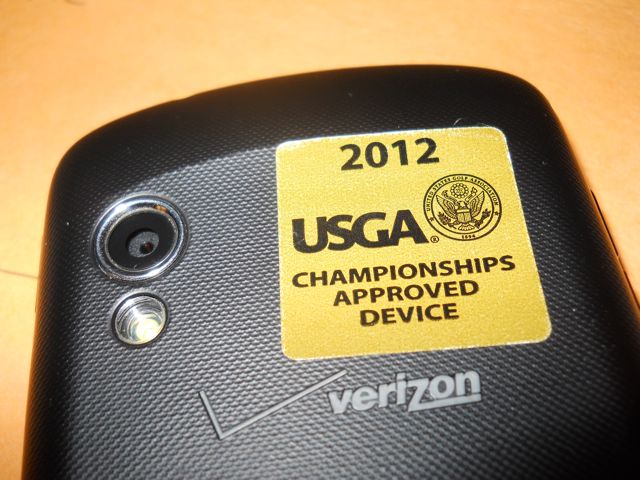
Forgive me, USGA, for I have sinned. If I could, I would call a penalty on myself for violating one of your rules — though I’m not sure how many strokes it would cost me for using a cell phone on the course during U.S. Open competition.

The truth is, I’m not really repentant. The crime was worth it, and I’d do it again. It’s just too compelling to use a mobile device to get information you can’t get otherwise, and to enrich the experience of watching something live. For many reasons, live golf is a perfect atmosphere for second-screen access and instant communication. There’s lots of downtime in between the action, perfect for catching up on what’s happening on the rest of the course, or for sharing our experience with absent friends. Or for keeping up with work while we’re sneaking away to watch golf.

So it’s you, not me, USGA, who needs to change. Soon. So that all the fans who love golf enough to show up in person can share my secret pleasures from Friday, which included being able to watch play on the 14th hole, live, while sitting alone in the sun on the side of the 17th fairway.

Let it be noted that I committed this crime using the USGA’s own very fine U.S. Open app. And its wonderful live video feature. How can I comply with your rules when your very own programmers have built such a beautiful HD-quality viewing mechanism? It was just too good to resist.

To be clear, as a media member I was authorized to have a cellular device on the grounds — under the stipulation that I use it only in the media tent. Why did I not comply? Basically, because, USGA, you have an information-gap problem. In other sports like baseball, teams are putting in advanced digital access because they are worried about competing with the couch — they don’t want fans to stay home because the experience there will be better than the ballpark.

At the U.S. Open you may not have that problem, since golf’s best test will almost certainly always be a sellout, like it was this week in San Francisco. And I get it that you want to go old-school and not have electronic scoreboards everywhere you look. But the quaint stuff only goes so far. The simple biggest problem I saw out on the course Friday was that many fans — your patrons — had no friggin idea who was in the lead, who was in the hunt, or where particular players were on the course. And that took away from the experience.

Couch potatoes at home or distracted folks at work had much better info at their finger tips or laptop screens — while watching online at home in the morning I was loving the Playtracker scoring feature on the U.S. Open website, which showed in a graphic view of the course who was playing which hole, and what their up-to-date stats were. And the USGA’s Open Twitter feed is fabulous, providing up-to-the-second info and compelling links. At Olympic we were stuck looking at small scoreboards that were hard to see in the setting sun.

At one point, standing alongside the 17th fairway we all had no idea whether Tiger birdied or bogeyed No. 7, and when the scoreboard changed his stats you couldn’t tell if the “1” was red or green because of the way the sunlight was hitting the board. Luckily someone wearing one of those earpiece radios came by and set us all straight. But the future of live golf shouldn’t be a bunch of zombies all listening silently. Give us some easy to understand rules, and let our cell phones be free so that we can view and share information to enrich our on-site experience.

I get it that overzealous picture-taking fans, like those who ticked off Phil at the Memorial, are to be avoided. But why not try some clear, simple rules with clear penalties? Say, anyone who doesn’t turn their ringer sound down and takes an audible picture gets escorted off the grounds — just like belligerent drunks. You don’t let the few over-imbibers keep the rest of us from enjoying a cold beer; don’t let bad cell users keep the rest of us from being able to stay connected to stats and views during the inevitable downtimes between groups.

Nobody cared that I was transgressing Friday, probably because I was discreet and know the simple trick of turning my volume to vibrate. I have faith that most other golf fans will similarly comply — hell, several people in the group I was around on 17 even turned around to stop a USGA cart that was loudly headed up the path while Tiger was trying to make birdie. Real golf fans get it, that players want quiet to do their thing. So why not try tricks like a ban on cell-phone pictures around tees and greens? And set up some “Tweet tents” or Wi-Fi zones far away from sensitive action areas? Not only will that keep sad, unconnected fans happy, but I smell a Starbucks sponsorship. Make this something where everyone wins.

If you need some help, I am happy to volunteer to be part of a research committee to determine what fans want to do, and how the experience can work for everyone. It was heartening to talk to USGA officials this week and hear that they understand that people want to use their digital devices while at competitions. Let’s hope this happens sooner rather than later, so my days of crime can come to an end.