Denver Broncos the latest to jump onto iPad Playbook

The Denver Broncos have jettisoned its old time playbooks in favor of the bright new shiny iPad; 120 tablets in all which will feature Verizon Wireless 4G access and with most of the iPads top end models with 64GB, according to the Denver Post.

The team plans to load the iPads not only with the playbook but also with each weeks game plan, scouting reports on upcoming teams and video clips among other digital data. The system will be set up so that as new plays are developed they will be ‘pushed’ onto each tablet.

In the past the team had printed a 500 pound playbook each week of the season that contained much of the information, but the sheer mass made it very difficult to quickly locate different pieces of information.

The program was co designed by the Broncos and a developer named PlayerLync and among the program’s features is the ability to allow players and coaches to annotate and highlight plays as well as provide the team with playbook security by enabling it to erase the entire iPad remotely.

The team will provide the iPads to coaches, players, scouts and other team personnel. It should be noted that while the players and coaches can use the iPads for practice and training purposes the NFL does not allow electronic devices of this type to be on the field during games.

The league has relented somewhat in that in the past these notebooks and tablets had to be off in the locker room 90 minutes prior to kickoff, now that rule has been rescinded.

This is part of a growing trend in the NFL and elsewhere; teams have found that instead of cumbersome paper notebooks, sleek iPads or tablets can not only easily replace them but enhance the value of the digital playbooks by allowing for remote upgrades and player feedback.

At least nine NFL teams now use the iPad, with five, the Dallas Cowboys, St. Louis Rams, Seattle Seahawks, Indianapolis Colts, and Detroit Lions, signing on with Global Apptitude last month. MLB has also been increasingly active in this area as well.
ExteNet Systems Scores Miami DAS Deal, Becoming a Player in Stadium Network Market

When it comes to in-stadium wireless networks, it turns out that teams and wireless providers aren’t the only players in the game. ExteNet Systems, a Lisle, Ill. startup, is rapidly scoring points by playing the “middleman” role, building out stadium networks at no cost to teams and making money by renting network access to the carriers.

Last week ExteNet announced it was the builder of the new Distributed Antenna System (DAS) installation at the new Marlins Park in Miami, with Verizon Wireless and T-Mobile USA already signed up as customers. And it turns out that ExteNet was also behind Verizon’s DAS deployment in and around Lucas Oil Stadium for the recent Super Bowl XLVI. Those deployments are just part of a new stadium-business push from ExteNet, which also put in a DAS system at the “Big House,” the huge bowl stadium at the University of Michigan, last fall.

Though ExteNet also provides in-building networks to some more traditional markets — like health care and hospitality, where large groups of people are seeking network access inside a confined space — it’s looking to add more stadium customers in the near future. According to CEO Ross Manire, a veteran of the networking industry, the boom in powerful handheld devices has created a “perfect storm” of capacity consumption that can’t be addressed by the historical cellular antenna architectures.

“You used to just worry about voice coverage,” said Manire in a phone interview last week. “But phones are really data terminals now, and the question becomes how do you manage strain on networks [at stadiums]. “In the past you may have been able to get a voice signal from a cell tower several blocks away. That doesn’t work now.”

The privately held ExteNet, which received a $128.4 million funding round at the start of 2010, thinks it can help both carriers and venue owners by providing “middleman” network services. The basic business model, Manire said, has ExteNet building and owning the stadium network, which it deploys at no cost to the team or building owners. It then charges carriers a “node activation fee,” a sort of monthly rent to let their services ride on the network.

If you’re not familar with how a DAS works, it’s essentialy a bunch of small cellular antennas that are mounted on ceilings and walls inside buildings, instead of on huge towers like traditional cellular antennas. A DAS network administrator provides normal cellular connectivity to users, and then connects those signals to the appropriate cellular vendor on the network’s back end. DAS deployments can also add Wi-Fi antennas to their infrastructure mix. ExteNet, like many DAS operators, can connect its back end to any number of cellular networks, meaning that fans don’t have to be a customer of a certain provider to get better in-stadium service.

The openness of ExteNet’s design may make it a better choice for stadium operators than an internal network designed and owned by a single carrier, since fans wouldn’t have to be customers of a specific carrier to get better service. ExteNet runs a network operations center 24/7 to provide support to all its networks, and signs a service level agreement (SLA) with both the stadium owner and its cellular partners to give both parties what they really want — happier customers.

“We’re seeing an incredible amount of attention from stadium and team owners, who need to provide a good [wireless] experience,” Manire said. “Fans believe they should be able to connect wherever they go. Of course that’s easier said than done.”

But now ExteNet may be part of making that connectivity a reality for more fans, going forward.

Panasonic, LiveU Team Up for Mobile Cellular TV Cams

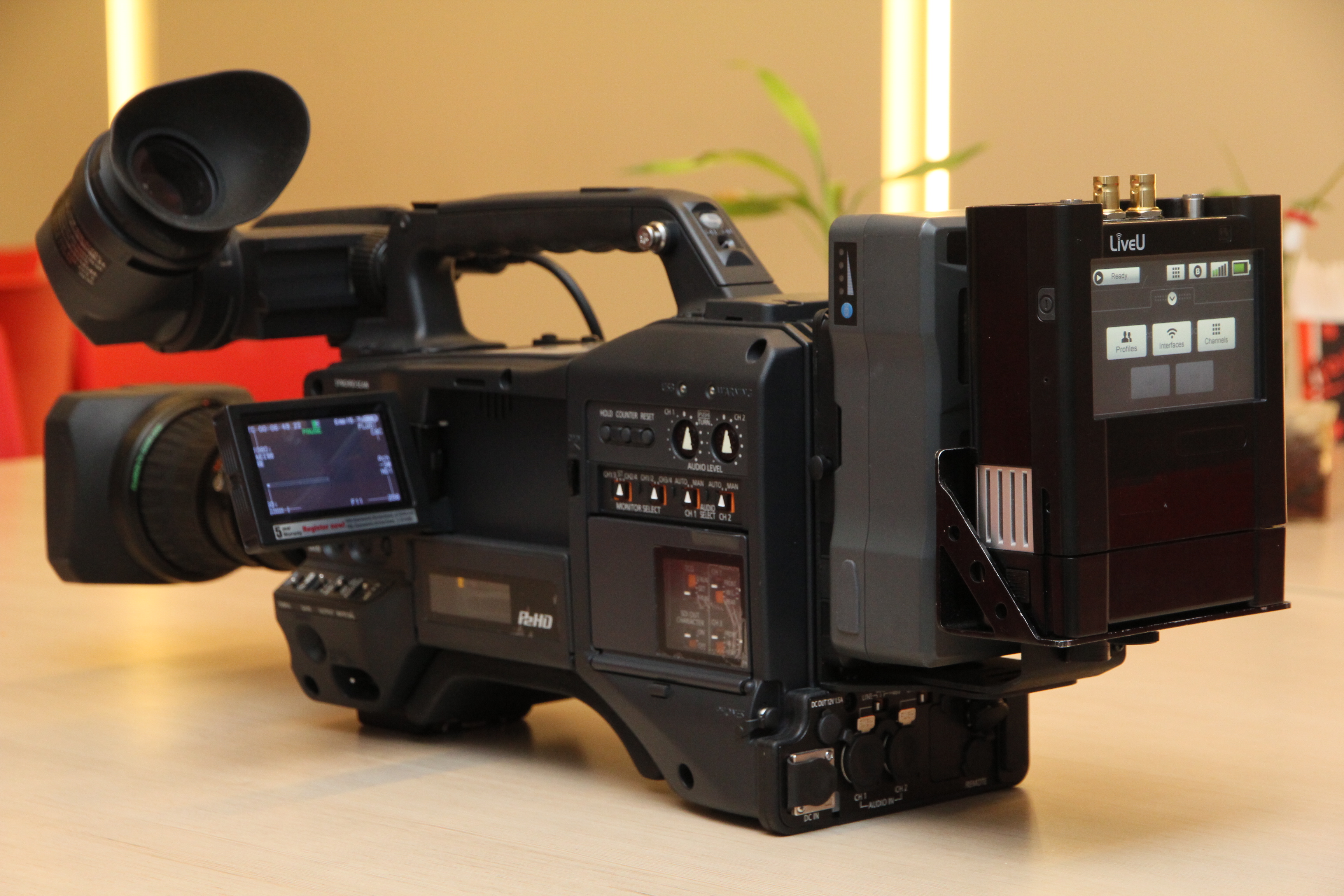
Panasonic announced Sunday that is is teaming up with cellular-modem camera pioneer LiveU to build a pro TV camera with a cellular connectivity unit bolted to the back of the camera, to make live mobile broadcasting easier and cheaper.

As we said last week we here at MSR think that cellular-equipped broadcast cams are a big thing going forward. For professional broadcasters and networks they theoretically can enable more live broadcasts from more places, even at major events and stadiums. And then there’s also an entirely new segment of broadcasting that they might enable — such as a small school streaming live to the Internet, without the need for a satellite truck or other expensive broadcast gear.

The Panasonic-LiveU deal, announced at the NAB show in Vegas, calls for “an integrated camcorder and live video uplink solution, utilizing the groundbreaking LU40i video uplink device and the new AJ-HPX600 P2 camcorder with planned wireless integration features.” So basically it’s a cellular modem bolted onto the back of a camera. Though this isn’t the finished product this demo version picture gives you an idea of what it might look like, and it’s a big improvement over cellular backpack modems or even the belt-holster thingy that LiveU recently announced.

Anyone else at NAB see any more cellular camera stuff? Let us know in the comments. Would like to get some more granular details about costs for the cell modem connections.

Mobile Sports Report TechWatch: Preliminary Windows 8 Tablet Specs

Intel takes wraps off of Windows 8 tablet specs
Intel has showed the expected features and capabilities of the Windows 8 tablets at its Developer Forum in Beijing last week, a nugget that was dug up by Cnet. Not surprising is the chip powering these next generation devices will be Intel’s Z2760 ‘Clover Trail’ processor.

The chip is a multithreaded dual core processor with a feature called ‘burst mode’ that enables it to accelerate performance for short periods of time. There will be two basic designs, one a 10-inch model and the second a slightly larger 11-inch that will feature a keyboard.

It will have an estimated 9-hour battery life, support 3G/4G and also have NFC (near field communications) and Wi-Fi Direct. Its weight will be roughly 1.5 pounds and it s expected to be 9 mm thick. A second half 2012 release date is expected for the tablets based on the specs, but that is based on Microsoft releasing Windows 8 in that time frame.

Expect a wave of tablets of all size in next few months
A host of tablet manufacturers have tablets in the pipeline and they will start appearing on shelves very shortly, according to multiple reports. Samsung, Nokia, and even possibly Apple have products that should be are nearing the market.

The Asus Transformer Pad 300 is expected to hit the streets next week with a 4G LTE supporting pad that is expected to have a $399 price tag for a 32GB model. Amazon reportedly has three Kindle Fire models on the designing board including a 8.9-inch one.

Then there is the long awaited Google Nexus Tablet that has been rumored for some time and s expected to be built by Asus. It is believed to be a 7-inch tablet that will have a $199 starting price point. For more information on these and others including Nokia, Apple and Samsung’s potential offerings head over to the International Business Times site.

Apple loses appeal on ‘push’ email
Chalk one up for Motorola Mobility as a German court has upheld a ban that prevents Apple from using ‘push’ email in its iCloud and MobileMe service in Germany. The court, based in Mannheim, confirmed that Motorola owns the patent and that Apple must pay to use it.

The ruling keeps the services shut down in Germany and Apple is liable for damages and has been ordered to provide information that will enable the courts to determine the amount of the damage.

A look at how the current patent wars are hurting the market
A nice, general piece on the growing problem of patent conflicts and how it has erupted into major warfare. The rise of patent trolls, including corporate ones and how companies now go out and buy patents simply for protection. Nothing groundbreaking but nice to see that the issue is making more news.

On the same topic the fact that most of the patents in the smartphone area are held by international companies could stunt the growth of home grown developers in China, the world’s largest smartphone market.

Local handset manufacturers sold 455 million units last year but have been warned that they may be violating copyright laws with their devices. The news came from The Mobile Terminal White Paper, issued by the China Academy of Telecommunication Research.

Twitter tried to buy Instagram first
I did not hear about this when the huge deal went down with Facebook but apparently there was more than one company lining up for the photo sharing company. Seems that Twitter co-founder and Chairman Jack Dorsey had tried in the past to purchase the company, but failed to get any real traction on a deal.

However, since Dorsey was one of the investors in Instagram, he will be seeing a pretty penny from the deal. For a nice look at Instagram head over to the NY Times for this piece.

Pew study highlights technology rift
A recent study by the Pew Research Center shows how much of a gap still exists between have’s and have not’s in terms of technology. While a full 19% of Americans now have some form of tablet, be it a fully loaded Apple iPad or a bare bones Barnes & Noble Nook, a greater percentage, 22% do not even have Internet access.

The report is focused on digital access in this country and provides some great snapshots of who uses which technologies including cell phones and laptops as well as tablets, and that is broken down by a variety of demographics.

It is interesting to see that a fairly large number of adults that do not have Internet access do so because they believe that it adds nothing to their lives. Also the rise of mobile Internet access has helped level the playing field in areas that had traditionally lagged n terms of access and use.

LiveU’s New Cellular TV Camera Modem Passes Super Bowl Test; LiveEdge Still MIA

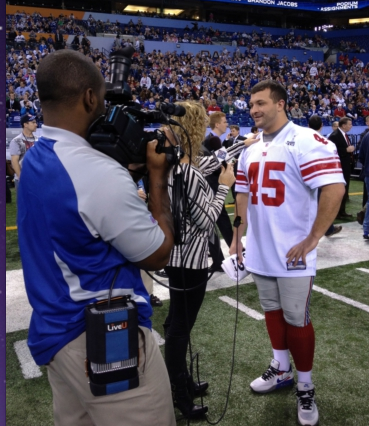
LiveU's belt-sized modem in action at the Super Bowl. Credit: LiveU

Mobile TV camera modem supplier LiveU said Wednesday that its new belt-sized cellular modem was used for live camera shots at the Super Bowl in February, according to a press release issued by the company. We here at Mobile Sports Report expect cellular cameras to be a big thing going forward, to enable more sports content live from where it happens without the expense of a satellite truck.

While LiveU has done the mobile/cellular thing before for sports its previous solutions were backpack-based to house the equipment that included modems and batteries. The newer LU40i unit, the company said, weighs in at around a pound and a half and can combine up to six 3G or 4G cellular connections to support a “professional HD-quality video uplink.” Our big unanswered question (we have a call in to the company and plan a longer look at mobile cameras soon) is how much does it cost to run one of these babies, since we are guessing that a live video stream would chew through a regular cellular data plan after a few plays. Our guess is that LiveU has some kind of deal with the cellular folks but we’ll know more soon.

The debut of the LU40i unit, which LiveU said was also used at the NBA All-Star Weekend, the Grammies and at CES and SXSW, begs the question of where are its competitors, especially the high profile LiveEdge, a company funded in part by Verizon and one of the companies selected to participate in Verizon’s “incubator” program for startups.

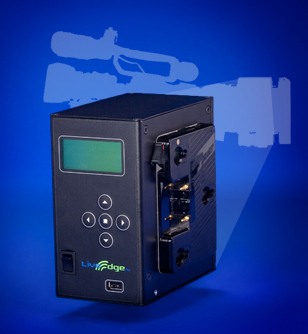
LiveEdge proposed modem unit, which snaps on the back of a pro TV camera. Credit: LiveEdge

LiveEdge, which originally launched with the idea of putting a WiMAX modem on the back of TV cameras, morphed toward LTE when it became apparent that the major cellular providers were moving to that technology. Last year, the company was highlighted by Verizon’s CEO at CES as one of the new apps for LTE services and scored the unspecified investment from Verizon as well as the incubator spot.

But since then there’s been nothing but crickets from LiveEdge, whose former CEO, Robert Klingle, has apparently left the building since he’s no longer listed on the company website. In fact the About page looks like it’s recently been truncated; it used to show other execs even after Klingle’s name was taken off earlier this year but now it’s blank. Repeated calls and emails to both Verizon and LiveEdge have gone unanswered, though one LiveEdge spokesperson who asked to remain unidentified did say several weeks ago that an announcement would be forthcoming soon.

Maybe at next week’s NAB show in Vegas? That’s where LiveU will be showing off the LU40i, which looks like the leader in the space for mobile, broadcast-quality TV.

MLB has App to Wirelessly Order Food at Select Ballparks

Minute Maid Park

As I was perusing the iTunes store, primarily looking for the Civil War Today app, but being easily diverted I wandered over to look at what MLB has to offer, which seems to be growing every time I head over.

I tend to gloss over established apps, just taking a quick look at what new features that they might include, now often just additional hooks into social media, but also there can be some surprises, which I found at MLB.Com At the Ballpark.

The free app does tout new social media integration, park info such as layout, parking, security and a rewards program but what really caught my eye was access to mobile food and beverage service at select ballparks.

Currently this is only available at is accessible at the following MLB ballparks: Citizens Bank Park (Philadelphia), Minute Maid Park (Houston), Chase Field (Phoenix) and Marlins Ballpark (Miami) but MLB has said that additional ones will be available.

I imagine that the parks the league is currently looking to establish networks in will be the next in line as these will likely have enough capacity to handle the additional traffic. While it may seem like a no-brainer that the network could handle it, heavy use can swap the network, which is why increasingly parks need separate networking equipment, such as the new Marlins ballpark.

The one piece of information that is not included, but which we will check in with MLB is where will this be available in the park? For all fans with iPads and iPhones or just ones in select section?

This is not the first time that a service has been available at a ballpark, but it looks as if MLB is going to take the bulls by the horn and establish a standard method to do so. Last time I was in box seats behind home at AT&T you could order food electronically from a server in the stands and even back at old Candlestick Park the service was available, however there was a fairly steep premium on beer carrying charges, as I recall.

Now I wonder if it will be available at the Anaheim er… Los Angeles Angels of Anaheim’s ballpark., They have just expanded the menu, primarily for fans that are traditionalist in that they need their hot dogs (like me ) at the game, but are willing to try new versions (like me). The Angels now offer a bacon wrapped dog, a hot dog wrapped in a tortilla and then deep fried and a hot dog topped with BBQ beef. For dessert there is now the Arctic Nachos which are cinnamon-sugar nachos topped with vanilla ice cream, then doused in caramel and chocolate sauce. Too much you say? Hah!

Next up larger seats?