Verizon Wireless joins the tablet market with Ellipsis 7

Ellipsis-7-tablet-366x251

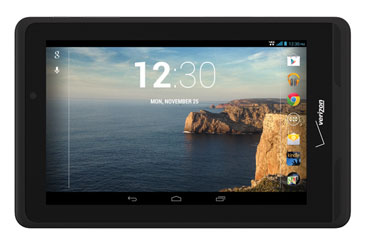
Football fans that use a Verizon-backed smartphone to watch NFL games will be thrilled to learn that they may now be able to boost the screen size in the future with the company’s 7-inch HD Ellipsis tablet that is expected to be in its stores by week’s end.

The details are sparse from Verizon on the exact specifications but the tablet will have a HD display but no report on the resolution while C/net is reporting that it will also feature a 1.2GHz quad core processor, 1GB of RAM and 8GB of storage that can be expanded via an optional microSD card.

Not surprisingly connectivity is a big feature with the Ellipsis 7. It will feature 4G LTE and mobile hotspot support for as many as eight additional Wi-Fi devices, according to C/net.

The Ellipsis tablet is obviously not chasing after Apple’s iPad, the Samsung Galaxy offerings or the high-end releases from Google, Amazon and others. Rather it is positioning itself as a low cost, solid alternative to these products for users who might not want or need all of the bells and whistles, and associated price tag, that come with these different offerings.

While it seems that everybody is now jumping into this space, from supermarkets to bookstores that is not a bad thing. As their price continues to drop the commercialization of tablets will continue and customers will benefit from this.

When the prices get low enough it makes sense to have one dedicated to work purposes, maybe with an external keyboard that has an additional battery while having a second tablet that can be kept by the television that can serve as a second screen, to watch two football games or allow one person in the room to escape sports. A low cost offering bedside for a late night reading before sleep. All of this is coming closer to reality as tablets become increasingly ubiquitous.

Verizon said that the tablet is the first of an expected family of Ellipsis products and it will be available online exclusively at the company’s stores for $249.99, with a short term offer now for $100 off any tablet from Verizon with a new 2-year wireless service contract.

Friday Grab Bag: A look back at ABA, Sculley returning to High Tech?

If you fondly remember red, white and blue basketballs then this is probably great news for you — ESPN Films is going to explore the history of the American Basketball Association in its latest 30 for 30 documentaries.

One of the few leagues that, at least semi-successfully, challenged an incumbent one, the ABA ran from 1967 until it merged with the NBA in 1976. It helped bring a new degree of flash into the NBA with freewheeling players such as Julius Irving.

Android KitKat and Nexus 5 here
The next generation of the Android operating system, code named KitKat and the Nexus 5 smartphone that is the first device to run the new OS are here this week.

CNN Tech has a nice roundup, and points out that LG will be making the phone that is expected to have a 4.95-inch display with 1920 x 1080 resolution and have the latest generation of Gorilla Glass 3 for the front cover. Expect to see a new generation of tablets and phones with the OS in the coming months.

Few tablets have paid cellular
When you look at the price for a tablet you often see two figures: one that lists the Wi-Fi only cost and one for having 3G or 4 LTE cellular as well, which is often at least $100 more. A recent study from theConsumer Electronics Association shows that few use cellular.

The survey found that only 29% of tablet owners buy cellular enabled tablets and of these only 49% buy a data plan. Of those who buy it is almost split evenly between those that buy a separate plan for the tablet and for those who bundle.

CEA to debut WristRevolution at 2014 International CES
With Samsung, Sony, Google and a host of others now chasing the ‘wearable tech’ space the International Consumer Electronics Show will have a section that is devoted to products and technologies coming out for this market segment.

In the past products that perform some of these functions such as health monitors/wrist watches would be found across the huge show floors but now they will be gathered into a single area so that both hardware and software developments can be easily tracked.

First ticket for wearing Google Glass?
Speaking of wearable technology it is being reported that a California driver was ticketed for wearing Google Glass while driving. The officer cited a law that starts with “person shall not drive a motor vehicle if a television receiver, a video monitor, or a television or video screen, or any other similar means of visually displaying…” They were also speeding.

John Sculley to buy BlackBerry?
Former Apple and Pepsi CEO John Sculley is now being rumored to be in the running to buy the beleaguered smart deceive manufacturer BlackBerry, according to a report carried in the IT Wire, originally from the Globe and Mail.

Sculley is probably best known for pushing out Steve Jobs, one of Apple’s founders and the man that recruited him for the job while at Apple. He has been active in high tech since leaving Apple and is said to be working to bring a group of investors together to buy BlackBerry.

TigerLogic seeks to drive fan engagement via social media

tiger

TigerLogic is charging into the collegiate sport scene with its social media platform Postano (meaning, ‘to post’ in Italian) a set of tools that will enable the school’s athletic departments to use fans’ social media posts to help promote the sports and school.

The company has already landed its platform at a number of schools, and at least one pro basketball team as well. Its customers see Postano as a way to engage fans not only at the events but in-between games as well. Among the early adopters are the University of Oregon and Arizona State University.

Postano is a flexible tool that can be adjusted to meet a school’s needs, according to the company. The goal is to enable schools to be able to present their teams in exactly the way they want them presented, down to the correct colors if somebody wants to paint their face school colors, said Tom O’Keefe, TigerLogic’s senior vice president of Social and Mobile.

The idea is pretty simple on the face of it: The company can provide a package of technology that allows the school to collect, curate and rebroadcast social media including posts from Instagram, Facebook, Vive and Twitter. They can be text, photos or video or combinations of these types of content.

Under Postano, the schools can create a media command center and then after the collection of the data they can display it in a variety of ways including on stadium scoreboards, or on displays set up for the purpose. Fans can see their own social conversations being broadcast while at the events. At the same time the schools can get a feel for the mood of the fan base by reviewing what is going on in the social media world.

Postano has created set packages specifically for college sports that include access to the following options: The Postano Social Hub, Postano Command Center, Postano Mobile and Postano Events and Social wall. It also will create customized features for its customers. The mobile platform supports both Apple’s iOS and the Android operating system.

One of the challenges that its technology faces is the inability of some stadiums to support large volumes of social media. Users can flood the grid bringing it to a halt. It does no good to try and engage fans if they cannot get a connection to post data.

While most major athletic conferences have signed away broadcasting and some digital media rights, the use of social media was not covered in these deals, and TigerLogic believes that this will be a major growth market for the company as schools use the media to further engage fans, O’Keefe said.

Horned Frogs get AT&T Wi-Fi, DAS for TCU Stadium

In case you had any doubts that AT&T is serious about this whole wireless-in-stadiums market, we have yet another announcement: AT&T announced availability of a Wi-Fi and DAS network for Texas Christian University’s Amon G. Carter Stadium, located in Fort Worth (“Foat Wuth”). There’s also a mobile app available for Horned Frogs fans, complete with the Bypass Lane powered concessions ordering feature.

For a company that claimed it wasn’t doing Wi-Fi networks in stadiums anymore, AT&T has sure been busy launching them. I guess we can alter the “no Wi-Fi” plan to “we’ll put in Wi-Fi if we get to own the network.” For TCU, AT&T’s implementation looks pretty robust, with 345 Wi-Fi access points and another 140 DAS antennas. At 45,000+ seats, the TCU stadium is what you might call middle-big, but 345 APs and 140 DAS should do pretty well, especially with an AT&T operation behind the scene.

Looks like our friends from Cisco might have a win in purple-land too, since the AT&T press release said the facility also now has a StadiumVision deployment, bringing high-definition information to all the digital displays in the stadium. No mention of Cisco in the release, but that’s pretty standard. We’ll circle back with Cisco folks to see if they can shed more light.

If we were doing a BCS-type ranking for college stadium deployments, you’d have to make AT&T the Alabama equivalent at No. 1, right? Any Verizon networks going in at colleges that we haven’t heard about? Let us know…

AT&T Bosox fans set wireless data records during World Series opener

It’s a bit of a broken record — another big sporting event, another huge wireless data usage event — but the numbers never fail to amaze me: According to our friends at AT&T, fans at Fenway Park Wednesday night set new records for wireless data usage during the Red Sox victory over the St. Louis Cardinals in the opening game of the 2013 World Series. How much data? Try 248 GB of data, bigger even than the Bosox’s Big Papi.

Mind you, none of these figures represent traffic that might have traversed over the Meru-supplied Wi-Fi network inside Fenway. The following figures are all from AT&T’s Distributed Antenna System (DAS) network, the collection of small cellular antennas that bring better connectivity to crowded public places. And this is only AT&T carried data, which means that the total of all wireless customers in the park is almost certainly a multiple larger. But for your enjoyment here are the AT&T stats, direct from our AT&T sources:

— Data usage on the AT&T in-stadium network during Game 1 was 248 GB (gigabytes) of data
— 248 GB of data is equal to more than 700,000 social media posts with photos
— AT&T fans made more than 17,361 voice calls and sent more than 56,335 SMS text messages Wednesday night on our in-stadium network
— The peak hour for data traffic on the in-stadium network was from 10–11 p.m. EST
— The 248 GB total surpassed the record for data usage for the AT&T in-stadium network at Busch Stadium in St. Louis in 2013, which was 183 GB set on 10/11/13

We’ll see if the Meru folks can provide any Wi-Fi stats before the series ends. Like football, baseball is perfect for data dalliances because of all the downtime between action. Just more proof that this mobile sports thing is more than just a fad.

Soldier Field gets upgraded DAS from AT&T, Boingo

We’re not sure exactly how much better the new DAS install is at Soldier Field in Chicago, but we are convinced that it may take some time for the mainstream media to learn the difference between better cellular and Wi-Fi.

(What do we mean? One Chicago TV station and the Chicago Tribune think that a new DAS means faster Wi-Fi. Ah well. In the meantime, keep reading MSR if you need clarity and details about stadium technology.)

In a somewhat confusing press release, Boingo and AT&T, in partnership with venue management services provider SMG, announced an “enhanced distributed antenna system network” at the home of the Chicago Bears, that wonderful old/new facility located hard along Lake Michigan’s shore just south of downtown.

What’s confusing about the release is that it doesn’t quite explain how and why Boingo and AT&T are partnering with SMG as neutral-host operators. Plus, it seems that both Boingo and AT&T have already been operating DAS installs at the stadium, so who knows how “new” the enhancements really are. Our best guess (we have emails in to both companies so expect more clarity soon) is that since Boingo has been operating Soldier Field’s Wi-Fi and AT&T is bullish on DAS installs everywhere, it makes sense to team up with an upgrade that will now provide better coverage, probably with more antennas and new coverage for AT&T’s 4G LTE network. We’d call this arrangement a win for Boingo, which is intent on building up its stadium DAS and Wi-Fi business. Plus, the companies have done business together before so maybe partnering for a DAS isn’t so confusing after all.

No word yet whether Verizon or Sprint or T-Mobile has signed on to participate in the DAS, or whether the new DAS will keep Bears fans online longer, distracting them from worrying about the health of Jay Cutler’s groin. Good thing to have as the snowflakes start flying in the Windy City.

UPDATE 1, 10/24: We are still seeking clarity on the business arrangement, but an AT&T spokesperson confirmed our guess about the LTE addition. Here is an official AT&T breakdown of the enhancements to the DAS: “The DAS equipment at Soldier Field is equivalent to about 7 individual cell sites, or enough to service a town about the size of 88,000. The DAS contains more than 250 stealth antennas inside and outside the stadium which have increased AT&T’s network capacity by approximately double (100%). The design changed when we added layers to the wedge shape that was previously used. The old system had 16 sectors, sliced like a pie. The new system has 22 sectors that service each section of the stadium as well as each level of the stadium.”

Sounds good. But now I’m thinking about pie. Pumpkin, with whipped cream. Hmmm.

UPDATE 2, 10/25: Now from the Boingo folks, who wouldn’t say more about operational details other than that Boingo and AT&T worked together on the upgrade. More from Boingo, which answers our question about whether there are other carriers using the DAS: “Boingo is responsible for the ongoing operation and management of the DAS network, working closely with both SMG at Soldier Field and AT&T. Boingo also manages Soldier Field DAS network access contracts for Verizon, Sprint and US Cellular.”