Forget ‘standards,’ NFL should just pay for stadium networks

When I read the report that outlined the NFL’s requirement that its teams need to build wireless networks that meet a certain undefined level of performance, my first thought was: Where do I apply to be one of the testers? Sounds like a never-ending job, with plenty of billable hours.

Putting aside the testing and minimum standards challenges for a second, what should really happen here is for the Shield to step forward and drop some of its millions in revenue to help build networks for each stadium, no matter who the owners and operators may be. It’s pretty clear to me that the NFL is moving in a direction where the league will control mobile stadium apps and grab the lion’s share of revenues generated. Requiring teams to pay for the networks to run the league apps seems like a process sure to hit snags, since you’re basically asking owners and operators to build an asset that the league will benefit from, for free.

Should stadiums be building networks anyway? I think so, because I see wireless connectivity as a basic part of infrastructure, especially for any place that expects (and profits) from attracting large crowds of attendees. It’s a fact of life now that people expect to be able to use their mobile devices wherever they go. Team owners and operators are already feeling heat from fans frustrated by poor or no network connectivity. Though it hasn’t yet been proven, the general feeling in sports and entertainment circles these days is that if you don’t give fans network access, they might not come back.

But expecting teams to step up and meet some aggressive league-determined goals — without the league chipping in — seems like a process doomed for conflict. Several stadium operators we’ve talked to are taking time to get Wi-Fi deployments right, since they are savvy enough to know that what passes for a minimum level of service today might seem hopelessly slow in 2 years. There’s also the advent of faster 802.11ac gear, which is just arriving to market. Why overspend now when you might have to do a total replace in less than 3 seasons? With mobile app and service development still in the earliest stages, teams aren’t likely to reap big rewards from network deployments that meet the NFL’s time frames.

The league, however, could make big bucks quickly if it’s able to sell a digital-content package to fans that would provide mobile access to live action, highlights and other goodies, with extra bells and whistles available when using a stadium game-day network. There’s no official plan yet to offer such a service, but reading the tea leaves it’s pretty easy to see that the NFL wants to go in an MLB-like direction, and reap the rewards of controlling the sport’s most popular asset, live or recorded game action. That’s going to happen well before teams figure out how to make significant returns on in-stadium wireless apps and services.

That’s why I think instead of putting the onus on the teams to build networks out, the league should fund most of the construction itself. With just its new $1 billion in fees from Verizon for rights to mobile broadcasts on cell phones, the league has plenty of cash to give each team enough to build networks that meet its initial standards, whatever they may be. And by establishing itself as lead integrator of a league-wide deployment, the NFL could exact plenty of favorable terms and conditions from technology suppliers that teams might not be able to get on their own.

As for that testing part, I’ll be looking for the league RFP for making sure each stadium’s networks are up to snuff — because given the complexity and uniqueness of each and every facility, testing each one to make sure it hits some asked-for level of performance seems like a never-ending task. Which is great if you bill by the hour.
TE Connectivity reveals several big-league DAS deals

When it comes to stadium networking deals, there are often a lot of names and companies behind the scenes that don’t get the headlines when services are initially deployed. But now that claiming project wins is seen as an important point of reference for future business, you may start to see more of the type of news releases that crossed our desk today: One from DAS supplier TE Connectivity, naming the company as the DAS provider for four major-league ballparks, including Yankee Stadium, Target Field in Minneapolis, The Ballpark in Arlington, and Citi Field.

Fans going to those stadiums may never know what or who TE Connectivity is, but the people responsible for making cellular networks work better inside arenas know TE Connectivity, a communications infrastructure supplier that did more than $13 billion in sales during 2012. According to its press release TE Connectivity’s DAS gear is inside “more than 50 baseball, football, and soccer stadiums around the world,” so we will probably be hearing more from TE Connectivity as the “inside baseball” of stadium networking space becomes more well-known.

Likewise, TE Connectivity’s third-part neutral host operator partner in Minneapolis, InSite Wireless Group, will probably start talking more soon about its third-party DAS hosting skills, which include not just stadiums but “convention centers, hotels and casinos, airports, and transit systems like the MBTA Boston subway system,” according to the company. We have calls scheduled with both companies this week, so look for more details here soon.

NBC clarifies ‘Old Mac’ problems for Sunday Night Football streaming: Newer OS required

If you are still wondering why you can’t see NBC’s streaming broadcast of its Sunday Night Football games on your Mac, I now have an answer: It’s because you’re running an older operating system, older than Mac OS version 10.7.5.

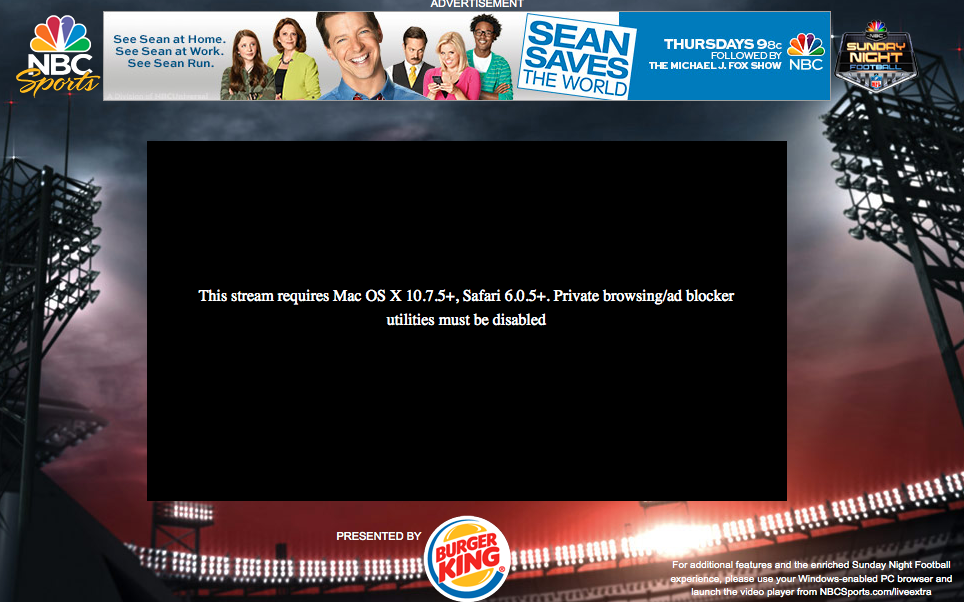
After a special-to-MSR telephone confab with some technical folks on NBC’s staff last week we quickly rooted out why I was able to see the banners and home page of the Sunday Night online broadcasts but not the live video player: According to the NBC folks, my older iMac and its 10.6.8 version of MacOS isn’t technically up to snuff for the special player NBC is using for the Sunday night show.

New error message shown by NBC's Sunday Night Football online to older Mac users. Credit: NBC.

New error message shown by NBC’s Sunday Night Football online to older Mac users. Credit: NBC.

Mind you, my not-that-old desktop does just fine showing every other NBC online offering, including the recent live broadcasts of the America’s Cup sailboat races, or the London Olympics. And for those I can use the browser of my choice, usually Chrome and sometimes Firefox. But because of the NFL’s recent deal with Microsoft, NBC is forced to use a different video player for its Sunday Night Football broadcasts. Though they aren’t completely blocked for Mac users who want to watch, they must have a machine with MacOS 10.7.5 or higher, and can only use the Safari browser. I will spare you the HTML5-related details why this is so, to only say that if you have a Mac and you want to watch SNF online, you need to upgrade your OS, make sure you have Safari 6.0.5 or higher, and turn off any ad-blocking utilities.

Is it worth the pain for you to upgrade your OS? I have no idea how you’d exactly go about doing so, I’ve looked at a few online tutorials but really it’s just not worth it for me (I think there is also a $19.99 charge from Apple for the software). I don’t blame NBC here, I actually can’t praise them enough for marshaling some pretty impressive resources to find the root of the problem for our humble little outlet and our devoted, passionate readers. After our inquiries, NBC also started showing the error message above to users of older Mac platforms, so they wouldn’t wander in the dark questioning their own sanity, like I did for the first few weeks of the season.

Instead I point the finger at the Shield and at Microsoft, for forging some deal that alienates some users solely so that the NFL can spend some more Microsoft cash, and so Microsoft can strike a blow against Apple that it can’t do in open competition. Bravo. Fan first, you know.

If I may editorialize a bit, I would say that the NFL gets away with cutting these bad-for-fan deals (like the exclusive deal with Verizon for NFL Mobile) because it’s so big and powerful that it can. What other entertainment outlet would cut a deal that would only allow 1/3 of the U.S. mobile phone customer base to watch their product? And what about when that service goes kablooey and there’s nobody explaining why? And the Microsoft deal, which cuts off older Mac customers from Sunday night football now and who knows what else in the future, is just another greed-driven strategic ploy that only benefits the NFL and Microsoft, and does nothing for fans.

It will be interesting to see what happens as the NFL moves more toward an MLB-type offering for online video and highlights, a move that we foresee even though we don’t have any solid evidence of it yet. Will the NFL cut deals to restrict access to selected hardware or software platforms? Is this a return to the bad old days of browser cutoffs? Is there a Net Neutrality argument in here somewhere?

Extreme thoughts, maybe, but who would have thought that in 2013 we’d see an entertainment outlet as popular as the NFL limit the capabilities of one technological platform versus another simply because it was paid to do so? And not just once, but several times? Aren’t we paying enough for football as it is? Or should we just get used to paying more, because we have no choice and apparently no seat at the table?

DAS Pig Soooey! AT&T brings DAS upgrade to Razorback Stadium

The loyal fans of the University of Arkansas Razorbacks can now be assured of a better level of cellular connectivity at football games, thanks to a new DAS install at Donald W. Reynolds Razorback Stadium, courtesy of AT&T.

Unlike its recent Pac-12 infrastructure deal, the contract to put better cell coverage in Razorback land is being pitched as part of AT&T’s overall network small-cell upgrade, something AT&T calls Project Velocity IP. For us, the part of the budget it comes from doesn’t matter as much as it is another DAS win for AT&T, and this time in the biggest of college football conferences, the SEC.

AT&T even has a press release out on the news, linked here. We’re working on getting a list of all the recent AT&T DAS wins, since it seems like we’re writing about a new one every week. Anyone else out there putting in more DAS deployments? Let us know.

Ever wonder how adept your NFL team is with social media?

The news from earlier this week that the aptly named AT&T Stadium that the Dallas Cowboys play in had a record amount of Wi-Fi traffic for the teams’ season opening game , 3x over last year, is no surprise to the people at social marketing firm W20 which has rated all of the NFL stadiums for their social media prowess and the Cowboys come in second.

Now this is not just a barometer of Wi-Fi traffic by any means and judges teams on a variety of metrics, but when it is all said and done you need the hardware and networking infrastructure to have a solid approach to social media and AT&T Stadium had 25,000 Wi-Fi connections using up 1.3 million Mbytes of data.

W20 has attempted to rate all 32 NFL teams on their ability to use social media to connect with their respective fans. It used use a proprietary algorithm that indexes social engagement scores from a wide variety of social media sites including Facebook, Instagram, Twitter and YouTube.

Even with a spanking brand new stadium it had to be upgraded during the off season to meet expected demand. The interesting thing is that the 49ers, who play in an old, dilapidated stadium, are number one. However the 49ers, being adjacent to Silicon Valley are quite aware of the importance of social media and are in a place where all of the expertise needed to support it is near at hand.

The team’s new stadium, slated to open next season, is expected to be a state of the art wonder including its wireless infrastructure that it claims will be state of the art.

The interesting thing about the poll is how quickly teams drop in the ratings. The 49ers rate a perfect 100, yet the #5 team, the Washington Redskins, has only a 66.87 rating while the last place Cincinnati Bengals have a 26.91. I think my high school would rank higher!

The NFL is only now catching on that Wi-Fi and other associated social media apps are now a basic component in fans lives. They take pictures from tailgaters to post on Facebook and Instagram, check fantasy results, trash talk friends and a host of other activities.

However they do not just create social media data, they consume it. The teams have a captive audience that is obviously receptive to looking, reading and participating. An Instagram effort to get fans pictures posted, Facebook contests at stadiums, best Twitter commentary, all help to engage fans and are functions teams could be doing, but for the most part are not.

There are a number of other rating systems that have judged the same thing for the NFL, but as we reported earlier the league badly lags in developing and delivering the hardware, networking and apps needed to be at the forefront of the convergence of sports and media.

While the NFL is king of the hill in American sports , the league has been worried about the slow erosion in attendance. New stadiums often push old time fans to poorer seats, expensive parking, seats and food and beverages add on. A big screen at a friends house and NFL Red Zone each weekend might cost a fan just a six pack as the rice of admission. By providing access to social media and the greater world outside the NFL can in some ways make the stadium experience more enjoyable for fans and so help keep them in the parks.

Something to think about next time you are sitting at a game with 5 bars and no connection.

Wi-Fi News: Big Traffic Surge at AT&T Stadium, New Network in Philly, Cisco Video at Barclays

Jerry jonesStill think the Wi-Fi in stadiums thing is a fad that will pass with time? If so we’re not at the peak yet; according to the folks at AT&T, wireless traffic for the NFL season opener at their new namesake AT&T Stadium (aka Cowboys Stadium in Dallas) jumped considerably from last year, with three times the amount of Wi-Fi data used this year compared to last year’s opening game.

According to AT&T network statistics, fans at the Cowboys-Giants Sunday night game made more than 25,000 Wi-Fi connections, using up 1.3 million Mbytes of data in the process. Another 207,000 MBytes were used on the cellular and DAS networks in the building, 30,000 more MBytes than used during last year’s opener, according to AT&T. Good thing AT&T spent the offseason improving the networks inside the stadium, which were almost brand new. So even if your facility has Wi-Fi, it might already need an upgrade. Blame the device makers!

Enterasys Scores Network Win at Philly’s Linc

When Enterasys emerged as the network builder for the New England Patriots’ Gillette Stadium last year, there were questions throughout the industry wondering whether the company was a player in the big-stadium game, or whether it got the deal because of its local presence in New England. Now Enterasys can talk about its next big win, a network for the Philadelphia Eagles’ Lincoln Financial Field. Todd Weiss has a good story with all the details over at CITEWorld, one of our new favorite sites for enterprise IT information.

Cisco Video at Barclays

It’s not exactly news, but the video embedded below is a good explanation of how Barclays Center and its technology leader Chip Foley is making use of Cisco’s stadium video technology to be one of the few cutting-edge arenas that is really offering powerful applications to fans in the building. Look for an extended interview with Chip in our upcoming Fall Technology Review. We met Chip at the SEAT Conference last month, and can’t wait to share his enthusiasm and ideas for bringing a better experience to fans.