Football On Your Phone — Manning Style, Bro

We write a lot about football on your phone — in fact I just did a long, kind of wonky piece earlier this week about the gyrations and gymnastics Verizon and the NFL are going through to justify Verizon’s $1 billion in rights for live football on a cellular phone. Of course there is another way to get football on your phone, and that is to switch your world to satellite and get DirecTV’s pricey Sunday Ticket — which lets you watch every NFL game, any time, on any device… including, yo, your phone.

Do we need a long post about it? No. Just the Mannings, the new TV pitchmen of the century. Take it away, boys.

Football in your pants, yo. I think Mobile Sports Report just jumped the shark.
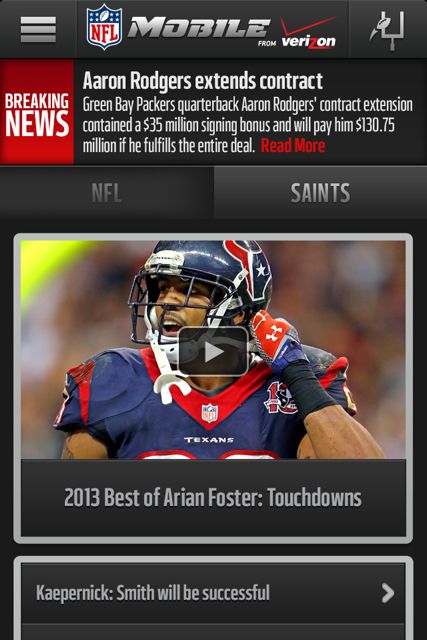
NFL, Verizon Introduce New NFL Mobile App

New NFL Mobile app; photo courtesy of NFL.

New NFL Mobile app; photo courtesy of NFL.

If you, like me, enjoy watching live NFL action on your Verizon smartphone, things are probably going to be a lot better this season as the league and Verizon have teamed up for a full refresh of the NFL Mobile app, which will also be available to smartphone customers of other carriers, with the only catch being that those customers won’t have access to live game action.

In a phone interview with Manish Jha, General Manager of Mobile at the National Football League, we learned about a whole bunch of new bells and whistles, maybe things you won’t necessarily notice, like improved back-end design and more up-to-date score information. What hasn’t changed for the 2013 season is the $5 monthly fee Verizon will charge its smartphone customers to view live NFL games on Sunday, Monday and Thursday nights, along with NFL network coverage and (perhaps most important) live RedZone coverage on Sunday.

(Don’t dismiss the RedZone coverage. If you live in California, like we do, you can sometimes get a full extra live game or two on Sundays because they are the only ones still going on.)

If your phone is from AT&T, or Sprint, or T-Mobile, you won’t be able to watch live action but you also won’t have to fight to find an NFL app that works well to bring you things like video highlights, replays, scores, and fantasy stats. Jha said the NFL and Verizon teamed up to produce one app to rule them all, the new NFL Mobile app which you should be able to find in the operating system app store of your choice. Also built into the new version of the app are some of the features from last year’s experimental Thursday Night Xtra app, which we never felt was fully baked; hopefully some of its interesting social media ideas are better fleshed out this time around.

“We want to make this the definitive NFL experience for a smartphone,” said Jha. And well should the NFL pay a lot of attention to mobile access: According to Jha, during last season mobile traffic to all NFL Internet sites surpassed desktop Internet traffic, even as that latter figure also increased.

Read that again: Mobile traffic to NFL sites eclipsed desktop traffic last year, even as desktop traffic grew. So now you have an idea why Verizon paid $1 billion to keep the rights for 4 more years as the NFL’s exclusive mobile carrier.

The only thing we still argue about is the league and Verizon’s decision to keep live cellular action off tablets; the Verzion NFL Mobile live access only works for devices they consider “phones,” though Jha even admits that such a definition may be a short-time thing, given the trend of phones getting big phat screens.

“We’re staying on top of trends, watching what comes out of Silicon Valley,” Jha said. “Right now we’re being pragmatic, trying to strike the right balance between serving fans and creating value for our sponsor.”

MSR Special Report: Bringing Technology to the ‘Friendly Confines’ of Wrigley Field

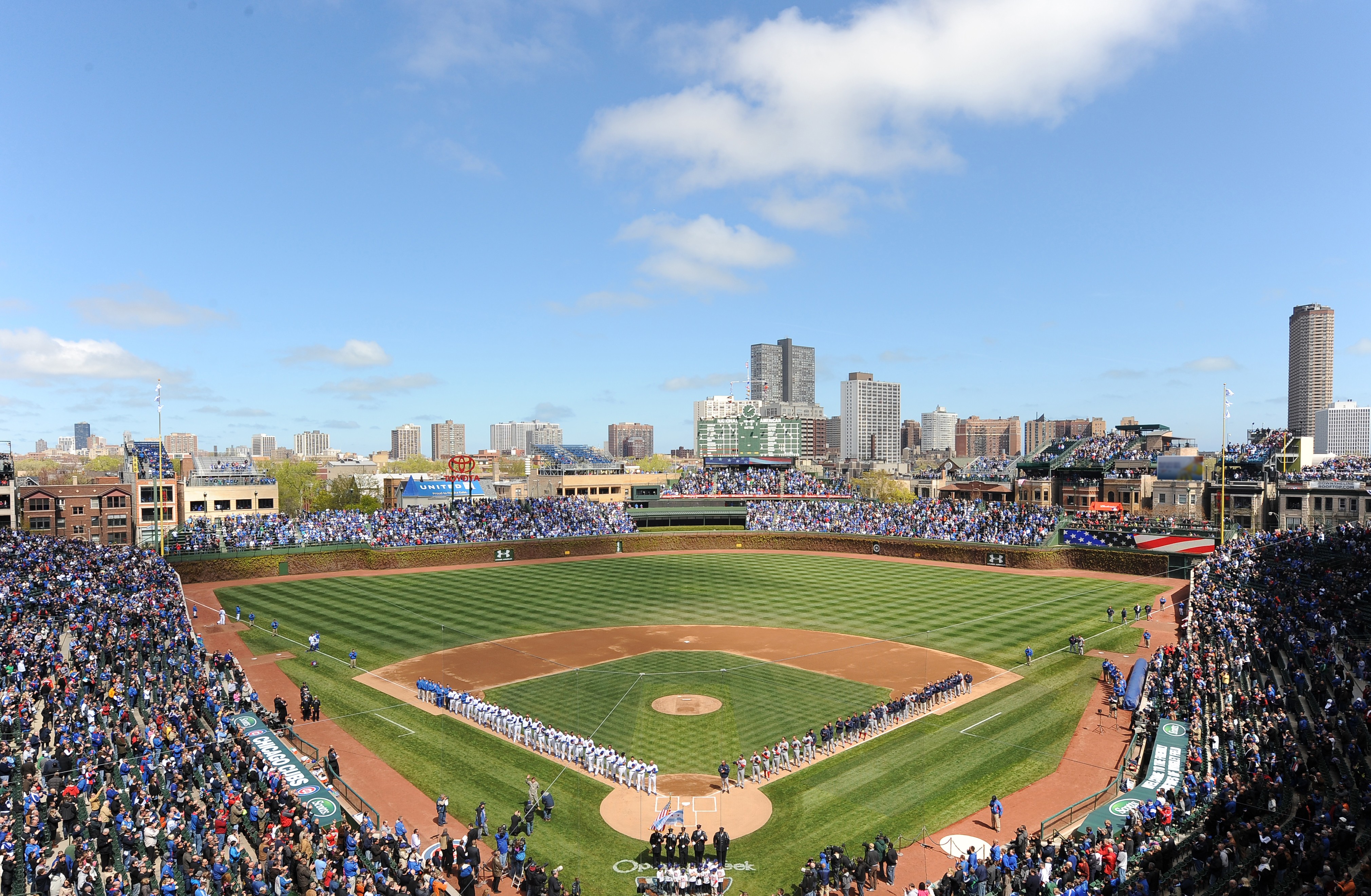
Wrigley Field on Opening Day, 2012. Photo courtesy of Chicago Cubs.  All rights reserved.

Wrigley Field on Opening Day, 2012. Photo courtesy of Chicago Cubs. All rights reserved.

Editor’s note: This is part of a series of interviews with speakers and thought leaders from the upcoming SEAT 2013 conference in Kansas City, Aug. 4-7.

There are baseball stadiums, and then there is Wrigley Field. As a dyed in the blue-pinstriped-wool Cubs fan, I can’t write objectively about the place. It is Mecca, the Friendly Confines, the hallowed outfield walls of ivy. It’s precisely because of people like me that Andrew McIntyre’s job of bringing better technology to the storied ballyard is so much more complex than that of his stadium-technology peers. Wrigley may have one of the greenest fields anywhere, but from an information-technology deployment standpoint Wrigley is about as far away from a “greenfield” project as you can get.

McIntyre, Senior Director of Information Technology for the Chicago Cubs, spoke with MSR recently on the phone to describe the delicate line his organization must tread as it brings necessary technology improvements to one of the world’s great historic sporting venues. In other stadiums, things like a brand-new huge video board would be welcomed, even celebrated. At Wrigley? Renovation plans that include an outfield video board will need to pass muster with national landmark regulations, and survice reactions from a widespread fan base that resists even the slightest changes to the stadium, and work with the unique neighborhood apartment buildings whose rooftops offer views into the stadium.

So when McIntyre said the Cubs need to get “everyone on board” before things like video screens can be introduced, he’s talking about a lot more than people who pull a Cubs paycheck. That extra planning, McIntyre admits, will likely keep the Cubs a bit behind their sports-stadium brethren in certain technology areas, like digital signage. But on many other fronts McIntyre and his technology team are helping the Cubs and Wrigley keep pace with advanced stadium services, like better mobile device connectivity.

Wi-Fi and DAS, with AT&T

Now in his second year with the Cubs, McIntyre and the IT team there has spent a good amount of time putting infrastructure in place that will support future efforts, beginning with things like optical fiber deployments that bring an almost 10-fold speed improvement in bandwidth backhaul.

Andrew McIntyre, Senior Director of Information Technology, Chicago Cubs. Photo courtesy of Chicago Cubs.  All rights reserved.

Andrew McIntyre, Senior Director of Information Technology, Chicago Cubs. Photo courtesy of Chicago Cubs. All rights reserved.

“Some severe infrastructure upgrades were needed here to enable initiatives moving forward,” McIntyre said. “There was historically a lack of investment from the IT side of the house. We’ve been working on a lot of non-fan-facing improvements that are very critical to us.”

One improvement that fans have been able to enjoy for the past season and a half is improved mobile connectivity inside the park, thanks to a neutral-host Distributed Antenna System (DAS) deployment and a stadium Wi-Fi network, built with carrier partner AT&T. “Next time you’re here, keep your eyes peeled for the antennas,” McIntyre said.

Having improved cellular and Wi-Fi connectivity puts the Cubs in the top third of MLB franchises, as by our count only 12 of the 30 major league parks currently offer free fan Wi-Fi services. When it comes to advanced apps and services that such in-park networks might power, like same-day seat upgrades or video replays, McIntyre said the Cubs are paying close attention to pilot programs underway at other parks, and will be “fast followers” when MLB-approved solutions are ready for prime time. (All in-stadium apps in baseball parks can only be run through the league’s At Bat or At the Ballpark mobile app.)

“I don’t think anyone’s knocking it out of the park yet” with in-stadium services, McIntyre said. But McIntyre also said he and the Cubs have met with franchises who are trying leading-edge deployments, including the San Francisco Giants and some European stadiums.

“We’re doing a lot of watching, listening, and learning,” McIntyre said.

Digital Signage as a Communication Vehicle

While most of the heated debate around the Cubs’ renovation plans centers on the size and placement of the proposed outfield video board, McIntyre and his team are looking deeper into a synchronized digital signage strategy, where boards all around the stadium — even, say, a concession stand pricing menu — could become a communications vehicle for the team to send messages out to the fans.

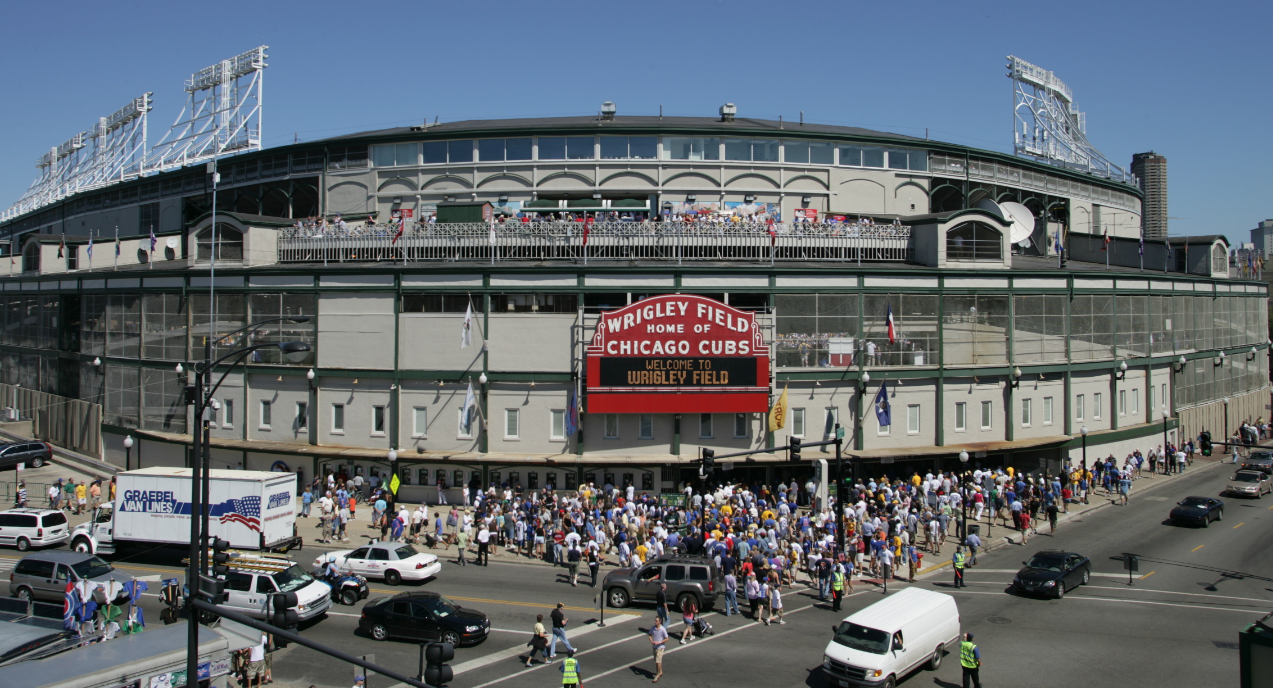
Wrigley Field marquee entrance. Photo courtesy of Chicago Cubs.  All rights reserved.

Wrigley Field marquee entrance. Photo courtesy of Chicago Cubs. All rights reserved.

“One major thing we are investigating is how the signage can change, to become a communications channel,” McIntyre said. Currently, when games go to a rain delay, there’s not a lot of ways for the team to give fans information about when the game might restart, or to communicate weather forecasts and safety instructions. That could change with a digital signage system that can instantly act as a synchronized stadium-wide messaging system.

“The digital signage strategy doesn’t necessarily get highlighted [in public discussions] but it can all become a vehicle to communicate,” McIntyre said.

Andrew McIntyre will be speaking at the upcoming SEAT Conference in Kansas City, Aug. 4-7.

AT&T Deploys ‘Mobile DAS’ to Answer Big-Event Needs

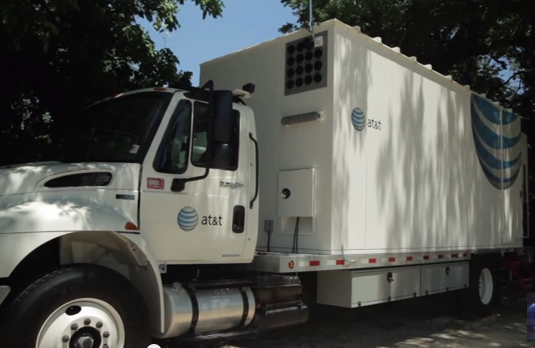
AT&T's Mobile DAS truck

AT&T’s Mobile DAS truck

For many sporting events these days, it’s a challenge to bring the mobile connectivity fans want and need when onsite. It’s an especially challenging task at outdoor events like golf tournaments, where infrastructure may be limited and large numbers of fans may be congregated in hard-to-reach areas, like near tees and greens.

At the recent Crowne Plaza Invitational at Colonial PGA Tour stop in Fort Worth, Texas, AT&T brought some new technology to handle fans’ mobile needs: A mobile DAS, or distributed antenna system, deployment that delivered much more granular cellular coverage to the event than other solutions, like cell towers on wheels (COWs) were capable of bringing.

Simply, by putting DAS head-end equipment into a truck (pictured above) and then by putting up a lot of smaller antennas around the course, AT&T was able to provide more coverage where it was needed, one of the hallmarks of any DAS system. With a few COWs on site as well, AT&T provided a much better level of connectivity than ever before, according to Chad Townes, VP of AT&T’s antenna solutions group.

“Your first choice is always to put in permanent infrastructure, and leave it there if we can,” said Townes in a phone interview earlier this week. But at many places where coverage is needed, like the Colonial Country Club, it simply isn’t possible to string wire and put up antennas. In the past, what cellular providers typically did in one-time situations was bring in the COWs, the cell antennas on wheels. The problem with those antennas, Townes said, is that they sometimes interfered with each other (if parked too closely together), plus they run into the same limitations a regular macro tower has, mainly an inability to handle a big, compact crowd of phone users.

Chad Townes, VP, AT&T Antenna Solutions Group

Chad Townes, VP, AT&T Antenna Solutions Group

Enter the mDAS, which Townes said was “created kind of out of necessity.” With numerous smaller antennas (which don’t interfere with each other as much) AT&T was able to provide much more targeted cellular coverage, a key for events like golf tournaments where fans are often clustered in areas like hospitality tents or greenside stands. Media and tournament officials also put heavy wireless demands on providers, and the mDAS was used to satisfy those bandwidth needs as well.

Townes said AT&T’s mDAS actually got its first test run at the Democratic National Convention a couple years ago, when AT&T didn’t want to sign a long-term DAS lease with the facility the convention was held in. The DAS truck was built, and the antennas were put up the day of the event, with great success. The next question was: Where to use mDAS next?

Inside the AT&T mDAS truck

Inside the AT&T mDAS truck

“Now that we had this asset, what could we do with it?” Townes said. Golf tournaments made instant sense, given their one-time needs for coverage and the infrastructure challenges of an open grassy field. Where else might AT&T deploy mDAS in the future? Maybe at state fairs, or motor sport events held on downtown streets, or big-crowd music festivals, Townes said.

Townes, who is scheduled to speak at the upcoming SEAT conference in Kansas City, said the mDAS was just another way AT&T has responded to the always-changing and never-the-same needs when it comes to providing big-event connectivity.

“Even when you’re putting wireless into stadiums, no two are alike because there are always differences in building materials, or the shape of the bowl,” Townes said. The mDAS, he added, “was just another example of how we had to get real creative” to solve an event’s connectivity needs. (AT&T video about the mDAS at Colonial below)

Sunday Sermon: Get your Seat to SEAT 2013

SEAT_290What are you doing the first week of August? If you are in the business of sports stadium or large-arena technology, you should be planning to attend the SEAT 2013 conference Aug. 4-7 in Kansas City. If you’re not, you’re going to miss out on the chance to interact with real people who are tackling the real tasks of bringing technology to their arenas, to enhance the fan experience while they improve their own organization’s bottom line.

As part of our partnership with the folks who run the SEAT conference we are in the process of putting together some great long-form interviews with the people who will be speaking at the event, and those stories will be appearing soon here on the MSR site. Though I hope the stories are informative and entertaining, I know they’re just a small substitute for the “main course” of information you can get by showing up at SEAT in person, to listen in person to the nuances and details of the work being done by these stadium-technology leaders.

Though we’ve paid a lot of attention to stadium technology here at MSR over the last two years, I’ve always known that we are only scratching the surface when we report, say, a new Wi-Fi network being deployed. There’s always more to the story, and as I am learning through these recent interviews with SEAT speakers, there is almost always something specific and local to a stadium, arena or large-crowd facility that is far different from the norm. Like having to deal with historic building regulations in order to install video boards, or having to satisfy a sponsor contract with a wireless service provider while trying to bring connectivity to all the fans in a facility. We’ll soon have some interesting tales from folks running some of the biggest-name places in the big leagues of sports, so stay tuned to hear their stories.

The bottom line is, there are no easy, cookie-cutter ways to deploy technology. That’s why I think hearing as many stories and insights as possible from the people doing this work today is invaluable. And that’s what you’ll get from Aug. 4-7 in Kansas City at SEAT: up-close and personal interaction with the leading deployers of stadium technology and applications, in a setting set up to foster collaboration and information sharing. Don’t miss out, book your ticket to SEAT today.

MSR, SEAT Conference Announce Strategic Partnership

SEAT_290Astute MSR readers may have noticed the new display ad on the top right hand side of the site, which promotes the upcoming SEAT 2013 conference. Now the rest of the story: Mobile Sports Report and SEAT are teaming up, with a strategic partnership to produce a special report as well as exclusive content centered around the sports technology executive audience.

We’ve long been fans of SEAT’s focus on providing a place for peers in the sports technology market to get together to discuss best practices, new technologies, and smart strategies for improving the fan experience while improving the bottom line. When the opportunity presented itself to join forces we jumped at the chance, and can’t wait to bring the stories of the SEAT attendees to the MSR audience.

If you’re not familiar with SEAT, it is the premier conference for the sports and arena technology executive, taking place this year in Kansas City, Aug. 4-7. SEAT, which stands for Sports and Entertainment Alliance in Technology, regularly attracts the top tech execs from all the U.S. major sports leagues, as well as representatives from entertainment venues and other large-crowd sports whose audiences and business operations present unique technology challenges.

We’ve covered some of those topics here in our focus on stadium Wi-Fi and DAS networks, but we’ll be expanding that charter as part of our partnership with SEAT. Look for exclusive interviews here on MSR with SEAT speakers and thought leaders, and if you choose to attend SEAT (and you should, if this is your field) then you will receive our upcoming special in-depth survey report on stadium technology deployment.

Want more info? Drop me a line here at kaps at mobilesportsreport.com. Better yet, sign up for the SEAT Conference and let’s talk there. See you in Kansas City!