Boingo scores Wi-Fi and DAS deal with Air Force Academy

Boingo Wireless said it will be the exclusive neutral-host DAS and Wi-Fi provider at the Air Force Academy’s football and basketball arenas, in a deal announced Wednesday by Boingo.

While we are waiting to see if we can talk to the Academy folks about their decision, on paper it’s an impressive win for Boingo as the company (perhaps best known for its airport Wi-Fi) expands its presence in the stadium networking world. Boingo currently is part of the stadium networks at Soldier Field in Chicago, and at the University of Arizona and the University of Nebraska.

Boingo will provide services to both 46,00-seat Falcon Field, home of the Academy’s football team (and a place where many press members find themselves wheezing for air due to the mile-high elevation and the long trek up the many steps from the field to the press box), as well as the Academy’s cavernous Cadet Field House, which houses an indoor track, an ice hockey rink and Clune Arena for hoops all in one building.

No word yet about which carriers have signed up for the DAS, or whether the Academy will charge for Wi-Fi access, like Soldier Field does in Chicago. Stay tuned though, because the Boingo folks are usually pretty good at getting us in touch with their network customers.
AT&T running ads about DAS in stadiums… MSR approves

Sure this is an AT&T ad. But an ad about putting in DAS at a stadium? Who would run a copy of this except us? Enjoy all you antenna geeks out there. And… there’s gotta be work for the fan, maybe conduit work? C’mon DAS dudes, let me in on the fun!

You had me at “Do you know how to optimize a 9-beam multi-beam antenna system?”

Stadium Tech Report: Aruba, AT&T team up to bring Wi-Fi to American Airlines Center

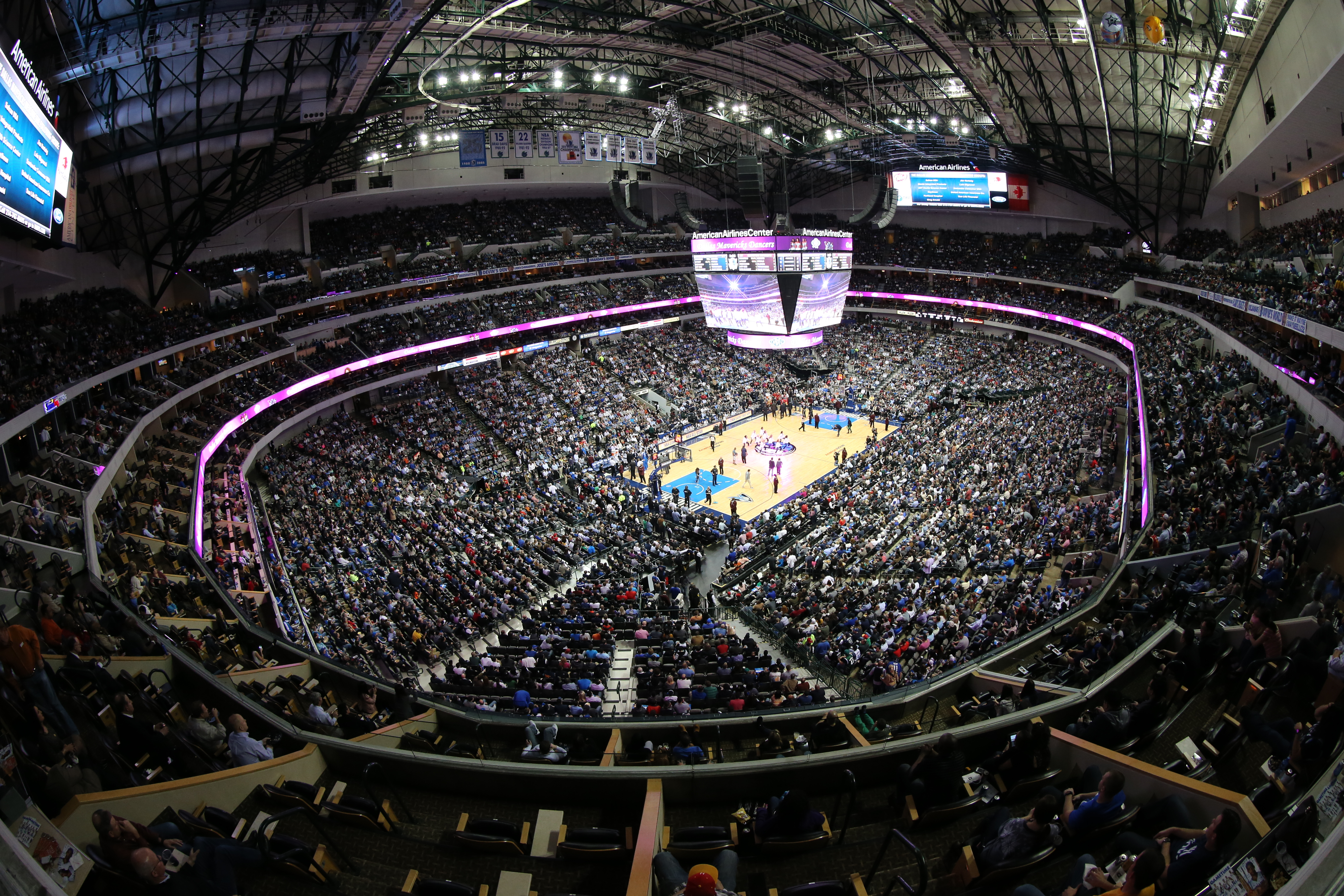
Inside the bowl at American Airlines Center

Inside the bowl at American Airlines Center

After famously voicing his opinion that it just wasn’t needed, Mark Cuban, the outspoken owner of the Dallas Mavericks, at least now grudingly agrees that stadium Wi-Fi is a must-have amenity for NBA arenas.

Last week his team’s home facility, the American Airlines Center in Dallas, formally took the wraps off a powerful new Wi-Fi network. Built by AT&T using 315 access points from wireless gear provider Aruba Networks, the new American Airlines Center network should be at the top of league-arena networks, even if the Mavs’ owner won’t be using it that much. But as he said (in the wake of a SXSW panel last week that was talking about Wi-Fi in stadiums), Cuban isn’t against Wi-Fi anymore. He just thinks you should do more on the floor so that fans aren’t watching their phones.

While Cuban’s points about wanting to keep fans engaged with the game instead of looking down at their phones are well-taken, the reality of an always-connected world is that good connectivity is always in demand, especially at sporting events where fans may seek to use breaks to stay in touch with their digital worlds. And while the 21,000-seat American Airlines Center has had DAS installations for improved cellular, a robust Wi-Fi network allows for greater levels of connectivity, as well as potential future applications that might produce a better fan experience as well as more revenue.

“At some point, you just can’t live without it,” said Lori Glasser-Seinera, vice president of corporate sponsorships at American Airlines Center, in a recent phone interview. Cuban, she agreed, was correct in trying to prioritize the fan experience, but even he now agrees that Wi-Fi needs to be part of the stadium amenities. Joe Heinlein, IT Director for the arena, said that for many fans not having connectivity could be a reason to justify staying home.

“We need to make sure we fill our seats, and not fill the couch,” Heinlein said, in the same phone interview. A good network, he said, is one way of ensuring that fans don’t have a reason to stay home.

Moving from back office to fan-facing

Though the fan-facing Wi-Fi network (which AT&T makes available for free to all attendees) is new, there has been an Aruba-based network in the facility for more than several years. According to Heinlein, the network vendor approached the arena in 2005 “with an incredible offer” to put in a Wi-Fi network for back of the house business operations.

“We’ve used it for internal operations, for the press, and in meeting rooms,” said Heinlein of the 40-AP network that went unseen by fans of the Mavs and the NHL’s Dallas Stars, who also share the building. (American Airlines Center is owned by the city of Dallas, which leases it to the Stars and Mavs.) But 2 years ago, Heinlein said the arena started talking about how to put fan-facing Wi-Fi into the facility, a discussion that involved Dallas-based AT&T, a longtime sponsor for the arena.

“Since Aruba had been a longtime partner of ours we requested that AT&T include them in the deployment,” Glasser-Seinera said. The final result is the new Wi-Fi network announced last week, one where AT&T will use advanced Wi-Fi technology to automatically log in AT&T customers. Other carriers’ customers can also use the network, after logging in through a separate process. Heinlein said the network was a joint project between the arena and partners including AT&T, and as such did not divulge the total costs of building the new network.

Aruba gear helps overcome changing network needs

With more than 200 events during a calendar year, American Airlines Center is a constantly changing venue (think circuses, and concerts), especially when it comes to network coverage. Heinlein said specific challenges to connectivity include the large open space in the center of the arena, as well as the need to extend coverage deeper into the floor for basketball games.

“We have a big hole in the center of the arena, and there’s not a lot of places there to hang [antenna] assets,” Heinlein said. A “good portion” of the APs are located beneath seats, Heinlein said, along with some other ones that are located in vertical risers, which had holes bored into them for that purpose.

“It’s always a challenge to get a signal where you need it,” Heinlein said.

For basketball, the seating plan moves farther out onto the floor than for hockey games, a factor that often has the arena’s IT team being creative in deployment strategies, like putting access points on top of mobile tripods to provide extra coverage.

“The people sitting close to the court are very important customers,” Heinlein noted. “One of the reasons we went with Aruba is that their APs lend themselves to being able to make quick changes, and we use that capability.”

Looking to the future, with a network now in place

Cuban’s opinions about replays not working well on cellphones may keep the Mavs from being on the cutting edge when it comes to stadium apps. But that doesn’t mean the arena will be sitting still when it comes to utilizing its new resource. According to Heinlein and Glasser-Seinera, there are many potential new avenues to explore when it comes to using robust in-building connectivity. One such idea is using Wi-Fi as a GPS type system, to help attendees find resources inside the building more quickly. In the past, such applications could only be dreamed about. Now, they can be tested in the real world.

“Now that the system is in, we can test it and try different things,” Heinlein said. “Now that it’s here, we can explore what’s possible.”

AT&T, Aruba behind new Wi-Fi network at American Airlines Center in Dallas

We’d heard this project was underway but now it’s official: AT&T and Aruba Networks are the forces behind a new Wi-Fi network at the American Airlines Center in Dallas, a 21,000-seat facility that is home to the Dallas Mavericks of the NBA and the Dallas Stars of the NHL.

According to an AT&T press release put out today the new Wi-Fi network will have 315 access points, bringing more connectivity to the AT&T DAS that has already been in place at the arena since 2012. For AT&T customers the network should be fairly simple since the company is supporting automatic authentication, which means no logins or setup screens. Fans who have phones from competing providers will also be able to use the network for free, after visiting a login page.

We haven’t yet been able to talk to AT&T folks or the IT department at the arena, but look for a Stadium Tech Report in the near future. We do know from reporting on our upcoming quarterly long-form Stadium Tech Report that the people running the arena weren’t making any small plans, so it will be interesting to hear about the breadth and depth of the deployment. From a business perspective it’s a big win for Aruba, especially since pairing with AT&T could lead to more stadium deals down the road.

It’s also always interesting to hear about AT&T getting behind a Wi-Fi deployment, since the company can often seem of two minds about Wi-Fi in stadiums. From the sounds of it, this is one of those “big name” deals where AT&T likes to get involved from the bottom up — and since it’s in AT&T’s home turf it makes sense that AT&T would want a big part in any wireless deployment close to its corporate offices. Here’s a quote from the press release:

“Providing Wi-Fi at premier venues like American Airlines Center is part of our strategy to mobilize everything for our customers,” said Aaron Coleman, AVP, AT&T Wi-Fi Solutions, in the AT&T press release. “By working with stadium venues to strategically design and deploy an in-stadium network we can satisfy the connectivity demands of the business and enhance the way teams and venues engage with their fans.”

As we said, we hope to have more details soon so stay tuned.

Stadium Tech Report: Comcast says Niners planning for 100 percent fan usage of Levi’s Stadium Wi-Fi network

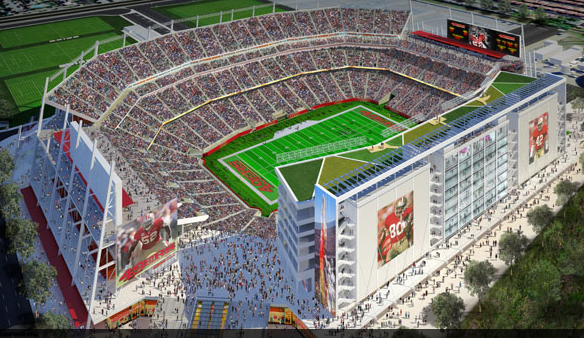
Screen shot 2014-02-25 at 4.16.18 PMEven as some other sports teams across the country are facing lower than expected usage of their in-stadium wireless networks, the San Francisco 49ers are planning for full capacity use of the Wi-Fi in their new Levi’s Stadium, according to the company supplying the back-end bandwidth.

“Many stadiums plan for 10 to 15 percent [of fans] using the network,” said Mike Tighe, executive director of data services at Comcast Business, in a recent phone interview following the announcement that Comcast would provide some huge pipes — twin 10 Gbps Ethernet fiber lines — as part of its Wi-Fi sponsorship deal with the Niners and Levi’s Stadium. But the Niners, Tighe said, know that their new stadium is a different beast, located smack dab in the middle of super-connected Silicon Valley. As such, Tighe said the team is building a network designed to support a connection from each and every one of the 68,500 possible fans who can fit in the new facility.

“The Niners know the Valley is a tech center, and they are planning for 100 percent of users [on the network],” Tighe said. The new stadium is located south of San Francisco in the city of Santa Clara, the headquarters location of many high-tech companies, whose always-connected workers are expected to be a huge part of the new stadium fan base. Though the team may never truly see 100 percent network use, it is a good bet that Niners’ crowds will be significantly heavier wireless users than the norm. That’s why Comcast is providing the twin 10-gig connections, which Tighe calls “the fattest pipes we offer.”

Comcast’s stadium expertise expanding

Over the last year or so, Comcast has built up an impressive resume of stadium-backhaul deals, with contracts that include bringing business-class services to the stadiums of the Denver Broncos, the Boston Red Sox and Boston Celtics, the Washington Nationals and the Oakland Athletics. Comcast, with headquarters in Philadelphia, also supplies bandwidth and Wi-Fi to the Philadelphia 76ers at Wells Fargo Arena and to the Phillies at Citizens Bank Park.

As providers of the service that eventually connects fans to the Internet, Tighe and Comcast have a front-row seat to the ever-expanding use of mobile devices at stadiums and arenas. One of the selling points of an Ethernet connection is its ability to rapidly scale upward, something Tighe said sports teams are rapidly learning about, especially if the team does well on the playing surface.

The Boston Red Sox, for instance, had a 100 Mbps Comcast connection, but then the team made the playoffs and network demand surged, Tighe said. “The good thing was, we were able to upgrade [the link] to 1 Gig in a week,” he said.

One new twist to wireless networking in stadiums is the need to equally support upload and download traffic, something Tighe said is much different than traditional cellular or wireless deployments, where download traffic was typically as much as five times as big as upload traffic. In stadiums it’s much different as fans spend a lot of time snapping pictures and videos and uploading them to friends or to social media websites.

“People in the stadium are content publishers,” Tighe said.

More stadiums are learning about networking demands

While some stadium tech representatives are still underestimating their potential network capacity needs, Tighe sees a general uptick in the technical knowledge base as more fans arrive with big-screen smartphones and tablets on game days.

“Everyone [in the stadium tech business] is learning and becoming more and more tech-savvy,” Tighe said. “They know people are coming to the stadium with phones and tablets, and expect to view plays from different angles and see replays.”

And when it comes to stadium networks, there may not be a more-anticipated opening than Levi’s, which is scheduled to open its doors to soccer games this summer ahead of the Niners’ season this fall. Tighe is confident that the network — and its backhaul — will change minds as to what is possible in the stadium networking market.

“When people see what the Niners have done it’s going to cause a lot of teams to rethink the fan experience,” Tighe said.

NBC scores with huge online numbers for Olympic hockey, even with cable restrictions

The combination of some must-see competition — U.S. vs. Canada in ice hockey — led NBC’s Olympic online efforts to a couple days of record-setting numbers in terms of overall viewers. Friday’s men’s semifinal game will go down as one of those watershed moments in online sports viewing, with NBC reporting more than 2.1 million unique users of the network’s “Live Extra” online video. Friday’s totals followed Thursday’s 1.2 million online viewers of the women’s gold medal game between the same two countries.

While several factors probably contributed to the perfect storm of viewership on Friday morning — an important game, during the least important day in the U.S. work week — what makes the more-than-a-Super-Bowl total even more impressive is the fact that if you were watching the game, you almost certainly had a cable TV contract to allow access. While we give credit to NBC for its achievement, we can only wonder how big the online number could have been if NBC had opened up its Olympic online coverage to all viewers, not just those with cable validation.

In the wake of this week’s blockbuster $19 billion acquisition of WhatsApp by Facebook, it’s worthwhile to ask whether or not broadcasters are being too old school when it comes to monetization models for big events like the Olympics. I don’t know the answer to this, but how much money could NBC potentially reap if it tried a WhatsApp pricing model — say, $1 for all Olympic streaming coverage — instead of restricting it to current cable customers? Here’s another idea: How about a streaming channel that shows the prime time coverage, without commercials, without blabbering hosts, available at hours children can watch? Anyone else out there like me who would gladly pay an extra $5 for something like that? Of course, then NBC’s prime time numbers would fall even further than they have already.

So yes, cheer for the massive online numbers. But the fact that just about every big event keeps setting new mobile/online viewer “records” should be a message that there is possibly a bigger untapped audience out there, maybe even far larger than the conventional TV/cable audience. Remember, at the last Olympics WhatsApp barely existed. The current model of sports-content distribution reminds me more of the cellular carriers’ approach to text messaging (remember 10 cents a message?) than WhatsApp’s version. And it’s pretty clear who’s winning that battle. It’s not the team who never saw the competition coming because they played by different rules.