Stadium for next U.S. World Cup game will have Ruckus-powered Wi-Fi available

Talk about luck of the draw: Fans of the U.S. men’s soccer team who are on hand for the squad’s next game on Tuesday, July 1, should be able to use a Ruckus Wireless-powered Wi-Fi network at the 51,900-seat Arena Fonte Nova in Salvador, Brazil.

As MSR reported last year, Ruckus Wireless won contracts to supply the Wi-Fi gear for at least two of the stadiums being used in the World Cup tournament. One of those was Arena Fonte Nova, which will now host the USA-Belgium tilt in the elimination round. And with U.S. fans leading the way in on-scene participation in the World Cup, it’s a good bet that the Arena Fonte Nova network will get a workout on Wi-Fi since it’s probably a good guess that cellular roaming fees might be prohibitive. (We say this having no idea what the roaming charges might be for U.S. carriers in Brazil; but if the Wi-Fi is free, we can say without a doubt that’s the cheaper option.)

According to Ruckus the Wi-Fi network at the arena (which is also called the Estadio Octavio Mangabeira) will have about 150 access points, which to us sounds a bit low for full stadium coverage for a 51,000-seat arena, but again, we’ve not seen any stats for a Ruckus solution in real-world situations so maybe it’s enough.

With more news about players biting players and Brazilians protesting the World Cup, it’s not surprising that we haven’t heard much in the way of news about performance or non-performance of wireless networks at the numerous stadiums. Unlike an Olympics or a Super Bowl, where you are in one place for a long time, the World Cup seems to be more about sporadic visits to different stadiums, and a lot of travel, and probably a lot more time spent just enjoying the scene rather than worrying about tweeting it or posting to Facebook. And since there is no reliable news source for overall network operations for the World Cup, we don’t have any statistics or performance metrics to report. But so far so good, eh? If anyone knows of any specific problems or reports of poor performance send them our way. And if anyone is in Salvador next week, take a Speedtest of the Wi-Fi and send it along.
StadiumPark touts ‘EZ Pass for stadiums’ parking app idea

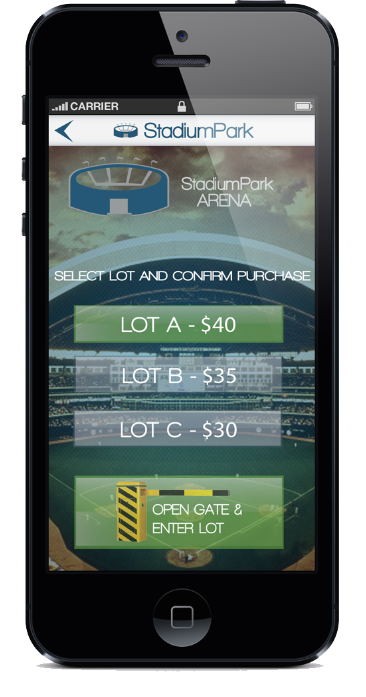
Screen shot of a potential StadiumPark app. Credit: StadiumPark.

Screen shot of a potential StadiumPark app. Credit: StadiumPark.

At first blush, it’s an idea so simple you wonder why it hasn’t been thought of before: Why not build a system that mimics highway EZ Pass functionality to make parking at sports events easier?

That’s the simple but powerful idea behind StadiumPark, a Rochester, N.Y. startup that has developed an app that will let fans pay for parking with their phones, in the hopes of curing one of the main pain points of live game interactions with a faster, easier experience that can benefit teams and stadium owners as well. Though StadiumPark doesn’t yet have any announced customers, it’s a good bet that before long some stadium owners and operators will take a chance on the idea, which is designed to also automatically open parking-lot gates, further reducing human overhead.

In a recent phone conversation with StadiumPark’s 26-year-old founder, Jeremy Crane, we learned the skill sets behind StadiumPark’s insights: According to Crane, part of his work background includes time spent with a large parking-lot company in Rochester that handled concerns like apartment buildings and some stadium lots. An interest in learning more about mobile parking payment systems opened Crane’s eyes to the idea of parking-payment methods other than people in vests taking cash payments through a car window.

A request from Syracuse University, Crane said, to develop an “EZ Pass type app” for parking at the school’s Carrier Dome spurred him into entrepreneurial action, and StadiumPark was born. The combination of an app (which requires users to pre-register with a credit card) and the wireless technology smarts to open parking-lot gates is the main selling point for StadiumPark, which Crane said is in discussions with several potential clients.

If the system works as advertised, it could potentially cut down on the amount of time fans spend in parking-lot lines, one of the banes of live-game attendance. For stadium owners and operators, there is an extra possible incentive of having greater control over parking payments, as well as potentially having more data on fan attendance beyond ticket sales.

“For the venue, the idea is to enable a better experience,” said Crane. “We see a clear advantage to both the stadium and the fans.”

StadiumPark’s business plan is to charge users a small convenience fee, while not charging stadiums or venues. For the system to work well it must clearly have buy-in and promotion from the arena owners and operators, to steer traffic to the StadiumPark-enabled lots. But if the quick rise in mobile parking payments for other places — like airports or shopping areas — is any indicator, a simple app that lets you park quickly and conveniently is one of the uses of technology that could probably gain rapid adoption from fans who just want to get to their seats.

AT&T: Hoops fans use more data than hockey fans

In a somewhat-not-surprising statistical revelation, AT&T said that basketball fans used more wireless data on its network than hockey fans at the respective arenas during both leagues’ recent championship series.

Using measurements of only AT&T customer traffic from the AT&T digital antenna system (DAS) deployments in arenas in Miami, San Antonio, Los Angeles and New York, AT&T said that hoops fans at the NBA Finals had both higher average data consumption rates and peak data rates than their NHL-watching counterparts. And when it came to home-fan data use, Miami’s American Airlines Arena hit the highest mark, with an average of 177 gigabytes of data used at the two games played in South Beach.

Though the San Antonio Spurs won the NBA title, fans at AT&T Center in Texas used an average of 138 GB of data. Miami’s arena also generated the highest peak data total of 223 GB of data. Of course maybe most of that was Miami fans using OpenTable to make early dinner reservations as the Spurs started blowing the Heat off the court.

On the frozen side of things, Los Angeles won both the real title and the data title, with fans in the Staples Center using an average of 98 GB of data during the three games there during the Stanley Cup Final. The average data usage in New York at Madison Square Garden was 83 GB of data on the AT&T network.

In defense of hockey fans, it’s really no surprise that they used less data since hockey games, especially playoff games, are mostly action and excitement, and not a million time outs. Plus, we all know that had the Chicago Blackhawks been rightfully in the Final to defend their title from last year, Da Hawks fans would have pushed everyone to shame with video renditions of the Chelsea Dagger. Next year.

NBC sets streaming records for Stanley Cup final

Call us biased, but we bet that the numbers would have been even better had the Chicago Blackhawks been in the Stanley Cup final instead of the Los Angeles Kings. Still, according to NBC, this year’s Stanley Cup Final recorded record online streaming numbers “for virtually every metric,” according to a press release out today.

Here are the figures from NBC: “Live streaming for the five-game 2014 Stanley Cup Final on NBC Sports Live Extra delivered 603,000 uniques and 37.14 million minutes, up 38% and 22%, respectively, vs. last year and made 2014 the most-consumed Stanley Cup Final ever.”

For the entire NHL playoffs, NBC said it had 1.52 million uniques and 201.50 million minutes watched, “the best-ever for an NHL post-season” and an increase of 180% in uniques and 183% in minutes as compared to last year.

One question we have for cable and broadcast execs: Do the authentication measures really help with cable subscriptions? Or are they just a kind of feel-good thing to make cable providers feel like people aren’t getting “free” content? I’d love to see some proof or stats that say the authentication measures are valuable — as opposed to the good will and free marketing you could reap by just making stuff free online. Because really, nothing is “free” online — if you want to watch sports online you still need broadband, which isn’t really free anywhere.

Off the soapbox now. And hoping that next year when the Blackhawks return to their rightful perch atop the league, the online numbers will double this year’s.

Stadium Tech Report: Miami Marlins rely on ExteNet DAS to keep wireless traffic flowing

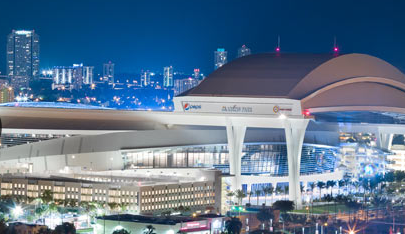
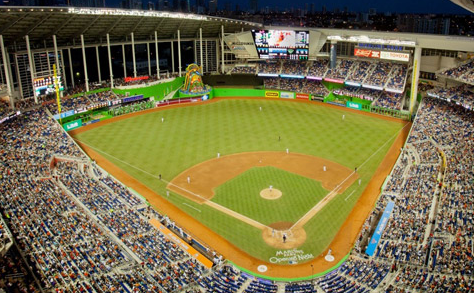
Marlins Park. Credit all photos: Miami Marlins.

Marlins Park. Credit all photos: Miami Marlins.

If you know anything about Marlins Park, maybe it’s the stadium’s unique retractable roof or the spectacular art that catches your eye. But there’s also something you can’t see that is equally exciting, at least when it comes to the in-stadium connectivity experience: A neutral-host distributed antenna system (DAS) that has more than kept pace with the rapid, continual increase in fan cellular activity.

“When it came to DAS, we were ahead of the game,” said David Enriquez, senior director of information technology for the Miami Marlins, in a recent phone interview. Well before the 37,000-seat stadium opened in 2012, Enriquez said the Marlins’ IT team was researching and planning for enhanced cellular connectivity – even before “DAS” became a hot industry acronym.

“We planned for a DAS even before they were in vogue,” said Enriquez. “We saw it as a necessary evil.”

With the iPhone and all its cataclysmic changes already in motion, Enriquez said the Marlins wanted to avoid what had happened recently at another arena that opened in the Sunshine state without good connectivity.

“What we didn’t want to see was something like what happened in Orlando, when they opened the arena [in 2010], it had bad coverage, and they were crucified in the press for bad [cellular] service,” Enriquez said. “We said, what we’d love to have is the complete opposite of that.”

David Enriquez

David Enriquez

At the opening of Marlins Park, the connectivity inside the walls was better than most, with a full-park Wi-Fi network using gear from Meru Networks and a neutral-host DAS deployed by integrator ExteNet Systems. And though Wi-Fi often gets the headlines when there is talk about stadium networks, in many facilities like Marlins Park, the DAS is an equal workhorse, since many fans still either don’t know how or don’t take the time to switch their devices over to Wi-Fi.

DAS is the workhorse

According to Enriquez, on an average night at the ballpark the Wi-Fi network will handle 40 percent of the wireless traffic, with the DAS taking care of the other 60 percent. That may be because of lack of knowledge, or perhaps satisfaction with the signal the DAS is giving them, Enriquez said.

“Early on, most people, honestly, did not know how to change [their phone] to Wi-Fi,” Enriquez said. Most fans, he added, weren’t typically streaming lots of video — they may, he said, have used the MLB At Bat app to look at a replay or two, but that could all be handled by DAS. “That trend is changing though and we are seeing much more video traffic, especially with the younger generation of guests,” Enriquez said.

Marlins Park outside

Marlins Park outside

“The truth is, many users may not take the time to switch [to Wi-Fi],” Enriquez said. “If they’re getting 4 to 5 bars on their cellular signal, they’re happy.”

Though the Marlins and ExteNet now have five major carriers on their DAS – AT&T, Verizon Wireless, Sprint, T-Mobile and MetroPCS (now part of T-Mobile), Enriquez said there was a bit of the chicken and egg problem at the start.

“Early on, nobody wanted to be the first on (the neutral DAS),” Enriquez said. “ We [the stadium] were just another node. Now, 3 years later, we are a central node in the Miami area and all the carriers are here. We’re a very central location.”

Staying in neutral

Enriquez, who has considerable experience in the large-venue IT world, said that having a neutral host for the DAS eliminates any potential concerns about favoritism between service providers. Even though costs to the team or stadium may be lower if they allow a carrier to take over DAS deployment, Enriquez said that for the Marlins a neutral host was worth the extra price.

“We didn’t want an advantage to be held by one carrier,” Enriquez said. Even if a carrier says it will act as a neutral host, when one carrier owns the deployment, others can “find it hard to believe there will be an equal time slice” when it comes to antenna access.

“We just wanted to avoid that, and make it irrelevant [as a concern],” Enriquez said.

The choice of bringing in an integrator like ExteNet, he said, provides an additional streamlining of operations, as there is now a single point for vendors to interact with to work out technology and deployment issues.

“We wanted to deal with one vendor – I didn’t want to be the middleman between the carriers and the Marlins,” Enriquez said. In that regard, he said, ExteNet has been “wonderful” as a neutral host. “They deal with all the carrier issues that I have no desire to deal with,” Enriquez said.

Less space needed for DAS upgrades

And even as fan cellular bandwidth use continues to grow – requiring carriers to constantly upgrade their systems – Enriquez said that DAS infrastructure is benefiting from improved technology to the point where even as carriers upgrade, their head end footprint is shrinking.

AT&T, for instance, has upgraded its DAS presence in Marlins Park four times over the past 2 years, Enriquez said, to the point where the carrier now has coverage for all four frequency bands. “They [AT&T] have done quite a bit to expand their coverage,” Enriquez said.

Still, the Marlins Park DAS head end hasn’t had to find new space beyond its original 1,500-square foot enclosure.

“Every time someone comes in to replace gear, we have a smaller [DAS] footprint,” Enriquez said. “It’s not going to eat you out of house and home anymore.”

Like other stadium IT directors, Enriquez is still surprised by the amount of wireless traffic generated by the fans who come to the games. “It’s incredible to see the need [for bandwidth” grow,” he said. “But people continue to give our network a thumbs up, we see that in our guest comments all the time. I just don’t know what we would do without the DAS.”

The U.S. Open’s last hurrah on NBC, ESPN — last chance for good online golf?

If there’s one thing that’s been a bonus of ESPN’s coverage of the U.S. Open golf championship, it’s the fact that for those of us on the West coast, coverage starts at 6 a.m. local time. That means that by the time most of us are at our computers Thursday or Friday, there’s already live golf to be found. For one last time, we’ll enjoy it as the lads tee it up at Pinehurst No. 2 starting Thursday morn.

Will it be the same next year when Fox takes over? Though Fox did a decent job of the Super Bowl online this past big game, there’s no telling how good or how bad Fox’s golf broadcasts will be, and much less how much Fox will devote to online efforts. If the past is any clue, we may see a regression of sorts when it comes to online options from Fox. For this year, anyway, we’ll still have the rich options usually available from ESPN (including the WatchESPN app) as well as the above-decent online offerings from NBC for the weekend play.

You can, of course, also use the official U.S. Open apps or mobile websites to get mobile/online coverage of two featured groups and featured holes, a la the Masters but with less depth. And if you can stand the amount of time it takes for all the dumb features to load, the PGA’s new home page will certainly be kept up to date with scores and video highlights, as well as pointers to where you can watch live stuff.

NBC, which earned all kinds of honors recently for its online coverage (especially its Olympic streaming efforts) still, in my book, is learning how to do all this. Yes, there was lots of Olympics stuff online, but you had to hunt really hard to find the actual live programming late at night from Sochi — and when you did, the NBC window could spoil the results for you, since the integrated Twitter feed was usually a minute or two AHEAD of the NBC “live” online broadcast. Still, NBC and the NBC-owned Golf Channel should have more info and analysis than you could possibly want all weekend.

If you are watching on an actual television set, the ESPN coverage on Thursday and Friday goes from 9 a.m. Eastern to 3 p.m. ET, then you switch over to NBC for two hours, and then back to ESPN for the last two hours of coverage. On the weekend, it’ll be the last call for Johnny “63” Miller as lead broadcaster, as NBC covers things from noon ET to 7:30 p.m. Saturday, and Sunday from noon until the winning putt drops. Or until there’s a tie and an 18-hole Monday playoff.