Stadium owners and operators — take our 2014 technology survey!

Call this a call to action for all of you who are part of stadium ownership or operations teams: We need your participation to help make our upcoming State of the Stadium Technology Survey for 2014 better! With our surveying underway, we already have more participants for this year’s survey than we had for last year’s inaugural effort. But the results get better with each new stadium, team or ownership group that participates, so read on below on how to sign up and add your information — and get a free copy of the results and analysis afterwards!

Done in a partnership with the SEAT Consortium, and set to be unveiled at the SEAT 2014 Conference in Miami on July 20, our State of the Stadium Technology Survey covers the main areas of stadium technology deployment, including Wi-Fi, DAS, Sports CRM, Digital Marketing, Social Media, and Digital Signage. We already have participants from all the major U.S. professional leagues, along with many major colleges as well as other large public venues like race tracks. When we close out our surveying in a couple weeks, we’ll tabulate the results and add in our analysis to produce our 2014 “State of the Stadium” publication, which we will make available to all attendees at the 2014 SEAT conference. All participants in the survey will also get a digital copy of the publication, whether they attend SEAT or not.

How can your team, school or stadium participate? There are two easy ways: One is to send me a direct email to kaps at mobilesportsreport.com, and I will send you the link to our online survey (which takes only several minutes to complete). You can also get a link by subscribing to our email newsletter; later this week there will be an email sent out with a link to the survey site, where you can view the questions and submit your answers. Again, by participating you only help make our results better — and in the process, you get our results and analysis for free for your school, team or stadium to use in your own deployment efforts.

Thanks in advance for your time and help!
Report excerpt: At Bat app driving the MLB digital experience bus

Editor’s note: The following excerpt from our MLB technology deployment analysis comes from our Stadium Tech Report for Q2 2014, which includes a wealth of information, research and analysis about the stadium tech marketplace. With a focus on Major League Baseball technology deployments, the report is available free for download so get your copy today. Enjoy the excerpt that follows.

At Bat driving the application bus

If there is one other thing that defines MLB’s digital advantage, it’s the league-wide requirement to use the MLB.com’s At Bat app as the only in-stadium app offered by every team. Though there is some grumbling heard from time to time from teams who want to innovate at a faster pace, for these early days of digital in-stadium experience having At Bat as a base is most likely a huge bonus, since it makes it easier for fans to learn how to find and use the features, no matter which stadium they are in.

Though we here at MSR are more in favor of an eventual open infrastructure – say, a package of MLB-approved APIs that third-party developers could use to bolster the At Bat ecosystem – in these days when fans are still learning how to connect to Wi-Fi and are still getting familiar with the idea of using their phones to purchase in-game seat upgrades or to order concessions, it’s probably not a bad idea to limit choices.

The interesting thing to watch may be to see if, in a few years, MLB has metrics to back up its all-for-one strategy, or whether the MLB digital team decides (like Apple and the iPhone) that opening up the platform could lead to more innovation. The good news for fans is, with better connectivity and more apps, going to games should be easier and more fun as time goes on.

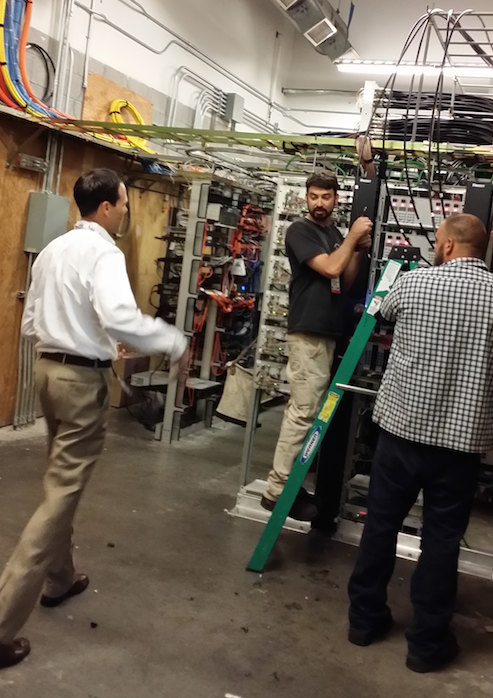
Giants CIO Bill Schlough (left) talks with workers in the park's main DAS head end facility.

Giants CIO Bill Schlough (left) talks with workers in the park’s main DAS head end facility.

DAS upgrades are good news

Maybe the best news on the DAS front is what seems to be (finally) some benefit from the always-improving pace of technology – accord- ing to several teams we’ve talked to recently, a pleasant surprise that comes about during DAS upgrades is the fact that head end equipment footprints are actually decreasing, meaning that the space crunch often caused by DAS may be easing somewhat.

Of course, some of those space savings may be eaten right back up by additional carriers joining in, or by existing carriers adding more coverage support. A continued issue that we will keep watching is whether or not more teams and stadium owner/operators choose neutral third- party hosts for their DAS, or whether they trust that a single carrier will be able to balance the needs of all. In our interview with AT&T’s John Donovan for this issue he said that he doesn’t think any carriers want to use DAS deployments as a strategic advantage over others; we will track your stories and what happens in the wiring closet to see if his opinion reflects reality.

To read the rest of our analysis, download your free copy of our Stadium Tech Report for Q2 2014.

Mobile technology and the Tour de France: Good, bad, ugly, cool — and you still need to pay NBC to watch it live online

Ever wanted to know what the Tour de France looks like from right in the middle of the pack? You now can see what it looks like for yourself, thanks to some on-bike cameras being used on a trial basis at this year’s race. Here is a link to a clip from Stage 1 that shows what it’s like to see a crash happen right in front of you. Great stuff, the kind of smart use of mobile technology that we’ve been waiting for since GoPro cameras hit the scene.

(For some reason it looks like the TdF is making some of these videos private, so watch them while you can. We also agree with what some commenters have been saying — what’s with the cheesy overdubbed music? Just use cycling action noise, please… thanks)

Of course, with technology advancements come things both good and bad, and if there is a crisis-about-to-happen trend it’s the proliferation of fans alongside the Tour de France trying to snap selfies with the racers in the background. Look, we get it: You are at a bucket-list type event, you spent hours by the side of the road waiting for the too-brief minute or two of action… so hell yeah, you’re going to snap a selfie to show everyone else how cool and important you are! Superb!

(VeloNews also has a report on the problem.)

The only problem is, over the last couple years, it’s become pretty obvious to anyone who watches Tour de France coverage on TV that the exuberant fans of old — usually fat old French guys who would sprint alongside the riders, on the steepest inclines where a human running can keep up with a bike for short distances — have now been replaced by a crew of idiots who know nothing about bike racing, but who want to be on TV. Or on the Internet. They dress up, they run in the road, they block the path of cyclists and motorcycles — every day now we hold our breath, hoping like hell there isn’t an incident where a fan takes out a leading rider, or far worse, a cyclist or fan suffers a terrible injury because some idiot was out in the middle of the road. Combine the idiot behavior with the turned-around selfie head not looking at what’s coming and you have a toxic stew. Who will save these jerks from themselves?

I’ve been around big bike races enough to know that there’s really no way of keeping these crowds completely controlled, short of putting up fences like they do for the last 1,000 meters in tour stages. Even then, people lean over the fences and cause crashes. I get it that part of the romance, the excitement of the Tour is the up-close involvement of fans. But these days it seems like it’s 90 percent self-important party clowns lining the roads, and not people who really care or understand the event. So far, it seems like the Tour has done little to try to tone down the on-road crowding. Let’s hope someone figures something out before there’s a race-changing or life-changing incident.

Crowds overwhelming cellular signals again?

This report is somewhat unconfirmed but in watching the NBC coverage live early this morning west coast time we heard one of the on-course reporters saying something about how team cars couldn’t communicate from the front of the pack to the back because they couldn’t get a cell signal — courtesy of the huge amount of fans lining the road for the stage into London. Shades of the Olympic road race! Guess they still haven’t figured out how to handle cellular crowds in the UK countryside.

TourTracker partners with CyclingNews: Best of both worlds!

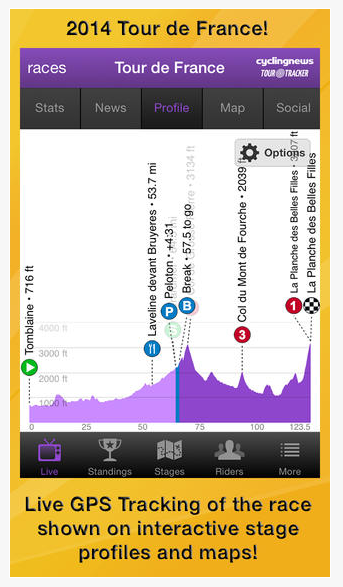
Screen shot of TourTracker TdF app

Screen shot of TourTracker TdF app

We are also happy to see that our favorite live-action tour-following app, TourTracker, is now finally available for Tour de France coverage thanks to a partnership with CyclingNews. We’re happy for founder Allan Padgett and TourTracker… the best way to follow the biggest race in a mobile fashion. Unfortunately, the TourTracker app won’t have live video coverage — for that you still need to pay NBC extra, to the tune of $4.99 a day or $29.99 for the whole race. For mobile access only it looks like the charge is $14.99; not sure if there is also a per-viewing charge as well as a charge for the app.

How do we feel about NBC milking cycling fans for chump change? It wouldn’t be so bad if you could ensure that Phil Liggett and Paul Sherwen were the only commentators heard, but from my short viewing stint today it appears that NBC has loaded up the announcer roster with those “other guys” that people generally can’t stand. My suggestion to Phil and Paul — hold some classes in the offseason to train the next generation of announcers! Please!

Report excerpt: AT&T’s Donovan talks stadium DAS

Editor’s note: The following excerpt from our exclusive interview with AT&T senior executive vice president John Donovan comes from our Stadium Tech Report for Q2 2014, which includes a wealth of information, research and analysis about the stadium tech marketplace. With a focus on Major League Baseball technology deployments, the report is available free for download so get your copy today. Enjoy the excerpt that follows.

AT&T senior executive vice president John Donovan

AT&T senior executive vice president John Donovan

John Donovan: The ‘network chief’ talks about AT&T’s successful stadium strategy

In a strategy borne by necessity, AT&T has become far and away the leader in deploying distributed antenna system (DAS) technology in stadiums and other large venues across the country. In a recent phone interview, Mobile Sports Report spoke with the man behind the plan, AT&T senior executive vice president John Donovan, who told us the hows and whys behind AT&T’s DAS strategy, and how AT&T is continuing to innovate to improve DAS performance. Donovan also offered some interesting insights about large-venue wireless consumption patterns, based on AT&T’s thorough and varied operator experience, which is likely second to none.

With 670 DAS systems deployed in large venues, including 150 in the past year, AT&T has no plans to slow down. In fact, Donovan said AT&T will deploy another 250 DAS systems this year, adding to its impressive totals for presence in large public venues. According to Donovan, AT&T DAS systems are currently active in 75 percent of the “big 4” professional sports venues in the U.S. (football, baseball, basketball and hockey), a list thaat includes 90 percent of NFL stadiums. AT&T also has DAS deployments in a large number of top college stadiums, making Donovan confident that his company is far and away the top provider of enhanced cellular services in stadiums.

“We are absolutely crushing the competition on performance in venues,” said Donovan, who 5 years ago spearheaded a move inside AT&T to create a team that specifically targeted large public venues. Now, the fruits of that team’s labors are paying off.

Building the DAS group

The several-hundred strong group, which Donovan said included employees with experience in tower rental operations, building right-of-way negotiations, and “young, aggressive wireless” technicians, had a mandate, he said, to target all the premium venues in the U.S., and get them a world-class wireless architecture.

“The objective was, to wire them all, really,” Donovan said. Armed with a large budget (“in the early days, it was ulimited,” Donovan said), the group started ranking every large public venue, calculating stats like “seat minutes,” a value of how often a seat in a stadium would be filled.

“The Staples Center [in Los Angeles] blew everyone away — one year they had 367 events,” said Donovan.

The main reason why AT&T had to improve cellular connectivity at large venues had to do mainly with the company’s legacy as the initial, exclusive carrier for the Apple iPhone. Though Verizon Wireless and other carriers eventually got access to the iPhone in 2011, AT&T’s early lead meant that many iPhone owners were still AT&T customers — and according to Donovan, the kind of people who bought iPhones were also the kind of people who went to sporting events and concerts.

“In the early days, we were the only ones with the problem [of congestion in arenas],” Donovan said. “If you take the demographic of an event, and map it to the demographic of an iPhone buyer, you get a big overlap.” While AT&T may have only had 30 percent of the overall wireless market share, in some arenas Donovan said AT&T’s “internal” market share could represent as many as 75 percent of the fans in attendance.

In those early days of a few years ago, with many of AT&T’s iPhones still using older 2G and 3G technology, making them work in crowded arenas was a challenge, Donovan said.

“We were really forced to innovate around architectures and manage RF [radio frequency],” Donovan said. “We got really good at design.”

Fast-forward to 2014, and the team is in a much different space, innovating ahead of the curve instead of scrambling to respond to pressures. One example of the new thinking is the debut of some large, spherical antennas that AT&T used at the Coachella music festival in April.

“We had this huge thing that looked like a human-sized bowling ball with 12 [antenna] sectors in it,” Donovan said. “We’ve got a 20-sector version coming out next year.” AT&T in the last couple years has also debuted antennas that allow the carrier to focus signals into smaller geographical space, to better target the packed crowds in arenas and large venues.

“We’ve gotten a lot better at design,” Donovan said.

To read the rest of the interview, download your free copy of our Stadium Tech Report for Q2 2014.

Stadium Tech Report: Read why we think MLB is the sports digital experience leader

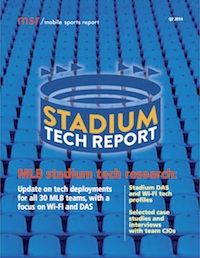
STRQ@_thumbIs there any doubt that when it comes to the digital fan experience, Major League Baseball is in first place? That’s the way we see things, and research we did for our second quarterly long-form STADIUM TECH REPORT issue bears that opinion out. Thanks to a far-sighted strategy that kept league control over all Internet content, and some innovative, forward-thinking technology leaders at several MLB teams, baseball is ahead of all other U.S. sports when it comes to delivering a consistent, enriched fan experience through technology. But will the lead last?

You can find some of the answers to that question in the second issue in our STADIUM TECH REPORT series which you can download for free right here. If you’ve already registered with us, all you need is a username and password; if you’re new to MSR, we just need an email address and title and you’re on your way to the best long-form compilation of research and analysis, as well as in-depth interviews with industry experts in the stadium technology marketplace. We’d also like to thank our Stadium Tech Report sponsors, which for this issue inlcude Crown Castle, SOLiD, Corning, ExteNet Systems and TE Connectivity — without their support, we couldn’t make all this excellent content free for readers.

AT&T senior executive vice president John Donovan

AT&T senior executive vice president John Donovan

MLB tech profiles, interview with AT&T’s John Donovan

What’s in our issue #2 of STR? Glad you asked! Inside the report our editorial coverage includes:

— MLB stadium tech research: This editorial research provides a technology update on stadiums used by all 30 MLB teams, gauging the level of deployment of Wi-Fi, DAS and beaconing technologies.

— MLB tech deployment profiles: These mini-case studies will take an in-depth look at technology deployments at MLB facilities including AT&T Park in San Francisco, Target Field in Minneapolis, and Miami’s Marlins Park. This issue also includes an in-depth interview with AT&T senior executive vice president John Donovan, the man behind AT&T’s successful DAS deployment strategy.

— MSR exclusive stadium tech analysis: The report also includes MLB stadium tech analysis from MSR editor in chief Paul Kapustka, as well as a bonus mini-case study of DAS deployment at historic Churchill Downs, home of the Kentucky Derby.

White box at bottom is one of the under-the-seat Wi-Fi access points at AT&T Park.

White box at bottom is one of the under-the-seat Wi-Fi access points at AT&T Park.

MLB stadiums: Wi-Fi and DAS deployment is strong

Since last year, 8 more MLB teams have added fan-facing Wi-Fi to their ballparks, bringing the league total to a respectable 67 percent, with 20 out of 30 stadiums with Wi-Fi. On the distributed antenna system (DAS) front things are even better, with 25 out of 30 parks having enhanced cellular connectivity thanks to a DAS (our report currently erroneously shows that the Washington Nationals don’t have a DAS — we learned late this weekend that they do, so DAS is doing even better than we thought). Though the adoption rate is lower than that found in the NBA (where 26 of 29 stadiums have fan-facing Wi-Fi), baseball as a league does a much better visible job of promoting the service, which is more impressive when you consider that deploying Wi-Fi in an open-air arena is a considerably tougher task than in a building with a ceiling, like an NBA stadium.

Perhaps it’s no surprise that the National League West Division leads the pack in MLB connectivity, with all 5 teams having both Wi-Fi and DAS deployments in their park. The adoption rate in that division may have something to do with other teams following what is perhaps the overall connected-stadium leader in any sport, AT&T Park in San Francisco. The first with Wi-Fi (since 2004), AT&T Park continues to lead in innovation and experimentation, as witnessed by their embrace of new tricks like under-the-seat Wi-Fi APs and the new iBeacon technology, which is being tested in 20 MLB parks this season.

All of this is explained in greater detail in our STADIUM TECH REPORT for Q2 2014 — so download your free copy today!

ESPN’s streaming World Cup: Record audiences, embarrassing crashes

Just like the U.S. Men’s soccer team, ESPN had it both good and bad during Wednesday’s World Cup game against Germany. On the plus side, ESPN recorded record audiences for its online broadcasts, easily topping any other sporting event ever, including Super Bowls.

But the bad was about as bad as the U.S. team’s somewhat lackluster shutout. By several accounts, including our personal viewing, ESPN’s live stream of the game crashed several times, and was (according to complaints on Twitter) simply unavailable for many viewers. While it’s an inexact science to track down how and why the problems may have been caused, there seems to be enough circumstantial evidence pointing to some pretty massive infrastructure failures from the worldwide leader. According to the Variety story, Univision’s live stream had no such problems, even though its size was smaller.

The line I love from the Variety story penned by our good pal Todd Spangler is the ESPN rep quoting “unprecedented demand” as a reason for the crashes. It would be one thing if something unexpected happened — like, say, the lights went out — and all of a sudden there was a huge audience that tuned in. But ESPN had to know the online viewership was going to be massive days ahead of time, given the start time in the middle of most of the U.S. business working hours. Plus, ESPN itself has spent the entire World Cup blasting emails about every 10 minutes or so, telling everyone it knows to tune in to games online. So: Huge demand? Yes. Unprecendented? Maybe. Unknown that it was coming? Unexplainable.

Maybe we’re holding ESPN to an unreal expectation here, but I’m trying to think how bad the fallout would be if Fox, or NBC, say, dropped the TV broadcast of a big event for even a few minutes. Media outlets around the world would be howling. It seems like online broadcasts are still getting a pass from observers, as if online doesn’t really count. But according to ESPN’s own numbers, online does count and the audiences are huge — 3.2 million uniques for the game — so why can’t big broadcasters put in an appropriate amount of resources to make sure the show goes on smoothly? Is it just that nobody really knows yet how much capacity it takes to keep a big event running? In that case, are advertisers and/or the sports who sell the online rights asking for refunds or make-goods?

As always we give a hats off to ESPN or any other broadcaster who tries to make as much content as possible available online. We just hope that going forward, those same broadcasters recognize that online is a significant, serious market, and that you underestimate your needs at your own peril.