Stadium Tech Report — NFL stadium technology reports — AFC East

Editor’s note: The following team-by-team capsule reports of NFL stadium technology deployments are an excerpt from our most recent Stadium Tech Report, THE FOOTBALL ISSUE. To get all the capsules in one place as well as our featured reports, interviews and analysis, download your free copy of the full report today.

AFC EAST

Reporting by Chris Gallo

Buffalo Bills
Ralph Wilson Stadium
Seating Capacity: 71,757
Wi-Fi – No
DAS – Yes, 200 antennas
Beaconing – No

The Buffalo Bills have had a busy offseason. After the passing of longtime owner Ralph Wilson, the organization was bought by Buffalo husaband-and-wife team of Terry and Kim Pegula for $1.4 billion. Even while the future of the team was uncertain, the stadium named after its longtime owner became fan-friendlier. New gates to enter the stadium, HD video boards, and increased cell service are just a few of the improvements. No Wi-Fi, but Ralph Wilson Stadium does have over 200 DAS antennas.

New England Patriots
Gillette Stadium
Seating Capacity: 68,756
Wi-Fi-Yes
DAS-Yes
Beaconing – No

The New England Patriots are doing everything to get fans off the couch and in Gillette Stadium, with Wi-Fi outfitted by Extreme Networks, a team-centric Game Day Live mobile app, and a squad that’s won the AFC East 5 years in a row. Is it time for another Patriots Super Bowl run?

Miami Dolphins
Sun Life Stadium
Seating Capacity: 75,540
Wi-Fi – Yes, 1,100 access points
DAS-Yes
Beaconing – Yes

Near the end of the 2013 season, Sun Life Stadium became one of the NFL’s first venues to feature beacon technology. The Qualcomm Gimbal contextual awareness platform delivers coupons for concessions as fans walk by and alerts them of shorter wait times on the concourse. Plus, AT&T upgraded the stadium with more than 1,100 Wi-Fi access points and DAS antennas a year ago. All of this has the Dolphins delivering one of the better wireless game day experiences. The search to find a new Dan Marino, however, is still a work in progress.

New York Jets
MetLife Stadium
Seating Capacity: 82,500
Wi-Fi – Yes, 850 access points
DAS – Yes, over 600 antennas
Beaconing – No

There are lots of benefits to hosting a Super Bowl – including the improved connectivity of your stadium. After AT&T and Verizon spent over a year outfitting MetLife Stadium with their own DAS deployments, the stadium saw a 60 percent increase in wireless data from the previous Super Bowl. Safe to say the stadium is well-equipped to easily connect fans with 850 Wi-Fi access points and more than 600 DAS antennas. MetLife Stadium enters its fourth season and continues to make the fan experience unforgettable. Now can the Jets make 2014 an unforgettable season and find their way back to the playoffs?
Stadium Tech Report — NFL stadium technology reports — AFC North

Editor’s note: The following team-by-team capsule reports of NFL stadium technology deployments are an excerpt from our most recent Stadium Tech Report, THE FOOTBALL ISSUE. To get all the capsules in one place as well as our featured reports, interviews and analysis, download your free copy of the full report today.

AFC NORTH

Reporting by Chris Gallo

Baltimore Ravens
M&T Bank Stadium
Seating Capacity: 71,008
Wi-Fi – No
DAS – Yes, 856 antennas
Beaconing – No

The Ravens are in the midst of a $35 million renovation to update their 15-year-old stadium. The focus of the enhancements is on aesthetics, with new video boards and more LED displays being installed. No Wi-Fi at the stadium yet, but fans should have no problem getting a cell signal via the now 2-year old Corning MobileAccess DAS system.

Screen Shot 2014-09-10 at 10.42.52 AMCincinnati Bengals
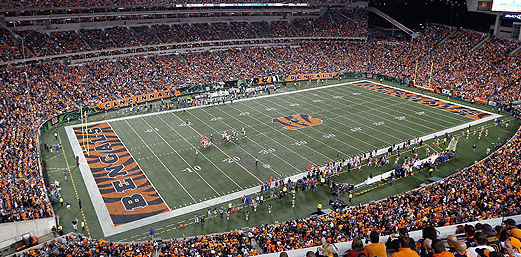
Paul Brown Stadium
Seating Capacity: 65,515
Wi-Fi-Yes
DAS-Yes
Beaconing – No

The upgrades on the field over the last two seasons have been significant for the Cincinnati Bengals. And soon you’ll be able to say the same about Paul Brown Stadium. Wi-Fi from Extreme Networks is in place for all home games this NFL season.


Cleveland Browns

FirstEnergy Stadium
Seating Capacity: 73,200
Wi-Fi – No, planned for 2015
DAS-Yes
Beaconing – No

Less than a year ago, the Cleveland Browns were awarded $62.5 million from the NFL to improve FirstEnergy Stadium. Upgrades for the 15-year-old stadium include Wi-Fi, video boards, and a new sound system. With two first-round draft picks, a Heisman trophy winner potentially under center, and another new coach – the stadium is not the only thing experiencing a makeover. But Browns fans will have to wait a year to have Wi-Fi and Johnny Football at the same time.

Pittsburgh Steelers
Heinz Field
Seating Capacity: 65,500
Wi-Fi – Yes, 193 access points
DAS – Yes, 339 antennas
Beaconing – No

With plans to increase its capacity over the coming years, it’s important for Heinz Field to continue to be one of the best home field advantages in all of football. The easiest way to do that is to keep fans happy. And as a Steelers fan, what sounds better than waving your Terrible Towel whilst taking a selfie? Steelers faithful can do just that thanks to 193 Wi-Fi access points and 339 DAS antennas outfitted from AT&T and Verizon. Now can Pittsburgh return to the playoffs after a 2-year break?

Levi’s Stadium Wi-Fi update: Usage down from record, but still strong — 2.4 TB for Eagles game

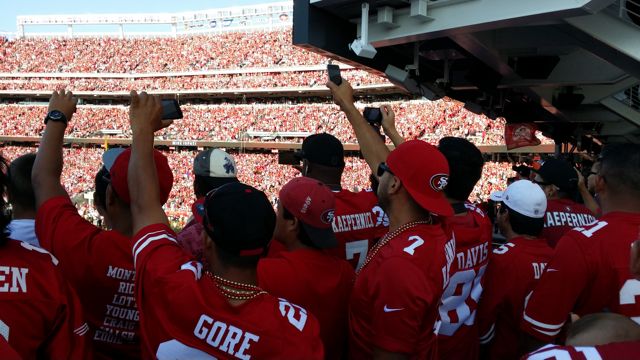
Fans take pictures of opening-day kickoff from southwest concourse. Credit, all photos: Paul Kapustka, MSR

Fans take pictures of opening-day kickoff from southwest concourse. Credit, all photos: Paul Kapustka, MSR

With three NFL games and now one collegiate contest under its belt, the Wi-Fi network at Levi’s Stadium is still handling big loads of data traffic, though not quite at the Super Bowl-beating level of 3.3 Terabytes recorded at the Niners’ home opener.

According to statistics provided by Niners vice president for technology Dan Williams, the Levi’s Wi-Fi network carried 2.4 TB of data during the Sept. 28 game against the Philadelphia Eagles, and another 2 TB during the Oct. 5 contest with the Kansas City Chiefs, both sellouts with reported attendance of 70,799 fans. And at an Oct. 24 college game between Cal and Oregon with 55,575 fans in attendance, the network carried 1.5 TB of traffic.

As you might be able to guess from the bandwidth numbers, the Sept. 28 game also had more users on the network, with 22,942 unique users, compared to 21,133 at the Oct. 5 game. For Cal-Oregon the unique user count was 13,508. At the Niners’ regular-season home opener on Sept. 14, there were more than 30,000 fans using the Wi-Fi network, with a peak of 19,000 simultaneous connections. The peak numbers for the later dates were 15,500 for the Sept. 28 game, 14,500 for the Oct. 5 game, and 8,400 for the college game.

In-seat and express food orders stay strong

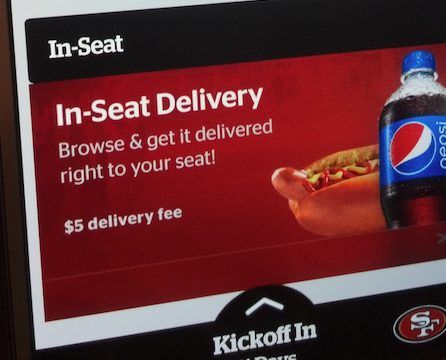
Screen grab from Levi's Stadium app showing in-seat food delivery option. Credit all photos: Paul Kapustka, Mobile Sports Report.

Screen grab from Levi’s Stadium app showing in-seat food delivery option.

Food and beverage orders via the Levi’s Stadium app appear to be holding between the 1,500-2,000 order level for both the express pickup option as well as the in-seat delivery, with both features available to every seat in the house. According to Williams, for the Eagles game there were 1,144 express pick-up orders and 1,652 in-seat deliveries, while at the Kansas City game there were 1,162 express and 1,712 in-seat orders. At the Cal-Oregon game, where many fans were probably not as aware of the Levi’s app functionality, there were 551 express orders and 308 in-seat deliveries.

The video-replay feature of the Levi’s app also continues to attract solid interest, with 1,297 unique users watching 5,089 replays at the Eagles game and 1,111 unique users watching 4,986 replays at the Kansas City game. At the college game 234 fans used the replay feature, watching 1,059 replays.

One more interesting stat provided by Williams — the Apple iPhone is the overwhelming favorite device for connecting to the Levi’s Stadium Wi-Fi, with 62 percent share for the Sept. 28 game, and 60 percent share for both the Oct. 5 and Oct. 24 games. Android devices represented 24 percent (Sept. 28), 26 percent (Oct. 5) and 25 percent of all devices, while Apple iPads accounted for 2 percent, 3 percent and 1 percent of devices for the respective Sept. 28, Oct. 5 and Oct. 24 games.

DAS usage also remains strong, but not tops in NFL

On the DAS side of the Levi’s Stadium network we have some stats from AT&T to share (but none from any other carriers). According to AT&T, for the Oct. 5 game AT&T customers used 549 GB of data, which was only the fourth-highest AT&T DAS total for that weekend. Dallas (827 GB), San Diego (716 GB) and New Orleans (598 GB) all had higher AT&T DAS traffic totals for that weekend’s games. (Remember, these are results for stadiums with AT&T DAS networks only, not for all stadiums.) For the Sept. 14 game, the Levi’s Stadium AT&T DAS recorded 673 GB of traffic, according to AT&T.

Seahawks, Verizon tap Extreme for CenturyLink Field Wi-Fi

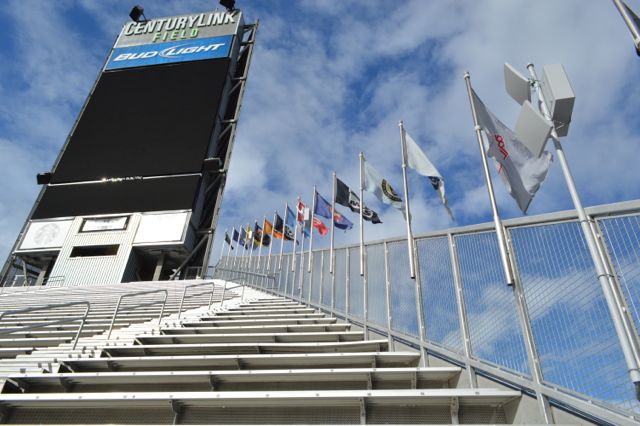
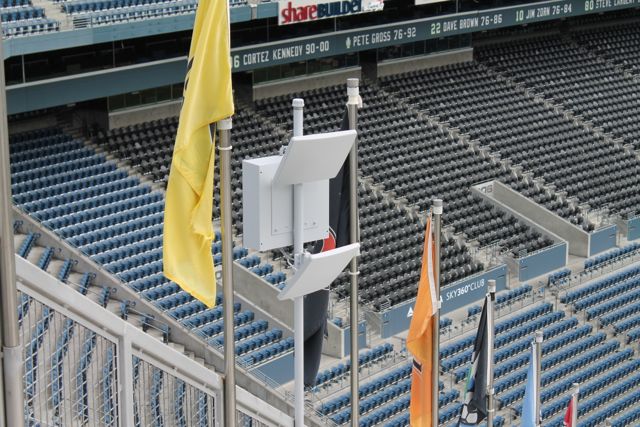
Wi-Fi access point antennas visible on poles. All photos, credit: Extreme Networks/Seattle Seahawks.

Wi-Fi access point antennas visible on poles. All photos, credit: Extreme Networks/Seattle Seahawks.

Ending one of the bigger stadium Wi-Fi mysteries of 2014, the Seattle Seahawks and Verizon announced today that they are using Extreme Networks Wi-Fi gear and analytics software to power the new Wi-Fi network at CenturyLink field in Seattle, home of the defending Super Bowl champion Seattle Seahawks.

While the network has (reportedly) been live since the start of the NFL regular season, today’s press release is the first official confirmation that the network exists from Verizon or the Seahawks. Previously, Mobile Sports Report had confirmed the network’s existence in an exclusive interview with the NFL’s CIO, Michelle McKenna-Doyle, where McKenna-Doyle said she had helped set up the connection between Verizon and CenturyLink. But no specifics on gear suppliers or breadth and depth of network were available until today.

According to Norman Rice, senior vice president of corporate development at Extreme Networks, CenturyLink Field is the sixth NFL stadium to use Extreme’s IndentFi high-density Wi-Fi gear for its Wi-Fi network, joining deployments by the New England Patriots, the Philadelphia Eagles, the Jacksonville Jaguars, the Tennessee Titans and the Cincinnati Bengals. All six franchises including Seattle will also use Extreme’s Purview analytics software, which helps provide Wi-Fi usage patterns and connectivity information that allows network administrators to fine tune the network.

We are scheduled to speak with some of the CenturyLink Field IT folks today so we will update this post with more info, including (we hope) a Wi-Fi access point count and some more details about the Seahawks app, which apparently has some nifty live video and replay features. Verizon has also said it has installed a DAS at CenturyLink, but there is no information on whether or not it is a neutral DAS and if so whether or not other carriers are on it.

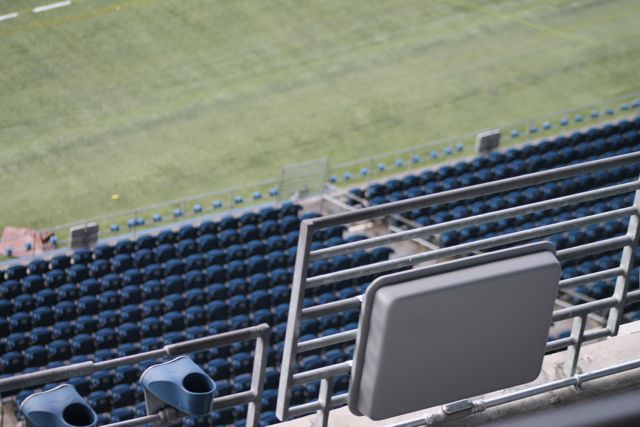
Below are some more photos of the Wi-Fi install, including a railing antenna… more info soon.

Railing AP

Railing AP

More pole-mounted Wi-Fi gear.

More pole-mounted Wi-Fi gear.

AT&T: DAS network also set traffic records for 2014 World Series games at AT&T Park

Giants CIO Bill Schlough (left) talks with workers in the park's main DAS head end facility.

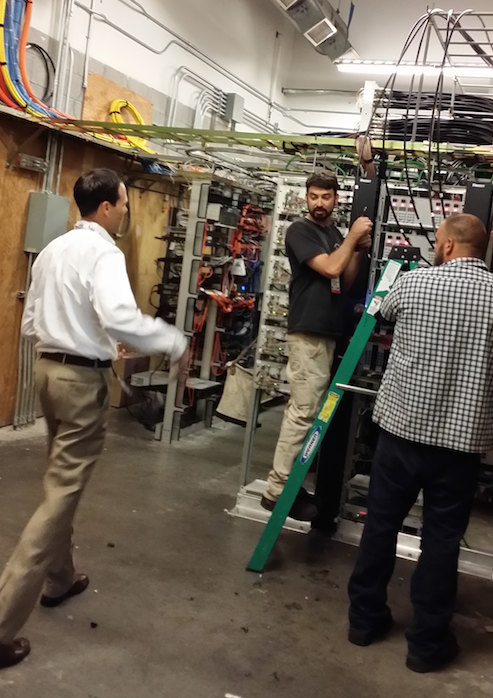
Giants CIO Bill Schlough (left) talks with workers in the park’s main DAS head end facility.

In addition to the over-the-top Wi-Fi usage numbers, it turns out that the in-stadium AT&T cellular network also experienced record usage during the recent World Series games at AT&T Park, with Saturday night’s crowd using 477 Gigabytes of data, according to AT&T.

In case you’re not familiar with the DAS acronym, it stands for distributed antenna system, and basically is a network of small antennas that bring cellular service to the tightly packed fans inside stadiums or other large public venues. At AT&T Park, AT&T runs the network as a neutral host, meaning that Verizon Wireless, Sprint and T-Mobile customers can also use the DAS to connect. If you’re in the park and you haven’t enabled your device to connect via Wi-Fi, you’re probably connected via the DAS. However, the stats provided here are only for AT&T customers on the DAS, since AT&T doesn’t have visibility into the other carriers’ metrics. Since the Wi-Fi network is open to all, the Wi-Fi numbers we reported earlier are for all customers, no matter who their provider is.

But even just the AT&T cellular numbers are pretty impressive, perhaps not surprisingly so since a good-weather World Series game is a bucket-list event for most attendees, meaning that texts, tweets, selfies and Vines were likely flowing freely at all three games in San Francisco. Here’s a breakdown from AT&T about how much more data was used during the games last weekend:

— Fans used an average of approximately 447GB of data per game over the weekend on the AT&T cellular network. This is equivalent to more than 1.27M social media post with photos.

— The numbers represent an increase of approximately 29 percent in cellular data usage compared to the average game during the League Championship series vs. St. Louis.

— It’s an increase of approximately 109 percent in cellular data usage compared to the average game during the final home series of the regular season vs. San Diego (9/25-9/28).

— The peak hour of data usage during three home games was on 10/25 was from 5-6pm PT, the hour in which the first pitch occurred. In this hour more than 83GB of data crossed the AT&T venue-specific cellular network.

According to AT&T, the total combined Wi-Fi and AT&T DAS traffic hit a record high of 2.09 Terabytes on Oct. 25, the highest single-game total in AT&T Park network history. What would be even more interesting would be if we could get DAS statistics from Verizon, Sprint and T-Mobile to get the total-total number for wireless data consumed during the biggest games of the year.

Half a stadium using Wi-Fi? 2014 World Series games set Wi-Fi records at AT&T Park

Though this year’s World Series still isn’t over, the three games this past weekend in San Francisco set new local records for fan Wi-Fi use, arguably cementing AT&T Park’s title as baseball’s best-connected stadium.

One of the more stunning numbers provided to us by Bill Schlough, the senior vice president and CIO for the Giants, was that nearly half the crowd in AT&T Park for Sunday’s Game 5 used the Wi-Fi network — a “take rate” we’ve never heard of before at any sporting event of any kind. According to Schlough the Giants’ Wi-Fi network had 20,638 unique users during Game 5, a take rate of 49.7 percent. (According to the official box score, the attendance that night was 43,087, give or take a Panda or four.) The game also set an AT&T Park record for Wi-Fi upload traffic with 747 Gigabytes of data being sent by people at the park out to the network.

(Including one special photo tweeted out by a former Giant you may have heard of.)

A record for downloaded Wi-Fi traffic, of 937 GB, was set during Friday night’s Game 3, and the record for a combination of download and upload traffic was set during Game 4, with a total of 1.62 Terabytes. According to Schlough, the total data transferred during the eight games of the 2014 postseason at AT&T Park was 10.3 TB, which is easily the high-water mark for any baseball stadium network we know of. (The total does not include regular cellular traffic carried by the AT&T Park DAS; we will add those numbers in when they become available.)

And while individual games such as Super Bowls or contests down the San Francisco Peninsula at Levi’s Stadium may set higher overall marks (thanks in part to having more fans in the building), we’d be interested to see if any other stadium networks can match AT&T Park’s season-long data number of 59.3 TB, which according to Schlough represents total traffic over 2014’s 91 games (regular and postseason) at AT&T Park.

One more fun number from Schlough: Since the park turned on its fan-facing Wi-Fi network in 2004, there have been 4,085,518 Wi-Fi connections during the 946 game days. Kansas City’s Kaufmann Stadium, which just got its Wi-Fi network installed recently, has one or two more games this season to start trying to catch the Giants from a networking perspective.

UPDATE: Looks like the Royals are claiming some already-decent usage of their Wi-Fi network: