Stadium Tech Report: Is the NBA the stadium Wi-Fi winner?

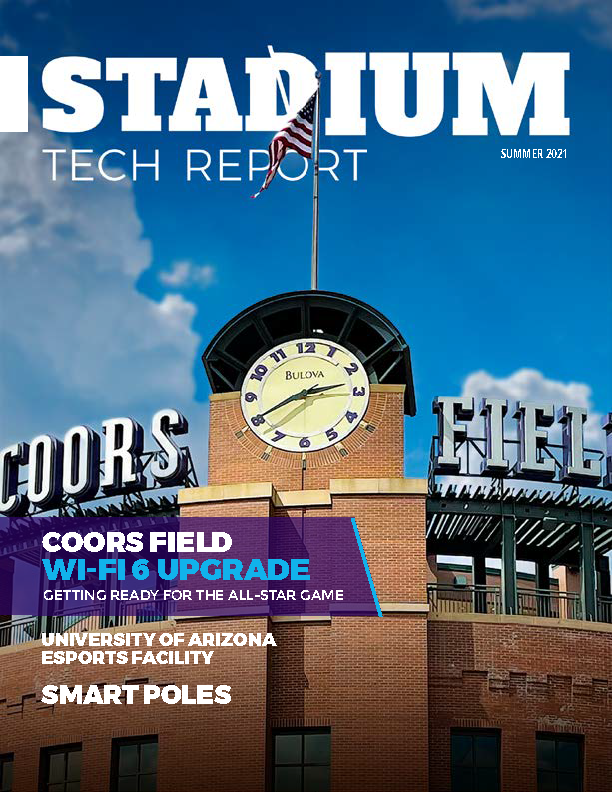
STR coverWith fan-facing Wi-Fi available in 23 of its 29 team facilities, it appears on paper that the National Basketball Association — the NBA — is the U.S. leader among pro sports leagues when it comes to stadium Wi-Fi. But if only a few of those same stadiums are actively promoting Wi-Fi or delivering advanced wireless services, is that title valid? For the answer or at least some informed conjecture, we point you to our inaugural Stadium Tech Report long-form issue, our Q1 2014 report which focuses on, you guessed it, Wi-Fi and wireless deployments in NBA stadiums.

Available now for free download, the 35-page PDF report delivers a capsule profile of each and every NBA team and whether or not it has Wi-Fi and DAS services in its stadiums. To spoil the fun a little, I will let you know that we found Wi-Fi to be almost universal, with 79 percent — or 23 of 29 NBA facilities — all having fan-facing Wi-Fi. (To save you time I will list the non-Wi-Fi stadiums here: Miami, Denver, Utah, Atlanta, Minnesota and Milwaukee.) There is also a DAS (Distributed Antenna System) for enhanced cellular in almost every arena, and the ones that don’t have it are either installing it now or plan to soon. But as we noted in the lead, even with all this connectivity, there are just a handful of teams who are really utilizing their wireless services to improve the fan experience. That measured embrace of wireless services makes us wonder why many teams are reluctant to promote the assets already installed.

Profiling the leaders

I could tell you more but — why not download the report? We put a lot of effort into this report, which is designed as a “lean back” type of publication, the kind of thing you can refer to over and over again as a reference, or as a resource to study when you need a break from Twitter and email. In addition to the team-by-team capsules we also have included three in-depth profiles of wireless deployment leaders, including the Barclays Center in Brooklyn, the Staples Center in Los Angeles, and Orlando’s Amway Center. There is also report-based analysis of the league’s wireless situation from yours truly, plus an industry thought-leader perspective from our friend Seth Buechley at SOLiD, on why facilities should use wireless technology to improve fan safety, a sometimes overlooked amenity that deserves more attention.

I’ll be talking here more about the report this week and next, but first and foremost I’d like to thank our sponsors, whose contributions make it possible for us to offer this time-consuming research and analysis for free to our readers. Along with SOLiD, who sponsored our State of the Stadium report last year, for our Stadium Tech Report Q1 issue we’d like to welcome Extreme Networks, Crown Castle and AmpThink, whose support of our efforts are deeply appreciated.

We also truly appreciate our readers, who have increased in considerable number the past few months. There’s no magic as to why we’re growing — starting last November, we started telling more of your stories, stories of stadium deployments with lessons learned, failures overcome and enthusiastic steps taken — in a series we started calling Stadium Tech Reports. Those stories have resonated, and we hope that this new long-form report series will too, as the format allows for a bit of leg-stretching and an easier way for our readers to share our stories — your stories — with your professional circles.

One favor to ask — please register!

With growth and change there is always a little bit of pain, and for our readers there is one task that we ask — that you register with us to download the new report, so we can better serve you going forward. (And instead of just forwarding the report, please ask your professional circle to go ahead and register too!)

We realize that many of you may have recently spent a little bit of time filling out a registration form to download our previous report, and we thank you for that effort. But with the new growth in readership we’ve had to step up our game as well and that meant biting the bullet to put in a new registration system that will allow us to provide a robust “gated” content system for our registered readers, meaning that for all the rest of the reports and other exclusive content we have planned for this year and beyond (it’s a growing list!) you won’t need to keep filling out forms.

Even though our report is bound up in a PDF, we realize that any such publication is always a “work in progress,” so please if you have any updates, corrections, suggestions or any other opinions, feel free to leave them here in the comments, or email me directly at kaps at mobilesportsreport.com. We have lots more in store for the stadium technology market this year, so register today so that you don’t miss a thing as the 2014 season rolls on.

MLB delivers daily fantasy game in partnership with DraftKings

draft

In the past Major League Baseball once denounced daily fantasy baseball games as gambling, implying that no skill was involved, but that has changed as baseball has teamed with fantasy sports contest provider DraftKings for an offering that launches with the upcoming season.

The Official Mini Fantasy Game of MLB.com is a free one-day fantasy league that can be entered daily and offers fans the ability to win tickets to regular season games, the 2014 All-Star Game and a 2014 World Series game. There are a total of four grand prizes, two each to the All-Star and World Series as well as a number of other prizes.

Players get a $50,000 salary cap and then select from a field of players that has 10 position players who can accumulate points (or lose them) by accomplishing select actions such as +5 points for a stolen base and +2 points for each strike out a pitcher earns. There will be several different offerings including a daily MLB.com Official Fantasy Contest and a weekly MLB.com Friday Home Team contest among others.

DraftKings specializes in creating what it calls daily leagues, ones that you can play and then quit, none of this following a fantasy baseball team for a season trying to convince a fellow owner to trade his star starting pitcher for your broken down LOOGY.

Its system is simple and has the potential to be lucrative for users. It has both free and paid contests in which participants select individuals to make up a team, watch how they perform that day and if they perform the best you can win cash. DraftKings is currently running several contests including a March Madness one. It offers contests in five major sports: MLB, NHL, NFL, NBA and the PGA. It offers a wide variety of contests from head-to-head to qualifiers.

This will be interesting to see how this pans out on many levels. Lotteries have tried to have sports offerings and most of the major league teams have fought against them. States, led by New Jersey, have then fought back, so far unsuccessfully. Now a league is endorsing it as a skill event and that could lead to an easing of other leagues’ dislike of this type of activity.

Turner Sports’ digital approach to March Madness a winner

turner

While most people I know have already seen their NCAA brackets crushed, one player is clearly winning at the tournament and that is Turner Sports and its online game-viewing policy.

According to Turner the men’s 2014 NCAA tournament has set an all-time record for online video consumption with a total of 51 million video streams accessed through the first full week of the tournament, a number that is 40% greater than what it achieved a year ago at the same point in the event.

To put the number in greater perspective, last year for the entire tournament there were a grand total of 49 million video streams accessed for the event. These numbers represent users accessing the videos from desktops or laptops as well as smartphones and tablets. Mobile (tablets and smartphones) platforms experienced the highest segment growth this year, with live streams for mobile device users up 74% over the first week of the tournament in 2013, according to Turner.

It is interesting to note that the videos were watched for 10.5 million hours, a number that witnessed only an increase by a mere 6%, showing that fans liked the ability to cherry pick the events that they watched and came in droves for them.

According to Turner Sports the top games featured some of the exciting upsets that have been a major factor in this tournament.

§ Dayton vs. Ohio State – 4,626,000 viewers
§ Mercer vs. Duke – 4,218,000
§ Harvard vs. Cincinnati – 2,767,000
§ Kentucky vs. Wichita State – 1,987,000
§ Stanford vs. New Mexico – 1,451,000

Not surprisingly the broadcast side of the business also had a record setting first week. The four networks that carried the games, TBS, truTV, CBS and TNT reported that they had the best first week in the 23 years that they have been carrying the tournament. It is averaging 9,277,000, up 4% from last year.

Ruckus will provide Wi-Fi for new MLS Earthquakes stadium in San Jose

Ruckus Wireless has scored a deal to provide a Wi-Fi network for the San Jose Earthquakes, in the team’s new 18,000-seat stadium slated to open in 2015.

The sponsorship agreement will see Ruckus designing and supplying the high-capacity Wi-Fi network in the new stadium, which will be located on Coleman Avenue in San Jose, near the city airport. According to Ruckus the network will use more than 150 of the company’s Ruckus ZoneFlex access points. David Callisch, vice president of corporate marketing for Ruckus, said the deal is a “partnership” with the Earthquakes, with Ruckus providing both some equipment discounts and technical and marketing assistance to make sure the network works well and is readily discovered by the fans coming to the arena.

“This is an exciting project that our fans can look forward to utilizing at our new stadium,” said Earthquakes president Dave Kaval, in a prepared statement. “We want our stadium to reflect our community, and technological innovation is a key component of Silicon Valley. Ruckus Wireless is a great fit because of their local roots and experience working not just with Silicon Valley Wi-Fi network deployments, but with these types of deployments around the world.”

The San Jose deal adds to a growing list of soccer stadium deployment wins for Ruckus, which already provides Wi-Fi at 20,000-seat plus Rio Tinto Stadium in Salt Lake City, Utah (home of the MLS Real Salt Lake club) as well as at several venues in Brazil being readied for the upcoming World Cup. Ruckus also provides the Wi-Fi at Time-Warner Cable Arena in Charlotte, N.C., home of the NBA’s Bobcats, and was also behind a new Wi-Fi network at the BNP Paribas Open in Indian Wells, Calif.

Callisch said the free app at the BNP Open, which allowed fans to watch live video of matches at courts other than the one they were sitting in front of, was the kind of in-stadium use that a cellular DAS just can’t handle.

“A 4G signal is just not suitable for something like high-quality video,” said Callisch. “You really need Wi-Fi for high capacity applications.”

Though Ruckus does sell gear for regular, indoor office-type networks, its line of advanced access points with directional antennas make it a good fit for stadium venues, where being able to fine-tune coverage is a necessity.

Ruckus, which went public on Nov. 16 of 2012, finished its fiscal 2013 year with $263.1 million in revenue, a 22.6 percent increase from the previous year. Its Q4 revenues were $73.0 million. Though Callisch wouldn’t break out what part of that total stadium and other large-venue contracts represent, he did say they all helped the bottom line.

Though large venue deals may involve discounts and other charges for marketing or extra technical help, Callisch did say that any time you deliver equipment in the hundreds, it’s a good business deal.

“We make money on all the [stadium] deals,” Callisch said. “It’s a growing vertical market for us.”

Friday Grab Bag: Where is the MLS TV deal?

For those of you who managed to miss it the Major League Soccer season started recently and its broadcast contract, which many had expected to be finalized sometime last winter, is still unfinished business.

Awful Announcing does a good job pointing out the issues, which have to do with how each side perceives itself. An interesting note showing the increasing popularity of the sport is that the average MLS attendance is greater than the NBA or NHL’s.

Android flaws could make upgrades a danger
System updates are a fact of life for most mobile phone users and a recent report from researchers at the System Security Lab at Indiana University and Microsoft have found a vulnerability that could enable hackers to take over Android systems.

It is not a real threat as they did a proof of concept test only but the threat would be in the form of an app that waits for a system update and then takes gains access for privileges that it had not had previously. Interestingly it only works if you have a fairly old version of Android running.

FIFA Exec paid millions for votes
If you ever wondered how sun-baked Qatar managed to win approval to host the World Cup during its summer this story might help explain it: FIFA executive Jack Warner appears to have made millions off of the deal.

According to a piece in the Telegraph a Quatari company paid Warner millions after the country won the vote. The Big Lead has a list of his apparent transgressions over the past few years that shows a long history of shady dealings.

NBA pondering new TV deal
MLS is not the only sport that is taking its time in finalizing its next broadcast deal as the NBA is also taking a leisurely approach on its current round of negotiations. However the NBA is in a much stronger position.

According to the Sports Business Daily there are a number of interesting options being considered at this time including adding an additional broadcasting partner, bringing its digital rights in-house and moving NBA on TNT off of Thursday night. It looks like big changes are in the works.

Drones can read Wi-Fi messages?

A report in the International Business Times is saying that you should turn off your smartphone’s Wi-Fi because drones that are flying overhead can monitor the conversation, using a pretty simple trick that I think many of us would fall for.

A drone overhead could present itself as a free Wi-Fi network, something that phones are constantly looking for. Then if a user connects it can intercept traffic. Boy would they be bored with reading my stuff.

Love baseball and need a date? MLB has you covered!
Major League Baseball has joined forces with online dating site Match.com to create club-focused singles pages, because apparently there was a need for this. I am not kidding it seems that some rabid fans, say Yankee fans, whose first question is to ask “Who hates the Red Sox?” [editor’s note: insert joke for “getting to first base” here.]

It will be interesting to see how this works; maybe MLB could do the same for the Dungeons and Dragons crowd, or even a dating site set up for stats nerds, which is almost the same as the D&D group.

Google seeks to expand ‘wearable’ options with Android Wear program

The Moto 360 Android

The Moto 360 Android

Google made a lot of noise a few years back with its push for Google Glass project, a pair of glasses that are connected to the Internet and now it is adding a second front in the wearable war with a push that it calls Android Wear.

The company has launched the Android Wear project in an effort to greatly expand the market for wearable hardware and related technology, with but not limited to helping a new generation watches running the company’s Android operating system.

The core of the effort will be a Software Developers Kit (SDK) that the company will be delivering to interested developers later this year.

While connected watches seem to be the first area that this effort will have an impact Google sees the effort expanding into other areas including bringing additional technology to more established platforms such as tablets.

However watches seem to be at the forefront of this space and potential developers that include everybody from Nike to Apple have indicated some level of interest in developing a watch. In addition there are already several connected watches on the market such as the Samsung Galaxy Gear and Pebble’s Steel Watch. Google has a number that have now announced their intention. With such a huge position in the smartphone operating system already Google has a huge advantage and it looks to be building on it quite quickly.

Several partners have already announced intentions to build watches and in some cases have shown examples of their development efforts. Motorola, unsurprisingly, has one in development called the Moto 360 Android that it said will be available this summer while LG Electronics said it would introduce its first Android watch, the G Watch, sometime this quarter.

The watches will be equipped with a variety of sensors and the ability to connect to an Android phone. So it can sub for the fitness trackers that are popular with the athletically inclined. It will allow notifications and text messages to be forwarded from a user’s phone and enable voice replies.

I imagine it would be a great tool to use to cheat on exams, but that might just be me. However being in a meeting and getting, say, March Madness game updates, could be a boon for those times when it is frowned upon to look at your smartphone. However the flip side of this is that many, at least those of us old enough, might just see this as a glorified pager with a bit more functionality.