Boingo adds University of Houston to growing stadium Wi-Fi and DAS customer list

University of Houston stadium rendering. Credit: University of Houston

University of Houston stadium rendering. Credit: University of Houston

Boingo Wireless, once known best for its Wi-Fi deployments in airports, is rapidly building up a big resume of stadium customers for Wi-Fi and DAS installations. The latest in a string of recent announcements is a Wi-Fi and DAS deployment deal for the new University of Houston football stadium, a 40,000-seat facility scheduled to open for the 2014 college season.

We’re working on setting up a call with the Houston folks to learn more about their deployment plans but in the meantime you can peruse the Boingo press release as well as the website about the new stadium, which has been under construction for a few years. Like the deployment underway at the Air Force Academy, Boingo’s wireless plans for Houston include a neutral third-party DAS installation as well as Wi-Fi for fans at the stadium as well as for internal stadium operations.

“A world-class facility like the Houston Football Stadium requires a state-of-the-art wireless network on par with major league venues,” said Mack Rhoades, Vice President for Intercollegiate Athletics at the University of Houston, in a prepared statement complete with a bad sports/Wi-Fi metaphor that publicity people just can’t resist. “Boingo brings experience in managing networks for professional and university stadiums and arenas nationwide, and they’ll provide a comprehensive wireless solution that’ll keep Cougars’ alumni, fans and staff connected from kick-off to the final touchdown.”

Like we said, more soon when we speak with the folks from U of H.

Stadium Tech Report: Boingo brings Wi-Fi, DAS to Air Force Academy stadiums

Falcon Stadium, Air Force Academy

Falcon Stadium, Air Force Academy

Perched dramatically in the foothills of the Rocky Mountains, the architectural gem known as Falcon Stadium is a great place to watch Air Force Academy football games. As a place to install a new wireless network, however, it’s not quite a beautiful site.

“It looks beautiful from the highway, but it’s not modern,” said Dermot “Derm” Coll, CEO of the Air Force Academy Athletic Corporation, in a recent phone interview. Though its many of its 46,692 seats offer soaring views across the field and across the plains and foothills just north of Colorado Springs, Coll said the stadium, which was built in 1962, was something of a black hole when it came to cellular or wireless communications.

Over the past few years as smartphones have become popular, Coll said fans were frustrated by their inability to make calls or connect to the Internet, and even staffers on site couldn’t communicate wirelessly. “Fans wanted to do what they do at home, so we saw a great need” for better connectivity, Coll said. And thanks to a new deal with Boingo Wireless, fans and cadets and any other visitors to Air Force Academy sports facilities will soon have both high-speed Wi-Fi and cellular DAS connectivity, which should make communications as pleasing as the mile-high views. In addition to Falcon Field, the deal also calls for Wi-Fi and DAS networks inside the AFA’s Cadet Field House, a cavernous 1960s-era building that hosts a basketball arena, a hockey arena and an indoor track.

Historic landmark status a challenge

Coll, who runs the organization that deals with all the business activities for Air Force athletics, said that signing the deal was the easy part of the long-planned installation. What proved tougher was bringing new wireless technology to facilities that were not only built in the ’60s, but also had historical landmark status.

“It was really challenging just to do things like run cable,” said Coll. “We had to be a little bit creative.”

Clune Arena, Air Force Academy

Clune Arena, Air Force Academy

Doug Lodder, vice president of business development at Boingo Wireless, said installers had to hide some Wi-Fi antennas behind specially designed shielding that sported the Air Force Academy lightning-bolt logo, so as to blend in with Falcon Stadium’s distinctive architecture. “There were not a lot of places to hang stuff,” Lodder said.

For the 5,900-seat Clune Arena for basketball and the 2,500-seat Cadet Ice Arena, there were similar challenges. “The Fieldhouse is pretty old and dated, a real Cold War building,” Coll said. “It was not great for tech to prosper there.”

Yet to show how tech-savvy fans have become, Coll said that a small Wi-Fi network installed for internal use was seen by fans who were looking for SSIDs they could connect to.

“We got beat up because people could see the SSID and wanted access to the [internal] Wi-Fi,” Coll said. “So we knew fans had the desire to connect.”

Boingo’s airport rep helps land the deal

When it came to finding a provider for the DAS, Coll said the Academy wanted a neutral third-party host and Boingo fit that bill.

“Boingo gave us a great opportunity without having to go with one carrier over another,” Coll said. Though carrier hosts will often pledge that all their competitors will be welcome to join a carrier-built DAS, Coll didn’t want to have to worry about whether negotiations might keep one provider or another from joining the enhanced cellular network.

“You don’t want to [have to] hope your carrier is on the tower,” Coll said.

Boingo, which provides Wi-Fi service to Denver International Airport, was no stranger to Coll and the Academy.

Cadet Field House, Air Force Academy

Cadet Field House, Air Force Academy

“We knew their reputation, and they brought a lot to the table,” Coll said. The network at the Academy facilities will be free of charge, unlike some other Boingo public Wi-Fi deployments (such as at Chicago’s Soldier Field) where fans are charged a small amount for network access. The network inside Falcon Stadium is scheduled to be live in time for this year’s spring graduation ceremonies; Coll said the Academy is also looking into the possibility of having Boingo provide more wireless services to the rest of the campus, which is widely spread out through the hillsides just north of Colorado Springs.

Though the Academy has a game-day app, according to Coll you couldn’t really do much with it at the stadium because of the connectivity problems. In the near future, Coll said the idea is to bring more live info to the app, including updated stats and video replays.

“In the past you could sit in Falcon Stadium and launch the app, and not much would happen,” Coll said. “Now we’re looking forward to seeing it perform on game day.”

Show me where to park, buy me a drink, let me see the game with friends: Using new technology to solve ‘old’ stadium problems

There was a lot of talk about new technology at the recent Stanford Graduate School of Business Sports Innovation conference, but what really caught my attention was conversations about how some smart people are planning to use new technologies to solve perennial fan pain points, like parking and concession issues, or just getting tickets close to friends who also want to see the game. I think using tech to conquer mundane problems is a great idea, and could be part of more common-sense plans that could do more to help sagging attendance than cooler ideas like video replays or Google Glass broadcasts at games.

Don’t get me wrong — I think it’s great when teams like the Indiana Pacers and the Orlando Magic push the envelope to do things like have Google Glass views shown on their arena big screens. But listening to the folks from the new ownership team at the Sacramento Kings as well as some other smart folks from the Pac-12 conference, the NBA and SAP at the April 8 conference at Stanford convinced me that we may be moving into an important second wave of stadium technology deployment, where we’re over the cool factor of the technology and are instead asking how it can be used to solve the kind of issues that keep people from buying tickets and attending games live.

To be sure, there are some table stakes to this game, and among most stadium professionals these days the need for ubiquitous connectivity inside arenas is a given. Dallas Mavericks owner Mark Cuban is semi-famous in tech circles for his desire to have fans cheering instead of looking at their phones, but new Sacramento principal owner Vivek Ranadive said not having networks in stadiums is a Luddite kind of view.

“Young people are going to look at their phones 400 times a day, whether he [Cuban] likes it or not,” Ranadive is fond of saying. Ranadive, the CEO and chairman of data-management software giant TIBCO, is the new cool kid on the NBA owners block after swooping in to save the Kings from being shuttled back to Seattle. As an all-around smart guy who likes to accomplish things, Ranadive has lots of ideas for the league and his new toy. At the Stanford conference he talked about plans to make the Kings’ new stadium one of the most digitally advanced buildings anywhere; but what was refreshing to me was his and his team’s focus on the fan experience, something that bodes well for NBA fans in and around Sacramento.

Paint your face purple: Why fans are different

As the CEO of a multi-billion dollar public concern, Ranadive knows all about keeping customers happy. But fans, he said, are much different. “Fans will paint their face purple,” he told the Stanford audience. “They will evangelize, tell everyone else about [going to a game]. Other CEOs I know are dying to have fans.”

(They also might like to have a team owner who tweets selfies with cool people like Shaq.)

So how are Ranadive and the Kings looking to use tech to take care of those fans? Ben Gumpert, senior vice president of marketing and strategy for the Kings, told of some ideas as part of an in-depth panel discussion later in the day at the Stanford conference. Among the ideas where tech could make a kind of background difference: By providing traffic or parking information for fans en route to a game; by knowing when a fan is in the stadium, and maybe bringing by a free drink on that fan’s birthday. Or by using Google+ Hangouts to facilitate a pre-game fan interaction time.

“We’re looking at all the negatives [of coming to a game], like traffic, where do you park, what’s the most efficient way in to the building, is there a phone charger near your seat,” said Gumpert. “We want to be early adopters and have the smartest building, but we also see a lot of technology being behind the scenes.”

Surprise and delight

From a personal standpoint, I agree with the Kings’ philosophy — even though there is an exciting NBA team here in the Bay area, the “pain points” of having to trek out to Oakland to see a game live keep me on the couch every time. Parking, commuting to the stadium and ticket procurement are all things I haven’t explored and I’m guessing there’s no easy way to figure all that out. If the Kings’ plans work out, the team app will have a lot of that info, which I think is hugely more important than, say, making sure the app has video highlights or Instagram access to player pictures.

L to R: John Abbamondi, NBA; Ben Gumpert, Sacramento Kings; Ward Bullard, SAP; David Aufhauser, Pac-12 Networks

L to R: John Abbamondi, NBA; Ben Gumpert, Sacramento Kings; Ward Bullard, SAP; David Aufhauser, Pac-12 Networks

I mean — Google Glass views are cool. But I wonder about a stadium and team ownership that is all excited about Google Glass TV views, but leaves parking up to some dude with a sign and an orange flag. Or leaves concession purchases in the 1950s, with one person taking your order, going back to get your hot dog, and then making change. If there is a trend toward using technology to fix real problems, instead of deploying technology for technology’s sake, I’m all for it.

“There need to be more ‘surprise and delight’ experiences in stadiums,” said Ward Bullard, formerly head of sports for Google+ who is now headed to a job with the sports-app division at SAP. “Using technology to bring value back to the fan hasn’t been strong enough.”

David Aufhauser, vice president and general manager of digital media for Pac-12 Networks, said there are many potential ways to use technology to improve the fan experience, especially via specialized types of access — like free ticket upgrades or giving fans the ability to watch press conferences or meet players personally. Bullard and Aufhauser, part of the panel discussion, also talked about ideas like allowing groups of fans to dynamically move their seats to sit together, or to better keep the shared experience alive.

“Sports is still one of the things people come to physically,” Bullard said. There should be a way, Bullard said, to keep the “high of the tailgate” party intact as fans move into the stadium.

“You don’t see many selfies from the couch,” said Gumpert. “What we need to do is find out which fan experiences matter most, and leverage the mechanisms” to improve the fan experience.

“It is a people business,” said John Abbamondi, vice president of team marketing and business operations for the NBA, who suggested teams use CRM to know if a person in the building is up for a season-ticket renewal. “Or [maybe] it’s their birthday, and you greet them with a special drink,” Abbamondi said. “Make it personal. It is about the high-five, the thing that gets you off the couch, That shouldn’t be overlooked.”

AT&T’s DAS and Wi-Fi network traffic for Final Four hits multiple Terabyte levels

AT&T StadiumWant to host a big sporting event? You better have a big network. Down in Texas, where everything’s big, AT&T had to go as large as possible to keep fans at the recent Final Four connected. According to AT&T, traffic on its cellular and Wi-Fi networks in and around AT&T Stadium surpassed terabyte levels during college basketball’s biggest weekend, with just over a TB of traffic on cellular and more than 4 TB on the stadium’s Wi-Fi network.

Granted, holding the final games of the college basketball season in a football stadium is sort of a guaranteed way to push the envelope when it comes to fan-phone traffic. With 79,444 fans at the semifinal games on April 5, this year’s event set a new record for most people at a college hoops game. Understandably, cell phone traffic also set records as according to AT&T its total data usage on cellular networks inside the stadium for all three games was 885 GB, up from 667 GB used at last year’s tourney in Atlanta and up from 376 GB used 2 years ago in New Orleans. When you throw in data usage at connected areas like the stadium parking lots, AT&T reported 1,268 GB of traffic, which is a massive amount of selfies.

And remember, this is JUST AT&T traffic. No telling how much T-Mobile, Sprint and Verizon customers generated. Anyone at those companies want to let us know, please do so and we’ll add it all up.

In its press releases before the game AT&T made some noise about how it was doing cool things to prepare for the tournament crowd, like putting “stealth” DAS antennas below the court. Any hoops/hockey stadium IT director knows what’s going on there; when you put a basketball court into a facility that has normally wider fields (football or hockey rinks) you have a huge problem bringing connectivity to the VIP courtside seats. Hence, the solution for the Final Four: antennas below the court. Something that will probably be copied in a lot of arenas around the country.

On the Wi-Fi side, AT&T has one of the bigger and better Wi-Fi networks inside its namesake stadium, and it was put to heavy use as well. According to AT&T its stadium Wi-Fi network carried 4,035 GB of traffic total for the three games. Is your network ready for that kind of pressure? How high will this usage surge go? Have we seen the top yet or are connected fans just getting started?

Can the NBA’s stadium networks handle live Google Glass camera views?

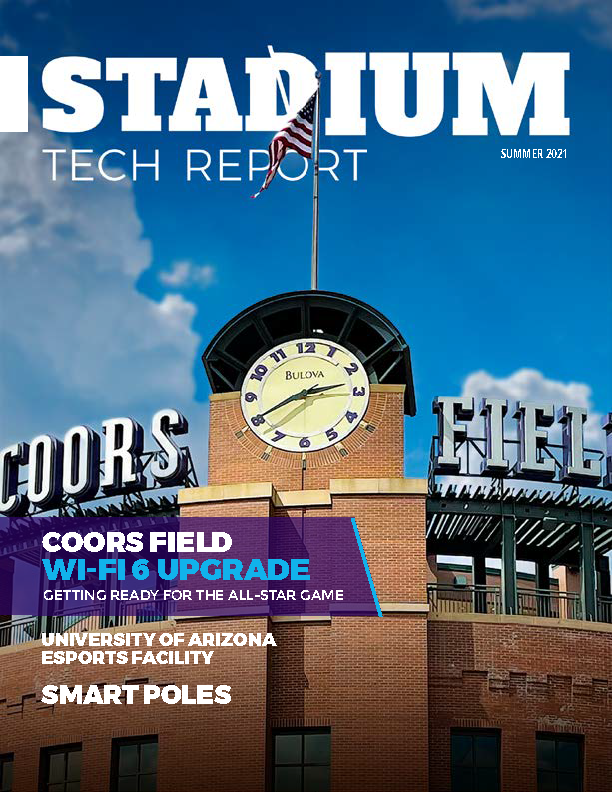
STR coverThe news that NBA teams are now partnering with San Francisco’s CrowdOptic to deliver Google Glass views to stadium big screens is a pretty interesting development to contemplate, on the heels of our Stadium Tech Report for Q1 2014, which looks at wireless network deployments in NBA stadiums. Done in a team-approved, controlled fashion, a few Google Glass streams could be pretty interesting. But CrowdOptic’s capabilities, as I understand them, are much bigger, and could theoretically allow for fans to see what other fans are seeing, if both are wearing Google Glass. The question we have for that latter idea is: Can the stadium networks handle all that traffic?

A good place to start to figure out the answer to that question is by downloading our Stadium Tech Report for Q1 2014, available free right now from our site. The 35-page PDF report delivers a capsule profile of each and every NBA team and whether or not it has Wi-Fi and DAS services in its stadiums. In our research we found Wi-Fi to be almost universal, with 79 percent — or 23 of 29 NBA facilities — all having fan-facing Wi-Fi. There is also a DAS (Distributed Antenna System) for enhanced cellular in almost every arena, and the ones that don’t have it are either installing it now or plan to soon.

But can those networks handle a crowd of Google Glass wearers, all broadcasting video of their court views? A good question for the next report, maybe. But you’ll need to know what the current network deployment situation is first, so… DOWNLOAD THE REPORT!

Has CrowdOptic found its niche with Google Glass and the NBA?

Screen shot of Google Glass footage from Indiana Pacers practice. Credit: Indiana Pacers

Screen shot of Google Glass footage from Indiana Pacers practice. Credit: Indiana Pacers

While we’re still far away from knowing whether or not wearable devices will really take off, the integration of personal-view video into stadium situations seems like a quick win. And San Francisco-based CrowdOptic appears to be ready to benefit from the latter idea, as its technology is being used in a couple announced deployments where Google Glass is being used to bring interesting video looks to big-screen displays in NBA arenas.

Both the Indiana Pacers and the Sacramento Kings have been using Google Glass to bring “personal” video views to the big screens in their arenas recently. Though players haven’t yet worn Google Glass during an actual game, in Indianapolis the wearable technology and its built-in camera was used to provide video feeds from a practice, as well as game-day views from cheerleaders and from a courtside PA announcer’s seat.

CrowdOptic, which had previously developed a unique mobile-device triangulation technology (which it somewhat unsuccessfully tried to market as a security or analytics-gathering tool) has seemingly found a perfect fit with Google Glass. According to a partnership announcement made with Wi-Fi gear and software provider Extreme Networks last week, CrowdOptics’ technology is helping weed out the best views from the devices to produce a watchable video stream.

This paragraph from the CrowdOptic press release with the Pacers actually describes it pretty well:

Another Google Glass view from an Indiana Pacers practice. Credit: Indiana Pacers

Another Google Glass view from an Indiana Pacers practice. Credit: Indiana Pacers

“The experience will be powered by CrowdOptic, a software platform which analyzes the real-time Google Glass feeds and curates them by their subject matter and quality, exporting only the highest quality live footage to the scoreboard. CrowdOptic’s ability to analyze where mobile and wearable devices are aimed allows future opportunities, such as optimizing in-seat arena services or providing fans the option to control their own broadcast.”

According to a recent Fortune Business article, CrowdOptic is charging NBA teams $25,000 per deployment, but some of that arrangement may change with the new Extreme partnership. Some new deals with additional NBA teams are also expected to be announced soon.

What will really be interesting to watch from a stadium technology perspective is how Google Glass use, for both team-approved activities as well as casual fan use, will affect things like in-stadium networks. Though our recent Stadium Tech Report for Q1 2014 found that most NBA stadiums already have fan-facing Wi-Fi, few seem ready for advanced applications, especially high-bandwidth generating ones like streaming Google Glass videos. What’s also unclear is how NBA broadcast rights may or may not affect the ability of teams or fans to record or stream live action via technology like Google Glass. Add another item to the stadium IT department and team legal department to-do lists!