AT&T adds DAS Coverage to New Orleans for Super Bowl Crowds

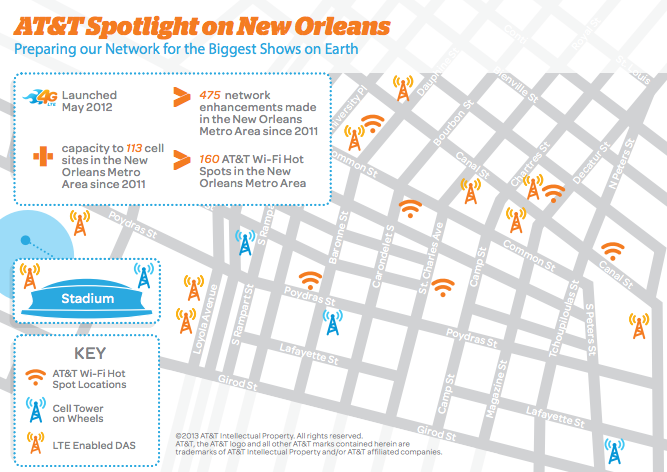
AT&T has beefed up its cellular coverage in the New Orleans downtown area by installing several Distributed Antenna Systems (DAS) to help handle the expected crowds for the forthcoming Super Bowl on Feb. 3.

According to an AT&T press release Ma Bell has added some outdoor DAS systems as well as DAS deployments inside New Orleans hotels to help ensure that Super Bowl fans stay connected with their mobile devices. For those new to cellular technologies, DAS is basically a bunch of smaller cellular antennas that get spread around strategic locations where large crowds might gather, to bring more capacity to the cellular cloud. You can put up DAS antennas outside, on street poles, or inside places like hotels. There they act just like regular cellular antennas, connecting to the closest handsets.

Just to make sure that important call, tweet or Facebook post gets through, AT&T will also deploy 11 temporary cell sites to the Big Easy for Super week — the cleverly named COWs or Cell towers On Wheels — and if all else fails you can look for one of the 135 existing AT&T Wi-Fi hotspots in the New Orleans area.

We expect other major cell providers to chime in with their Super Bowl enhancements soon. The good news is, the Mercedes Benz Superdome had a pretty major DAS upgrade of its own last year so cell service inside should be OK.
CBS Plans Big Online Blitz for Super Bowl: Watch Online, Mobile, and oh yeah… on TV

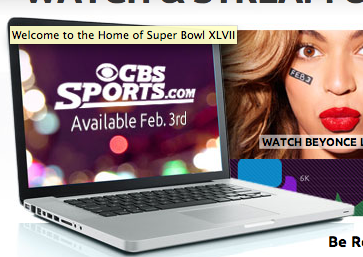
With the Harbaugh Bowl lineup now set, NFL fans will be glad to know that CBS is planning to stream this year’s Super Bowl live online, for free, at this website, with apparently no requirement to download any software like last year’s broadcast.

The Feb. 3 game between the San Francisco 49ers and the Baltimore Ravens is scheduled to begin at 6:30 p.m. Eastern time, with lots of stuff beforehand. You can also “like” the CBS Sports Facebook page, or follow CBS Sports on Twitter, just in case you’re not getting enough pre-Super Bowl info.

What we really like, though, is the simple instructions for online viewing — “Bookmark this page to access the live stream on Super Bowl Sunday,” reads the CBS page. That’s a lot easier than last year’s online broadcast by NBC, which required viewers to download the Microsoft Silverlight plugin. Not good. Let’s also hope that they will sync the broadcasts this year, unlike last year when the online show was 3 to 4 plays behind the live TV, making it useless as a “second screen” app.

According to tweets we have seen from CBS execs, as well as this press release written up by Engadget, there are apparently going to be a lot of bells and whistles available online, even perhaps a fan-selected camera view. CBS’s Jason Kint was apparently beta testing the app during Sunday’s games:

Our only quibble is that CBS Sports won’t exactly show the game live on your cell phone — to have it stream via a cell phone or pad you need to have a Verizon contract and you need to download the NFL Mobile app, which costs $5 per month. No word yet whether or not you will be able to watch via the CBS web page via a mobile phone or tablet browser, but we will discount double-check that option so stay tuned.

Verizon and the NFL: Pals Now, but What About the Future?

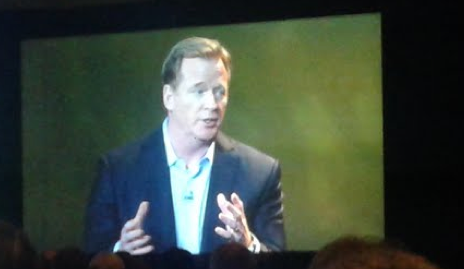
NFL commish Roger Goodell at CES. Credit: Paul Kapustka, Mobile Sports Report

On the surface the appearance of NFL Commissioner Roger Goodell at the Verizon CES keynote was all happiness and light, as chairman Rog traded pleasantries with Verizon CEO Lowell McAdam. But if you listened between the lines there was a bit of a disconnect, making us here at MSR wonder how in sync the two current partners will be in the near future.

The two areas where Verizon and the NFL seem headed in different directions are in mobile content delivery and in-stadium wireless networks, two huge matters for both entities. Currently Verizon is the NFL’s exclusive partner for providing mobile access to live NFL games, available only on Verizon devices via the NFLMobile app. Verizon currently can show live games on Thursday nights, Sunday nights and Monday Night Football, as well as the RedZone channel, which shows a lot of live content from games all around the league. Verizon paid something on the order of $700 million for the deal, which is said to expire after next season.

The unexpected appearance of Goodell during McAdam’s speech led us to initially believe there was some renewal announcement in the air — but instead Goodell left without talking about the future of NFL Mobile. Our guess for most of this season is that the NFL wants to take full control of its mobile/digital content offerings and sell them to fans at a steep cost, like Major League Baseball does. The silence in the presence of Verizon’s CEO can’t be good news for the phone carrier.

Likewise, Goodell has said he wants all stadiums in the league to install high-capacity Wi-Fi networks, to better serve fans with mobile content, social media and other connectivity options while they’re at the games. McAdam’s company, unlike its main competitor AT&T, has not made public Wi-Fi a priority and McAdam talked at CES about his hopes to use the company’s new 4G LTE video broadcast tools to help bring fans mobile coverage of events like the Super Bowl. He even made a pass at Goodell, telling the commish on stage that “we’d love to broadcast the big game [Super Bowl] in the 2014 time frame.” Goodell didn’t bite and didn’t comment. That doesn’t sound like much of a deal or even a promise. Akward stuff for a CEO to be floating, in front of thousands of witnesses.

Though we haven’t yet delved fully into how Verizon’s LTE video broadcast technology works, we’re skeptical that it can handle the big traffic demands of a full stadium of mobile users — more than half of whom are likely not Verizon customers and therefore unable to use any Verizon network technologies. Our guess is that the NFL will keep looking to Wi-Fi to solve stadium network issues — leaving Verizon on the sideline.

Wi-Fi Whispers: Is Time-Warner Cable Deal With WeFi About Mobile Sports Content?

The news that came out last week continued an interesting question: why would a cable company want to expand its free Wi-Fi services? Could it be that a big cableco sees free Wi-Fi as a way to keep its current cable customers — by making sure they can watch sports content wherever and whenever they want?

Nobody knows for sure yet, but in all the numerous news reports of the recent deal between cable giant Time-Warner Cable and Wi-Fi aggregator startup WeFi, there were a lot of details on the what but hardly any on the why.

Like other cablecos, TWC has been moving forward aggressively with a Wi-Fi hotspot deployment. By tapping WeFi’s capability to help people find free hotspots, TWC is buying rather than building, taking advantage of the idea that private networks may get built out farther and faster than even the biggest service providers could manage. But the question still lingers — why?

GigaOM’s Kevin Fitchard in the story linked above touches a bit on an idea — he quotes a WeFi exec’s idea that “cable providers want to encourage their customers to access their broadband connections and video programming outside of the home, making those services that much stickier.” But I don’t think it’s just about the sticky. I think it’s about maximizing the access to the content that is king over all other types, namely live sports content.

Sports remains the far and away No. 1 reason people watch TVs — just go find a list of the top viewed programs ever. Or check out stats from this summer’s Olympics. And a lot of that viewing is going to move to mobile screens, like tablets. So why is TWC putting Wi-Fi hotspots on the beaches of Southern California? Surprise, surprise, TWC last year paid $3 billion to snag the rights to L.A. Lakers basketball games. So now Lakers fans who are TWC subscribers can watch the games while they’re on the sand. But most importantly to TWC — they won’t cancel their cable subscriptions, meaning that TWC doesn’t have to shell out the $500 or so that is the estimated cost of finding a new subscriber.

Since it’s LA those subscribers may also be watching things like Dancing With the Stars or American Idol, but don’t kid yourself — you don’t see anyone ponying up billions in just rights fees for reality shows. And people don’t cancel cable subscriptions or buy pricey ones just to watch those shows. They do for sports, and I’m betting that cable’s big move to provide free Wi-Fi is all about making sure sports fans can watch the content they’ve already paid for — instead of, say, paying Verizon $5 extra a month to watch NFL games on your phone.

Here’s the news coverage of the TWC/WeFi deal:

Jeff Baumgartner at Light Reading
Todd Spangler at Multichannel News
Kevin Fitchard at GigaOM

And the LA Times story about sports rights, also a good read: Joe Flint and Meg James, LA Times (HT to Spangler’s Twitter feed for the link)

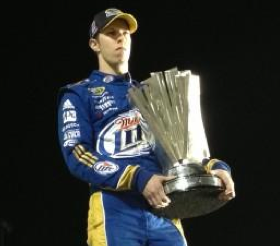
‘Tweeter’ Keselowski Wins Sprint Cup Championship

I’ve got to admit, I had never really known who NASCAR driver Brad Keselowski was until he sent the tweet heard round the sports world last February. Turns out not only is the guy social-media savvy, he’s a pretty good driver too, capturing his first Sprint Cup title Sunday.

Though the Chase to the Championship was tense, Sunday’s finish was decided early when top contender Jimmy Johnson went basically out of the race with 40 laps to go. That pretty much allowed Kesolowski to coast to the overall win with a 15th-place finish, and after he was done of course the first thing he did was send off a tweet.

Since Daytona, we’ve been following Keselowski and I have to say he has made the sport more enjoyable for me during the season, with his quick post-race comments and regular humor. While NASCAR wisely embraced his Daytona fire-picture moment (and quickly sealed a deal with Twitter to help promote the sport even more), there seemed to be signs of a backlash with NASCAR’s recent $25K fine of Keselowski for tweeting. While some think the fine was more of a punishment for Keselowski’s profanity-laced response to the crashing and fighting at Phoenix, NASCAR should back off on the tweet-fines because the social media world will reject you as quickly as it followed you if you show even the smallest signs of “not getting it.” (MSR free marketing suggestion: Why not partner with GoPro and have automated cameras where the drivers and crews can send auto-tweets and video clips during races?)

Right now, Keselowski certainly gets it, from Twitter to the race track. Enjoy the title, No. 2 car.

(And a big race-fan thanks to senior editor Greg Quick for compiling the weekly Watching NASCAR posts!)

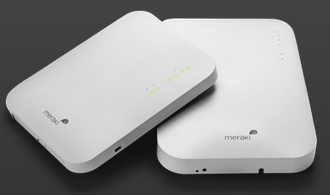
Wi-Fi Whispers Bulletin: Cisco Buys Meraki for $1.2 Billion

Why wait until Wednesday? No whispering here, with the news breaking Sunday of Cisco’s $1.2 billion purchase of mesh-networking Wi-Fi provider Meraki. Coming on the heels of last week’s successful public offering by Ruckus Wireless, you’d have to say that Wi-Fi is the hottest topic in the greater tech world right now.

And if you didn’t want to say it, we will.

From a sports-specific viewpoint, it’s not clear how the Meraki purchase might help Cisco’s sports and entertainment group, since Meraki has reportedly had much more success in enterprise/campus deployments, where its easy setup and cloud-based management systems ease the process of deploying wireless networks. Since stadiums are a lot more high-touch — there are unusual RF problems caused by the buildings themselves, and the crowds of fans require fine-tuning of antenna directions — the Meraki gear may not be a big bonus, at least initially. Though according to Meraki, its gear has handled big outdoor events quite well, including the Monterey Jazz Festival. So maybe Meraki will help Cisco in the stadium-network battleground.

From a big-picture view, you can never be too thin, too rich or have too much networking intellectual property. And the billion-dollar-buy (all cash!) is a sign that Cisco, the biggest player at the table, isn’t hesitant about trying to buy a winning hand.

While we here at Mobile Sports Report have been concentrating on the deployment of stadium Wi-Fi networks, it’s clear that as a whole the greater public Wi-Fi market, of which stadiums are a part, is set to get bigger, faster. This weekend’s big cash events are just the start.