Wednesday Wi-Fi Whispers: Lots of Networking at F1 Race in Austin

If you are a fan of F1 racing you might be headed down to Austin, Texas this weekend for the Austin Grand Prix at the new Circuit of The Americas course. From what we can deduce, it should be a good place to connect with your mobile device, since we have seen two press releases over the past weeks talking about wireless deployments at the track. But will there be free fan Wi-Fi? Probably, but we’re not sure yet.

We’re not sure because the main press release — from our friends at AT&T — talks mainly about how Ma Bell wired this place for high capacity data transfers, which we are guessing means lots of fiber for set video camera positions and the whole boatload of car-performance stats that regularly fly around the ether at any big-time motorsports event. From the sounds of it the new AT&T network should support fan Wi-Fi — but unfortunately neither AT&T nor the course/race website makes any mention of whether or not there will be free Wi-Fi for fans.

In case you’re wondering, we think such information omissions are a big mistake. But we are checking with AT&T and the race folks to see what’s up.

In the meantime, if you are a Verizon customer your cell phone should also work better at the track, thanks to an independent Distributed Antenna System (DAS) infrastructure put in place by our friends at ExteNet, a company that has built similar deployments at other sporting stadiums, like the new Barclays Center in Brooklyn. According to ExteNet its DAS will improve cellular reception around the track, mainly for Verizon customers this year since Verizon is the only cellular provider using the ExteNet solution right now. Since ExteNet builds independent networks — which means any provider can sign up and pay ExteNet to carry signals from their customers — other providers like Sprint or T-Mobile may join up for future events. Our guess is that AT&T won’t have to. The cool thing is, fans should be able to share photos and videos of the F1 racers as quickly as possible. And that is a good thing.

Wednesday Wi-Fi Whispers: Ruckus Goes Narrow with New Directional Antenna

Ruckus Wireless on Tuesday announced a new suite of products and an enhanced overall focus aimed at addressing high-density networking needs like stadiums, including an innovative antenna technology that can focus beams into smaller angles — all the better for servicing tightly packed crowds.

If Wi-Fi networking infrastructure deployments were originally about coverage, they’ve now switched to more concerns about capacity, said Steve Hratko, director of carrier marketing at Ruckus, who met with us at the Wireless Broadband Alliance’s Wi-Fi Global Congress conference in San Francisco Tuesday. And when it comes to deploying antennas and other infrastructure to serve high-density crowds, Hratko said, “all the rules of thumb have changed.”

One of those rules has to do with antennas. Historically antennas were designed to cast as wide a signal as possible, to cover the most airspace with the fewest number of devices. Now, with demand increasing at explosive levels, to serve high-density areas like stadiums takes some different deployment thinking, like antennas that use narrower beams. Ruckus’ new Wi-Fi access points, Hratko said, can shrink their signals into 30-degree slices, making it easier to aim them at a specific sector of seats, or other geographically specific areas, like airport waiting rooms.

“Sometimes, the beams can’t be narrow enough,” said Hratko. “It all ends up being more clever about where you put antennas.”

Ruckus, which is in the midst of preparing for an initial public offering, is also ready to help clients with its deployment smarts, which it is learning as it puts its gear into more high-density places like Time-Warner Cable Arena, where Ruckus gear helped keep the Democratic National Convention wirelessly connected earlier this summer. We’re sure we’ll hear more high-density talk from Ruckus sometime soon.

BT: Olympics Used 6 Terabytes of Wi-Fi Traffic

We’re going to try to track down the presentation — it was loaded with cool networking statistics — but one of the ones we did write down during a BT talk about Olympics network usage at the Wi-Fi conference was the staggering stat that there was 6 Terabytes of Wi-Fi traffic consumed on BT’s London networks during the games this summer — with some 697,383 separate Wi-Fi sessions initiated on the 1,500 access points BT had installed for Olympics use.

Though BT exec Chris Bruce said the network performed without many hitches — we heard some different stories — by all accounts the Wi-Fi networks on the Games sites apparently held up even in the face of record demand. It’s old news to us here at MSR but Bruce said if you didn’t believe it before, believe it now — crowds at big sporting events want to take pictures and video and share them instantly.

“Crowd behavior now is such that everyone wants to capture the moment and share the moment,” Bruce said, meaning that event hosts better have super-sturdy Wi-Fi and cellular or be ready for the inevitable immediate social-media backlash. One funny story he noted was that when planning started for the London Games 10 years out, the idea of having a Wi-Fi network wasn’t even considered. His advice for future big-event network planners?

“Take your demand model and keep revising it,” he said. “You just can’t predict it ahead of time.”

Giants Fans at AT&T Park Sent Lots of Texts During World Series, But Also Watched the Game

Our friends over at AT&T sent us some interesting wireless network stats from last week’s first two games of this year’s World Series, which were played in the San Francisco Giants’ well-wired home, AT&T Park. With the stadium’s state-of-the-art wireless infrastructure, it’s perhaps no surprise that fans consumed multiple gigabits of data, both sending and receiving.

We’ll include all the raw stats below — including some fun ones like the 53,000 SMS text messsages sent in the 6 p.m. hour of Game 1, the time span during which eventual Series MVP Pablo Sandoval hit his second and third home runs of the game — but what jumped out at us was the fact that voice calls peaked before the games started and data traffic peaked within the first hour. To us, that meant what happened was what we’ve believed all along: That fans do like to send a picture or a photo of themselves at big games, or call friends who aren’t there, but then once the games start they’re watching what’s happening on the field.

So even in Tweet-happy and iPhone-crazy San Francisco, the great fears of fans only looking at their phones and forgetting to cheer isn’t something that’s going to happen anytime soon. If nothing else, the players on the Detroit Tigers and St. Louis Cardinals can tell you that fans at AT&T Park were certainly paying attention and directing all their attention to the field, quite loudly at times. It might be some time before others believe cell phones and sporting events can co-exist, but we’re here to tell you it’s already happening now.

(Stats and figures below courtesy of AT&T, describing the stats their network folks compiled based on fans’ usage of our network during Games 1 and 2 of the World Series at AT&T Park in San Francisco.)

2012 World Series – games 1 & 2

· Fans still love the long ball – More than 15 percent more data was uploaded and nearly 20,000 more texts were shared on our network inside the park (between the hours of 4-9pm PST) during game one than game two of the 2012 World Series at AT&T Park.

· A text speaks 1,000 words – AT&T mobile users sent and received more than 350,000 texts across our network during the first two games of the World Series (between the hours of 4-9pm PST).

· Hush up, the game’s about to start – For both of the first two games of the 2012 World Series at AT&T Park (between the hours of 4-9pm PST) the most calls made on AT&T’s Network occurred during the hour directly preceding the game’s first pitch (4-5 pm PST).

· Fastest fingers – The hourly data upload and hourly total data peaks occurred in the first hour (5-6 pm PST) of both game one and two (between the hours of 4-9pm PST). Data uploaded as well as total data volumes decreased during each hour the game went on (between the hours of 4-9pm PST).

Additional Data

Game 1

· The hourly data upload peak of 16.2 GB (between the hours of 4-9pm PST) occurred in the hour in which Pablo Sandoval hit his first home run

· The peak point in hourly total data consumption (between the hours of 4-9pm PST) happened in the first hour of the game with a total volume of 35.3 GB passing through AT&T’s Network.

· AT&T subscribers downloaded the most data – 18.3 GB – during the 6 pm hour (between the hours of 4-9pm PST)

· AT&T mobile users sent and received the most texts (between the hours of 4-9pm PST) during the 6pm hour, the hour in which Pablo Sandoval hit his second and then his historic third home run, with more than 53,000 SMS texts sent and delivered across AT&T’s Network. That’s more than one text for every fan in the stadium. (Total attendance – 42,855)

· For the opening game of the 2012 World Series at AT&T Park (between the hours of 4-9pm PST) the most calls made on AT&T’s Network occurred during the hour directly preceding the game’s first pitch.

Game 2

· The hourly data upload peak of 13.8 GB (between the hours of 4-9pm PST) occurred in the hour in which the first pitch was thrown

· The peak point in hourly total data consumption (between the hours of 4-9pm PST) happened in the first hour of the game with a total volume of 33.1 GB passing through AT&T’s Network.

· AT&T subscribers downloaded the most data – 20.6 GB – during the 6 pm hour (between the hours of 4-9pm PST)

· AT&T mobile users sent and received the most texts (between the hours of 4-9pm PST) during the 7pm hour with more than 42,000 SMS texts sent and delivered across AT&T’s Network. That’s nearly one text for every fan in the stadium. (Total attendance – 42,982)

· For the second game of the 2012 World Series at AT&T Park (between the hours of 4-9pm PST) the most calls made on AT&T’s Network occurred during the hour directly preceding the game’s first pitch.

Giants Win, Twitter Explodes

It’s become pretty normal for Twitter to blow up after any big event now (just wait until the U.S. Presidential elections) but when the company’s hometown baseball team wins the World Series, the explosion of tweets is the Internet equivalent of the fireworks going off around us here in the Bay Area tonight. According to Topsy, the tweets hit 38,000 per minute right after Sergio Romo got Miguel Cabrera to watch strike three on that sick fastball:

38,000+ tweets per minute for the @ after winning the #worldseries! Go Giants! #sfgiants http://t.co/rK1bocEK

@Topsy

Topsy

In honor of the Giants and for Twitter, some choice post-game missives from the folks we follow. Any good ones you’ve seen, put them in the comments and I’ll add them later to the main post.

Second time today Romo’s clinched a game for the Giants.

@jimrome

Jim Rome

When a #WorldSeries is won on the road…almost as awkward as that Erin Andrews interview of Marco Scutaro.

@Matt_Ginella

Matt Ginella

my neighborhood is one #SFGiants party spot. Honking has begun in earnest.

@om

Om Malik

RT @: Dear God. Giants championship parade scheduled for Halloween. That is going to be a FREAKSHOW.

@jason_kint

Jason Kint

p.s. Thank you Melky for the All-Star victory 😉

@omid

Omid Ashtari

Giants win with pitching, defense..managers moves..timely hitting..sounds like simple formula..if it were everyone would do it..congrats SF

@karlravechespn

karl ravech

https://twitter.com/evanadrian/status/262764923556352002/photo/1

Across the street from me, how to watch the game in The City. (Also, faster than Twitter for news.) http://t.co/KB2TRbD9

@Rafe

Rafe Needleman

Watching Golf this Week: Get up Early for the CIMB Classic in Malaysia

Quick, turn the channel on now! If you are up way late or up really early there is a chance you may catch live golf this week — including Tiger Woods and Jason Dufner — at the CIMB Classic in Kuala Lumpur, Malaysia. (I was wondering why big media hitters like Alan Shipnuck were in China this week.) It might not be an official season event (it is sanctioned) but with a $6.1 million purse and $1.3 million to the winner, yeah you’ll get a lot of guys on long plane rides. And the Tour gets exposure in China, where as you can expect there is a lot of golf gear to sell. Win-win. So who will win? Who knows, here’s a link to the field. And remember, it’s live on the Golf Channel every day this weekend from 1 a.m. to 4 a.m. Eastern. Think I’ll go catch up on Tiger’s short game before I turn in here on the West Coast, Wednesday evening.

CIMB CLASSIC

(all times Eastern)
TV COVERAGE

Thursday, Oct. 25 — Golf Channel, 1 a.m. — 4 a.m.
Friday, Oct. 26 — Golf Channel, 1 a.m. — 4 a.m.
Saturday, Oct. 27 — Golf Channel, 1 a.m. — 4 a.m.
Sunday, Oct. 28 — Golf Channel, 1 a.m. — 4 a.m.

FACEBOOK PAGE
CIMB Classic is on Facebook.

TOP TWITTER FEEDS TO FOLLOW

Geoff Shackelford — well known golf writer. If you’re not following Geoff you are missing the online boat.
Golf Channel — official Golf Channel feed
@PGATOUR — official PGA Twitter feed
@StephanieWei — great golf writer who is a Twitter fiend.
Doug Ferguson is the lead golf writer for AP. Good Twitter insights that often aren’t part of your wire-service lead.

WHAT’S THE COURSE LIKE?
Here’s the deets on the The Mines Resort & Golf Club.

WHO WON THIS THING LAST TIME?
Bo Van Pelt.

Wednesday Wi-Fi Whispers: Brocade and the Niners, Part 2

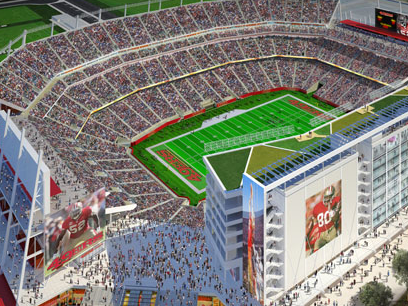
Just a quick promised expansion of last week’s top story, the official signing of Brocade as the provider for the upcoming network in the new San Francsico 49ers stadium. Dave Stevens, Brocade CTO, told us that the deal between the networking gear provider and the team had been brewing for several years, while Brocade was building its new headquarters near the team’s Santa Clara training and business facility.

“Brocade’s campus buildings were all about being green, with photovoltaic power and LEED certification,” said Stevens, noting that some similar design guidelines (solar, sustainable) are being used in the Niners’ new stadium. “I think there was some commonality between them and us with vision.”

In terms of whether or not Brocade has the experience to build a stadium-ready infrastructure, Stevens said the company has already installed a couple stadium networks, but hasn’t publicized them. He also noted that Brocade typically sells to customers like large national telecom carriers and other big mission-critical enterprise businesses. “We grew up on that, so we’re confident with that [high pressure] environment,” Stevens said. In terms of stadium networks, he added, “we’re familiar with what has to be done.”

For the new Niners stadium, Stevens acknowledged that its location in the middle of Silicon Valley raises the bar for expectations about network performance. “It’s a much higher bar than for any other venue,” he agreed. “It’s the middle of Silicon Valley. But we should be able to put an infrastructure in place with enough capacity to drive whatever apps people can dream up.”

Right now Stevens said Brocade is guessing that a lot of the Wi-Fi gear will incorporate the new 802.11ac standard, which holds the promise of much greater throughput and much better antenna performance. But he also knows that in the ensuing two years before the stadium is scheduled to open, advances in mobile devices will probably continue to push the envelope for mobile data networks.

“There’s just an unprecedented amount of I/O capacity that’s now being carried around in people’s pockets,” Stevens said. “If you’re a tech guy it’s scary. But we are looking to deliver an unprecedented [wireless] experience, and make sure it’s ready by day one.”