ExteNet Signs Wireless Deal with Minor Hockey League, Adds App Integration

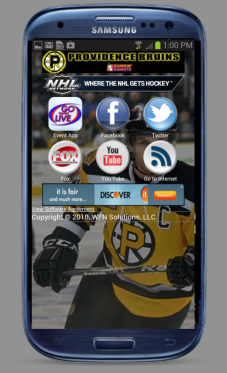
Screenshot of Go Beyond Live app.

Screenshot of Go Beyond Live app.

Wireless infrastructure provider ExteNet Systems this week announced that it has been named the “Official Arena Wireless Network Provider” for the American Hockey League, a minor-league circuit with teams in 30 cities across the country. Though no specific deals have yet been inked for specific arenas, the Lisle, Ill.-based ExteNet said it will start announcing plans later this year or early next, after it evaluates facilities to see what technology is needed.

Known best for its deployments of Distributed Antenna Systems in sporting venues, ExteNet can also design and deploy stadium Wi-Fi, which it may need to do for some of the AHL arenas. “There are some things that can’t be done just by cellular alone,” said Jon Davis, vice president of business development at ExteNet, in a phone interview earlier this week.

While we’re always skeptical of such open-ended deals like ExteNet’s AHL agreement as well as the one it recently signed with AEG — we have seen too many such announcements in the tech world that end up being a lot of nothing — ExteNet’s track record of building networks for large institutions like the University of Michigan and the Miami Marlins seems to suggest that the company is capable of handling large-scale operations. If nothing else, maybe ExteNet will be hiring more engineers soon, so forward those resumes.

An interesting sideline to the AHL deal is ExteNet’s announcement that it will make available to AHL teams an in-stadium app, developed by the Wireless Fan Network. Called Go Beyond Live, the app has various features designed for use in sports arenas, like concession ordering and replay video services. According to ExteNet the Go Beyond Live app is not exclusive, meaning that teams can add their own apps to whatever infrastructure is built. But the partnership highlights what we here at MSR see as a big potential future for app developers, namely building apps for the thousands of teams and leagues that aren’t in the top pro tiers.
Ruckus Scores Wi-Fi Deal for Soccer Stadiums in Brazil — But Will Wi-Fi be Missing in Action at Brazil’s 2014 World Cup?

The curious wording of a press release out today is making us wonder: Will in-stadium Wi-Fi be missing in action during the soccer World Cup next year in Brazil?

The thing that got us asking this question is the release today of news from Wi-Fi gear vendor Ruckus Wireless, which trumpets a deal for more than 360 Ruckus wireless access points, to be deployed in two of Brazil’s biggest soccer stadiums. But the release doesn’t mention the World Cup at all, and there is no date given for when the equipment may be installed.

While our guess (we are waiting for word back from Ruckus) is that there is some World Cup wireless rights deal that precludes supplying vendors like Ruckus from using the term “World Cup” in any announcements, the press release got us looking to see if any of the other stadiums that will be used in the month-long tourney already have or have plans to get Wi-Fi before the soccer starts. So far, we haven’t been able to find anything concrete that spells out whether or not Wi-Fi will be available at any of the 12 venues across Brazil. Our short history in covering this market tells us that if there isn’t a press release saying that Wi-Fi will be available, you can bet that it probably won’t be.

For the sake of the thousands of futbol fans who will no doubt be traveling to Brazil for the matches, we hope we’re wrong. But the best info we have found in a limited bit of Internet searching are a few articles from ZDNet’s Brazil Contributing Editor Angelica Mari. For the most part, the information seems to come from hopeful press releases, like this one about a plan for Sao Paulo to invest $22 million in a free Wi-Fi project, something Mari notes has been promised and not delivered many times before. In July Mari reported that the World Cup said it would have free Wi-Fi at all matches, but again, there were no specifics about deployments and her cautionary line, “But the actual ability of mobile providers to deliver is questionable,” should probably be taken as a pretty good warning that not all is well when it comes to Wi-Fi at the games.

For Ruckus, the deal to put wireless access points into two of Brazil’s biggest stadiums — the 71,000-seat National Stadium, also known as Estádio Nacional de Brasília, and Arena Octávio Mangabeira (also known as Arena Fonte Nova, depending on who you ask), a 50,433-seat facility in the city of Salvador — is another international win, and proof that Ruckus gear is passing the test when it comes to dense public facilities. But whether the gear be active in time for World Cup action is still unknown. UPDATE: Ruckus has confirmed that the gear is scheduled to be working by next June. Apparently we were also correct in assuming there is a rights deal that precludes the use of the term “World Cup” in any such announcements.

Unlike the London Olympics, which were amazingly the most un-wired games in history, the 2014 World Cup is looking like it might be a bit of a communications nightmare, given that local citizens like Mari routinely note that the country’s cellular infrastructure and services leave much to be desired.

Another possible scenario is that the Ruckus deal is just part of a bigger deal, where Ruckus would be one of several providers to the consortium of Latin America telecom providers (Claro, Oi, Telefónica, and TIM) who are in charge of World Cup communications. That might explain why a Ruckus release didn’t say World Cup, or mention other stadiums. Word on the street is that press announcements for World Cup infrastructure are being kept tight to the vest, so maybe we’ll hear more soon.

Big DAS Deals: AT&T Bringing DAS to Pac-12, Extenet Scores with AEG

Though no specific stadium installation plans have yet been made public, two big DAS deals were announced in the past week, with AT&T on track to bring DAS deployments to the Pac-12 conference, while ExteNet scored an exclusive DAS deal with entertainment giant AEG.

I don’t have confirmation but I do believe that AT&T’s agreement to be the exclusive wireless sponsor for the Pac-12 is the first such deal signed with one of the top collegiate conferences. Though agreements and details will have to be worked out on a stadium-by-stadium basis, the opportunity to be the exclusive provider of DAS infrastructure for all big facilities at the 12 major universities is a big win for AT&T. Jon Wilner over at the Mercury News has a good explanation of the full deal, which also includes content agreements for carrying Pac-12 broadcasts on AT&T U-Verse.

After deploying DAS (Distributed Antenna System) networks to all stadiums by next year, it will be interesting to see if AT&T helps the schools financially with any corresponding Wi-Fi network buildouts. AT&T has gone on the record publicly to say that it doesn’t want to help fund Wi-Fi, but that stance might be different if AT&T has exclusive deals like this one. In other DAS news AT&T also was announced as the supplier of new DAS deployments at CenturyLink Field in Seattle; you have to believe that when it comes to stadium DAS AT&T is the market leader, all part of a big push toward the small cellular antenna systems started a few years ago by CTO John Donovan.

ExteNet and AEG

But even with AT&T’s big wins, that doesn’t mean there isn’t DAS opportunity for multiple players. Infrastructure experts ExteNet proved that with the announcement of its exclusive-rights deal to build DAS and other wireless infrastructure for AEG facilities. In terms of venues, AEG owns or is affiliated with a long list of big facilites, like the Staples Center in LA, the Sprint Center in Kansas City, O2 in London, and more.

With no announced specific plans yet a deal like this is what we call “a work in progress.” And some of the AEG facilities already have networks, so it’s unclear what the total opportunity is. Still, not a bad win for ExteNet, which has put networks in places for customers like the University of Michigan and the Miami Marlins and the Barclays Center.

“We are working with individual [AEG] venues to understand the level of coverage, if any, in their venues,” said ExteNet VP Jon Davis in an email reply to our questions. “The specific venues we are engaged with have limited, if any, in-building coverage. There is a mix of sports and music concerts in these venues and the demand is for high bandwidth mobile connectivity to cater to the coverage and, increasingly more important, capacity needs for these venues.”

Despite Macintosh Issues, NBC Records Record Audiences for Sunday Night Football Online Streams

Even though Macintosh users are now second-class citizens when it comes to watching NFL games online, NBC this season has still racked up record numbers of online streams of live action, according to NBC.

The NFL’s season opening game, carried by NBC on Thursday Sept. 5, accounted for more than 20 million minutes of online streaming, making it the biggest-ever online sports event that wasn’t a Super Bowl or Olympics, according to NBC. And this past Sunday’s game between the San Francisco 49ers and the Seattle Seahawks racked up another 18 million-plus online minutes, making it the new #2 such online event (surpassing the Week 1 Sunday night show, which totaled nearly 12 million online minutes, according to NBC).

“It’s safe to say we’re definitely seeing a significant increase in online viewing,” said an NBC spokesperson, who spoke with us via phone on Tuesday.

In regards to the issues we (and some of our readers) had in accessing the live game streams from Macintosh computers, NBC had this official response:

“We [NBC] have the ability to stream our linear Sunday Night Football coverage to all desktops, and to tablets through the browser. However, for the 2013 season, we do not have the ability to stream our enriched package, which includes alternate camera angles, to non-Microsoft operating systems.”

Why are Mac platforms second-class citizens this year? It’s an educated guess, but it can probably be traced to the NFL’s deal with Microsoft made earlier this year, though we have no official confirmation of that being the reason. You make the call. What does that mean for Mac users? On Sunday night online, only Windows devices will have access to the “enhanced” online features, including multiple camera angles and social media links. Mac users should still be able to view live action, but only using Safari browsers — Chrome or Firefox won’t work.

So why do some Mac users see no video at all? In my case, I suspect that my reluctance to upgrade my desktop OS or an older version of Safari (which I only use sparingly) is behind my inability to see live video. While some readers said that de-installing Safari AdBlocker allowed them to see live video, others were like me, and couldn’t get the stream to work at all. The NBC spokesperson said they aren’t seeing or hearing about any widespread problems; readers who still have problems next week Sunday, please let us know!

It’s possible that all the problems of favored or shunned client platforms could become a thing of the past in the short-term future, when new NFL TV contracts kick in next year. Part of the problems are simply that technology is moving faster than TV rights contracts — the last time the NFL signed TV deals, tablets didn’t exist at all, so there was no legal language spelling out who could and who couldn’t use them to access live action. Verizon’s NFL Mobile package suffers from similar restrictions, with viewers able to only use cellphones and not tablets via a cellular connection to view live action via the NFL Mobile app. It’s a mess right now, and viewers are paying the price in more ways than one.

What is clear is that many more viewers see online as just another method to access content they have already paid for, either via a cable contract or a cellular or a satellite deal. The onus, I think, is on the league and its content partners to take better care of its customers, who are just trying to watch their favorite sport. They shouldn’t have to both pay and experience the pain of little or no support.

Sunday Sermon: More Support and Execution Needed for Mobile Sports Apps

So far this NFL season, we’ve had two weeks and two big failures on the mobile football-viewing application front. For the opener there was the (still unexplained) meltdown of Verizon Wireless’ NFL Mobile app, a snafu that probably caused millions to miss live coverage that they had paid for on their phones.

This weekend, we’re still not sure of the extent of the problem (or whether it was something NBC knew about) but I was unable to view NBC’s Sunday Night Football game on the web, even though as a Comcast subscriber and a Mac user NBC’s own site tells me that I can. Attempts to watch in Chrome or Firefox met with error messages pointing me to Safari. And while some of our readers said that disabling an ad-blocking extension allowed them to use Safari to watch SNF online, even using Safari I wasn’t able to connect and neither were other readers. The bigger question is, why, in 2013, is a major network restricting access to different browsers and OSes? Aren’t we past all that?

Apparently not. The bigger problem, I think, is that there’s too much money and attention being spent promoting online and wireless sports-viewing apps, and not enough spent on the coding and technical support. When I finally got through to a Verizon support rep on opening day that person tried to say that errors couldn’t be fixed because “high call volume,” as if that’s a believable phrase anymore, was taking resources away from tech support. And even the NFL Mobile support’s efforts to pass off Verizon’s errors as a “server hiccup” are lame. Verizon makes something like $40 billion a quarter, and can pay $1 billion just for mobile NFL rights. But they can’t keep their phone banks staffed or their biggest sports app working on opening day? That is a priority decision that is a head slap to the users who pay $5 extra a month for NFL Mobile. But it’s apparently about the norm for mobile sports viewing apps.

NBC’s apparent decision to alienate Macintosh users is harder to figure out. At the very least, if they are going to take money from Microsoft and that is behind why NBC is “enhancing” things for Windows viewers online, be honest and tell Mac users upfront that you’re not going to get access.

If I can send any advice to teams thinking about putting in stadium apps, it would be to make sure you also have budget for technical support. I know it’s not easy to design an app or a web service that works with the dizzying amount of client devices and software install versions out in the world today. But when the biggest companies out there now are falling down on the job, it’s not a good sign for the industry overall. More support for mobile apps, please — before users stop trying them out of sheer frustration.

Sunday Night Football Online — Not Available to Mac Users?

We’re still trying to contact NBC Sports for an explanation, but for some reason we aren’t able to watch Sunday Night Football online using either one of the two Macs we have here at MSR headquarters. It may very well be that we haven’t downloaded the appropriate crappy extra plugins needed, since NBC online stuff is terrible for asking you to add junk to your computer that you don’t want.

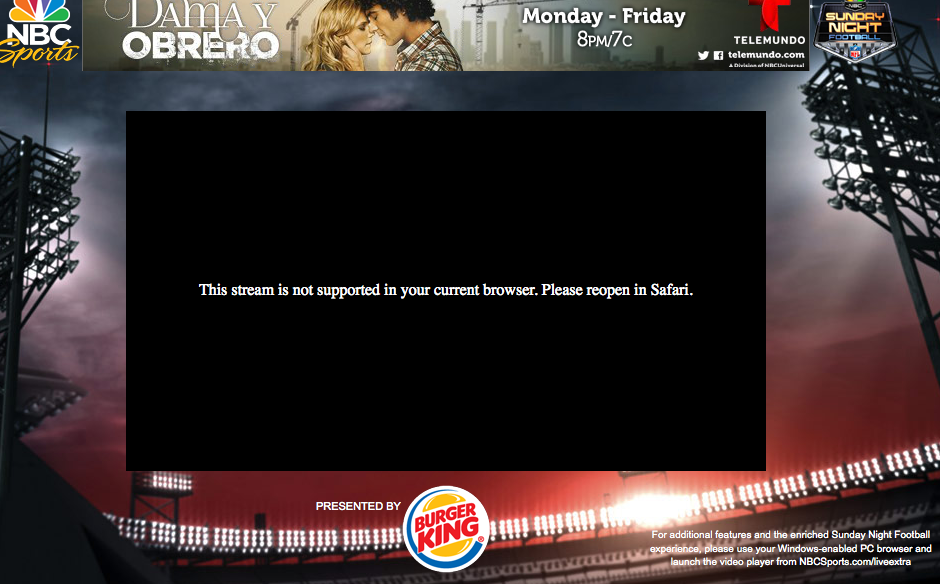
And though the NBC Sunday Night football online site says Mac users can use any browser they want, when I use Chrome to try to log in I get a message that tells me I need to use Safari instead.

Screen shot 2013-09-15 at 5.46.13 PM

When I switch to Safari, all I get is a blank screen (other than the banner ads, which display fine) and a message that says “For additional features and the enriched Sunday Night Football experience please use your Windows-enabled PC browser and launch the video player from NBCSports.com/liveextra” — which isn’t much help and really surprising in an era when more Mac PCs and laptops are being sold.

Anyone at NBC who can explain what’s going on? Maybe we can get it figured out before the weather clears in Seattle, where play is delayed?

QUICK UPDATE, 9/17: Just spoke with an NBC representative (more info coming in separate post) who said that streaming IS available to Mac users, but only with Safari browsers. Check back for a longer post with some technical guidelines — not sure yet but guessing my inability to see live video even in Safari (which some other readers also experienced) is probably due to my using an older version of Mac OS or Safari. So: Macs aren’t shut out for SNF, but they are definitely second-class citizens now, in part no doubt due to the deal signed earlier this year between the league and Microsoft. NBC, for example, can now only offer its extended features (multiple camera angles, social media stuff) to Microsoft client devices; wonder what other restrictions the shield agreed to for Microsoft cash?