Soldier Field gets upgraded DAS from AT&T, Boingo

We’re not sure exactly how much better the new DAS install is at Soldier Field in Chicago, but we are convinced that it may take some time for the mainstream media to learn the difference between better cellular and Wi-Fi.

(What do we mean? One Chicago TV station and the Chicago Tribune think that a new DAS means faster Wi-Fi. Ah well. In the meantime, keep reading MSR if you need clarity and details about stadium technology.)

In a somewhat confusing press release, Boingo and AT&T, in partnership with venue management services provider SMG, announced an “enhanced distributed antenna system network” at the home of the Chicago Bears, that wonderful old/new facility located hard along Lake Michigan’s shore just south of downtown.

What’s confusing about the release is that it doesn’t quite explain how and why Boingo and AT&T are partnering with SMG as neutral-host operators. Plus, it seems that both Boingo and AT&T have already been operating DAS installs at the stadium, so who knows how “new” the enhancements really are. Our best guess (we have emails in to both companies so expect more clarity soon) is that since Boingo has been operating Soldier Field’s Wi-Fi and AT&T is bullish on DAS installs everywhere, it makes sense to team up with an upgrade that will now provide better coverage, probably with more antennas and new coverage for AT&T’s 4G LTE network. We’d call this arrangement a win for Boingo, which is intent on building up its stadium DAS and Wi-Fi business. Plus, the companies have done business together before so maybe partnering for a DAS isn’t so confusing after all.

No word yet whether Verizon or Sprint or T-Mobile has signed on to participate in the DAS, or whether the new DAS will keep Bears fans online longer, distracting them from worrying about the health of Jay Cutler’s groin. Good thing to have as the snowflakes start flying in the Windy City.

UPDATE 1, 10/24: We are still seeking clarity on the business arrangement, but an AT&T spokesperson confirmed our guess about the LTE addition. Here is an official AT&T breakdown of the enhancements to the DAS: “The DAS equipment at Soldier Field is equivalent to about 7 individual cell sites, or enough to service a town about the size of 88,000. The DAS contains more than 250 stealth antennas inside and outside the stadium which have increased AT&T’s network capacity by approximately double (100%). The design changed when we added layers to the wedge shape that was previously used. The old system had 16 sectors, sliced like a pie. The new system has 22 sectors that service each section of the stadium as well as each level of the stadium.”

Sounds good. But now I’m thinking about pie. Pumpkin, with whipped cream. Hmmm.

UPDATE 2, 10/25: Now from the Boingo folks, who wouldn’t say more about operational details other than that Boingo and AT&T worked together on the upgrade. More from Boingo, which answers our question about whether there are other carriers using the DAS: “Boingo is responsible for the ongoing operation and management of the DAS network, working closely with both SMG at Soldier Field and AT&T. Boingo also manages Soldier Field DAS network access contracts for Verizon, Sprint and US Cellular.”
TE Connectivity reveals several big-league DAS deals

When it comes to stadium networking deals, there are often a lot of names and companies behind the scenes that don’t get the headlines when services are initially deployed. But now that claiming project wins is seen as an important point of reference for future business, you may start to see more of the type of news releases that crossed our desk today: One from DAS supplier TE Connectivity, naming the company as the DAS provider for four major-league ballparks, including Yankee Stadium, Target Field in Minneapolis, The Ballpark in Arlington, and Citi Field.

Fans going to those stadiums may never know what or who TE Connectivity is, but the people responsible for making cellular networks work better inside arenas know TE Connectivity, a communications infrastructure supplier that did more than $13 billion in sales during 2012. According to its press release TE Connectivity’s DAS gear is inside “more than 50 baseball, football, and soccer stadiums around the world,” so we will probably be hearing more from TE Connectivity as the “inside baseball” of stadium networking space becomes more well-known.

Likewise, TE Connectivity’s third-part neutral host operator partner in Minneapolis, InSite Wireless Group, will probably start talking more soon about its third-party DAS hosting skills, which include not just stadiums but “convention centers, hotels and casinos, airports, and transit systems like the MBTA Boston subway system,” according to the company. We have calls scheduled with both companies this week, so look for more details here soon.

NBC clarifies ‘Old Mac’ problems for Sunday Night Football streaming: Newer OS required

If you are still wondering why you can’t see NBC’s streaming broadcast of its Sunday Night Football games on your Mac, I now have an answer: It’s because you’re running an older operating system, older than Mac OS version 10.7.5.

After a special-to-MSR telephone confab with some technical folks on NBC’s staff last week we quickly rooted out why I was able to see the banners and home page of the Sunday Night online broadcasts but not the live video player: According to the NBC folks, my older iMac and its 10.6.8 version of MacOS isn’t technically up to snuff for the special player NBC is using for the Sunday night show.

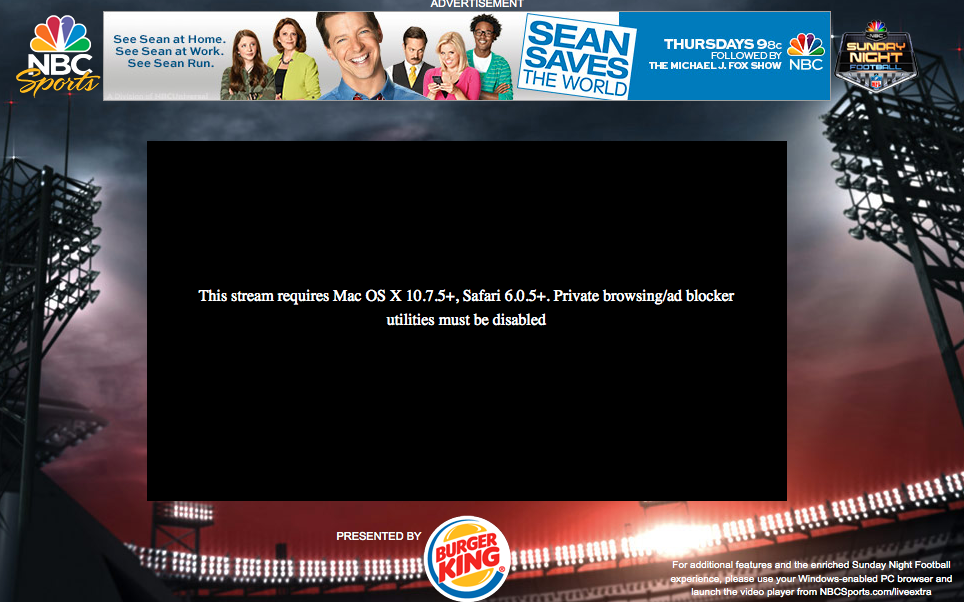
New error message shown by NBC's Sunday Night Football online to older Mac users. Credit: NBC.

New error message shown by NBC’s Sunday Night Football online to older Mac users. Credit: NBC.

Mind you, my not-that-old desktop does just fine showing every other NBC online offering, including the recent live broadcasts of the America’s Cup sailboat races, or the London Olympics. And for those I can use the browser of my choice, usually Chrome and sometimes Firefox. But because of the NFL’s recent deal with Microsoft, NBC is forced to use a different video player for its Sunday Night Football broadcasts. Though they aren’t completely blocked for Mac users who want to watch, they must have a machine with MacOS 10.7.5 or higher, and can only use the Safari browser. I will spare you the HTML5-related details why this is so, to only say that if you have a Mac and you want to watch SNF online, you need to upgrade your OS, make sure you have Safari 6.0.5 or higher, and turn off any ad-blocking utilities.

Is it worth the pain for you to upgrade your OS? I have no idea how you’d exactly go about doing so, I’ve looked at a few online tutorials but really it’s just not worth it for me (I think there is also a $19.99 charge from Apple for the software). I don’t blame NBC here, I actually can’t praise them enough for marshaling some pretty impressive resources to find the root of the problem for our humble little outlet and our devoted, passionate readers. After our inquiries, NBC also started showing the error message above to users of older Mac platforms, so they wouldn’t wander in the dark questioning their own sanity, like I did for the first few weeks of the season.

Instead I point the finger at the Shield and at Microsoft, for forging some deal that alienates some users solely so that the NFL can spend some more Microsoft cash, and so Microsoft can strike a blow against Apple that it can’t do in open competition. Bravo. Fan first, you know.

If I may editorialize a bit, I would say that the NFL gets away with cutting these bad-for-fan deals (like the exclusive deal with Verizon for NFL Mobile) because it’s so big and powerful that it can. What other entertainment outlet would cut a deal that would only allow 1/3 of the U.S. mobile phone customer base to watch their product? And what about when that service goes kablooey and there’s nobody explaining why? And the Microsoft deal, which cuts off older Mac customers from Sunday night football now and who knows what else in the future, is just another greed-driven strategic ploy that only benefits the NFL and Microsoft, and does nothing for fans.

It will be interesting to see what happens as the NFL moves more toward an MLB-type offering for online video and highlights, a move that we foresee even though we don’t have any solid evidence of it yet. Will the NFL cut deals to restrict access to selected hardware or software platforms? Is this a return to the bad old days of browser cutoffs? Is there a Net Neutrality argument in here somewhere?

Extreme thoughts, maybe, but who would have thought that in 2013 we’d see an entertainment outlet as popular as the NFL limit the capabilities of one technological platform versus another simply because it was paid to do so? And not just once, but several times? Aren’t we paying enough for football as it is? Or should we just get used to paying more, because we have no choice and apparently no seat at the table?

DAS Pig Soooey! AT&T brings DAS upgrade to Razorback Stadium

The loyal fans of the University of Arkansas Razorbacks can now be assured of a better level of cellular connectivity at football games, thanks to a new DAS install at Donald W. Reynolds Razorback Stadium, courtesy of AT&T.

Unlike its recent Pac-12 infrastructure deal, the contract to put better cell coverage in Razorback land is being pitched as part of AT&T’s overall network small-cell upgrade, something AT&T calls Project Velocity IP. For us, the part of the budget it comes from doesn’t matter as much as it is another DAS win for AT&T, and this time in the biggest of college football conferences, the SEC.

AT&T even has a press release out on the news, linked here. We’re working on getting a list of all the recent AT&T DAS wins, since it seems like we’re writing about a new one every week. Anyone else out there putting in more DAS deployments? Let us know.

AT&T turns on Wi-Fi at Miami Dolphins’ Sun Life Stadium

We knew that AT&T had put in a new DAS at Miami’s Sun Life Stadium earlier this year, so we were a bit surprised when we saw the Dolphins announce a new Wi-Fi network for their season opener a couple Sundays ago. A quick phone chat with Chad Townes, VP of AT&T’s antenna solutions group, set us straight: Turns out that AT&T had installed a Wi-Fi network alongside the DAS, but hadn’t planned to turn it up until the NFL season started.

For those of us who were lucky enough to be at the SEAT Conference in August, however, the questions couldn’t stop there. At SEAT, Townes made one of the bolder statements of the gathering, proclaiming that AT&T wasn’t going to fund stadium Wi-Fi developments anymore. So why was AT&T building Wi-Fi at Sun Life?

The Wi-Fi at Sun Life, Townes said, was built via a model AT&T was comfortable with — mainly, it was a financial model where the team and venue participated in the deployment costs. “Our position on Wi-Fi remains clear,” Townes said — mainly, that AT&T isn’t going to fully fund a network that it doesn’t reap benefits from. Since stadium Wi-Fi is or will be mainly used for high-bandwidth apps like video replays, it will generate wireless traffic that “doesn’t leave the stadium,” Townes said. AT&T is more interested in building and paying for DAS, or distributed antenna systems, which bring better cellular connectivity for fans at stadiums.

Traffic that leaves the stadium, to connect fans to the outside Internet, is of interest to AT&T since it is something the company can make money on, by providing the service to customers. OK, but then what about the recent deal AT&T signed with the Pac-12, which called for DAS builds in all conference stadiums, but may also call for AT&T to build… stadium Wi-Fi networks?

Again, it’s all about the economics, which in the Pac-12 case involved a big content carriage deal between the conference and AT&T’s home Internet and video service, U-verse. From what we’ve heard and read the deal involves a lot of stadium-intensive content agreements, so to make it all run right, AT&T wants to build the networks itself. In the case of that deal, Townes said networks would be built to “support the value of our brand” in those stadiums. So the bottom line is — AT&T isn’t going to simply pay for a Wi-Fi network in your stadium. Unless there’s more to the deal than that.

NBC’s Sunday Night Football Fails Continue for Mac Users; UPDATE: Problem Diagnosed

UPDATE, 9/30: After a quick call with NBC’s tech folks Monday the problem was discovered: Due to new HTML5 code NBC is using that is specific to its Sunday Night Football broadcasts, Mac users need to have MacOS version 10.7 or higher installed to see the player. Like many users who haven’t been able to see the Sunday Night online broadcasts, my machine is running Mac OS 10.6.8. There is no workaround, so to watch Sunday Night Football on a Mac you will need to upgrade your OS, which costs $19.99. Here is a link to Apple support spelling out the details, if anyone has done this recently and wants to share the steps, send me an email and I will print it in a separate blog post.

Until someone explains to us why this is happening, we’re going to keep reporting that it appears that online streaming of NBC’s Sunday Night Football isn’t working for a lot of people with Apple Macintosh computers.

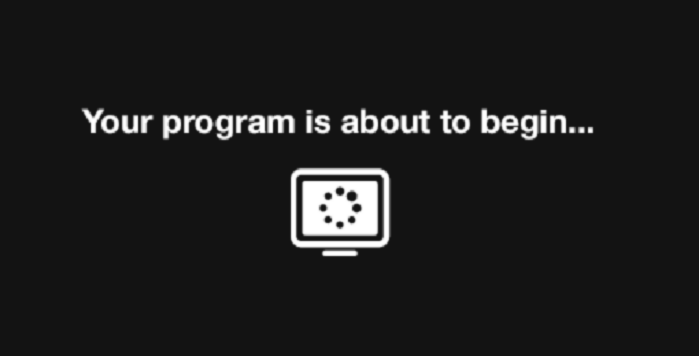
Just teasing! The program never really begins.

Just teasing! The program never really begins.

An NBC spokesperson this week had promised to put us in touch with someone from their technical team, but we never got another message back, so another Sunday night we are stuck without football on our computer. What’s even more ironic tonight is that for the first time some video did appear — but it was just an ad for Google Chrome, which of course, NBC doesn’t support this football season if you are a Mac user. You need to use Safari. But for us and several folks commenting to our site, it still isn’t working. For me, the Google ad played and then the screen went back to black.

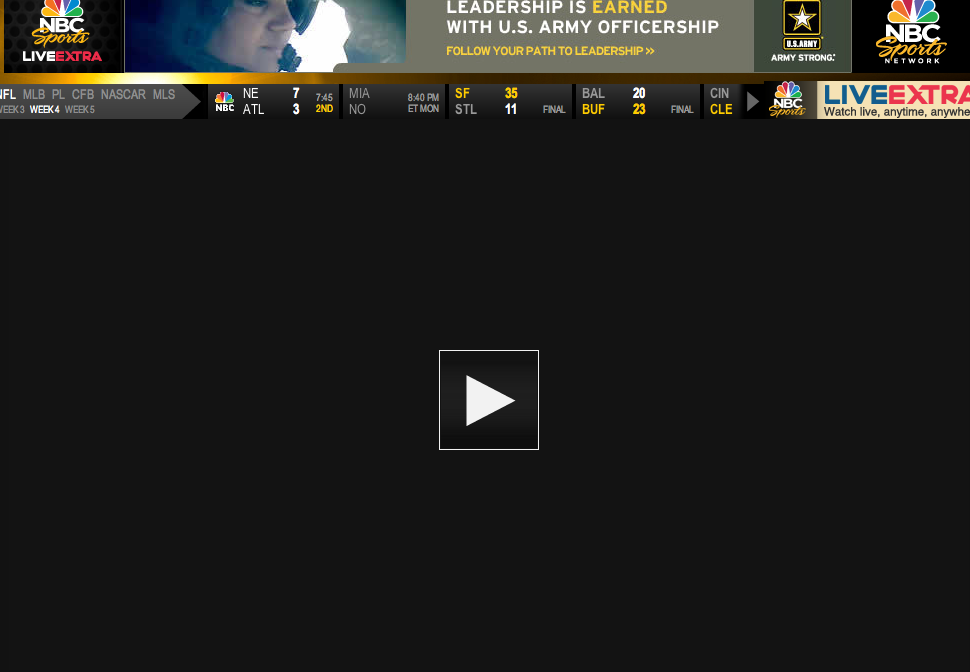
Instead of Sunday night football, this is what I see. Anyone else having these problems? Add a comment, maybe we can get NBC to realize something ain't right.

Instead of Sunday night football, this is what I see. Anyone else having these problems? Add a comment, maybe we can get NBC to realize something ain’t right.

At first I thought there might be some error on my end but I checked my configurations with the FAQs on the NBC site and my machine is up to speed. Plus, I am able to watch plenty of non-NFL coverage, including the excellent coverage of the final race of the America’s Cup. Great stuff, live on my computer. But for some reason the NFL broadcasts aren’t working.

I’m going to lay the blame here at the feet of Microsoft, since it is apparently the Microsoft-NFL deal that is responsible for the disabling of Macintosh computers. Didn’t Microsoft once lose an antitrust suit designed in part to keep it from using its economic might to squash competing technologies? Someone get me Google’s legal team on the line.

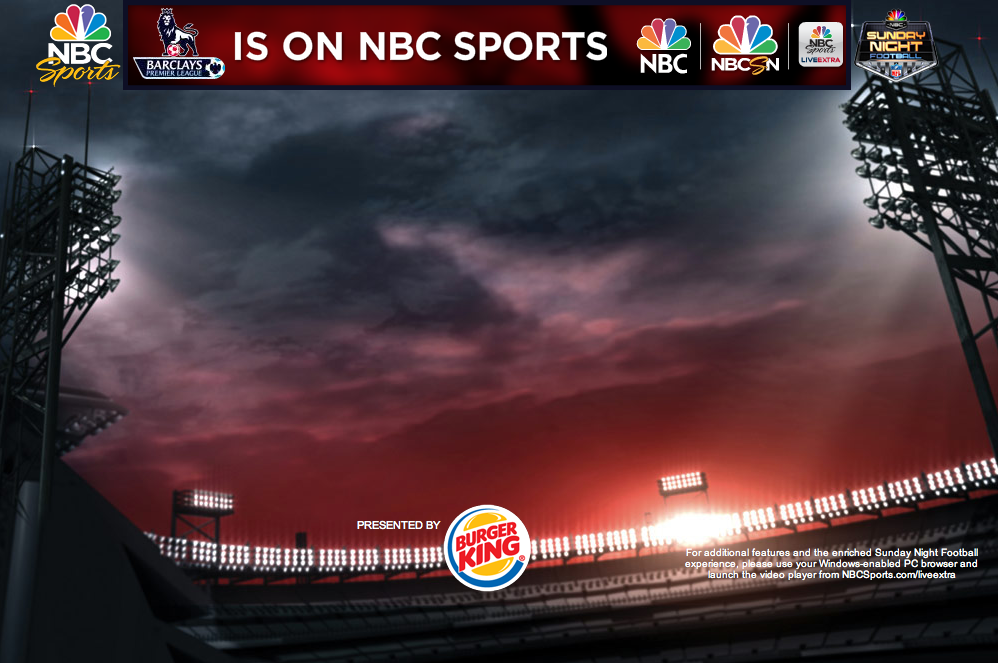
Arrgh, now we're back to the super fail screen.

Arrgh, now we’re back to the super fail screen.